

Donald Trump’s 2025 pardon of a man convicted of acting as an illegal agent of China did not just free one retired New York cop. It helped seal the record on how a compromised FBI counterintelligence chief, his politically connected ex‑girlfriend, and a circle of Trump‑world operatives with ties across Russia, China, and Albania had escaped serious scrutiny. It is the worst corruption case in the modern history of FBI counterintelligence, and the least examined.
Allison Guerriero, the former mistress of former FBI New York counterintelligence chief Charles McGonigal, has waged a pardon campaign whose effect is to benefit Chinese security interests, and has worked through interviews, social media, and private channels to shape how his corruption is understood. Private messages obtained by Hacking, but Legal show that work in her own words. The period of his career when he was most dangerous, running counterintelligence in New York during the 2016 election, has barely been touched by prosecutors or inspectors general.
A Pardon That Helped Beijing
On 7 November 2025, Donald Trump pardoned Michael McMahon, a retired NYPD sergeant convicted in 2023 of acting as an illegal agent of the Chinese government as part of Beijing’s “Operation Fox Hunt.” A Brooklyn jury found McMahon guilty of interstate stalking, conspiracy, and acting as an illegal agent of the People’s Republic of China after he was hired to track a former Wuhan city official and his family, whom Chinese authorities wanted repatriated.
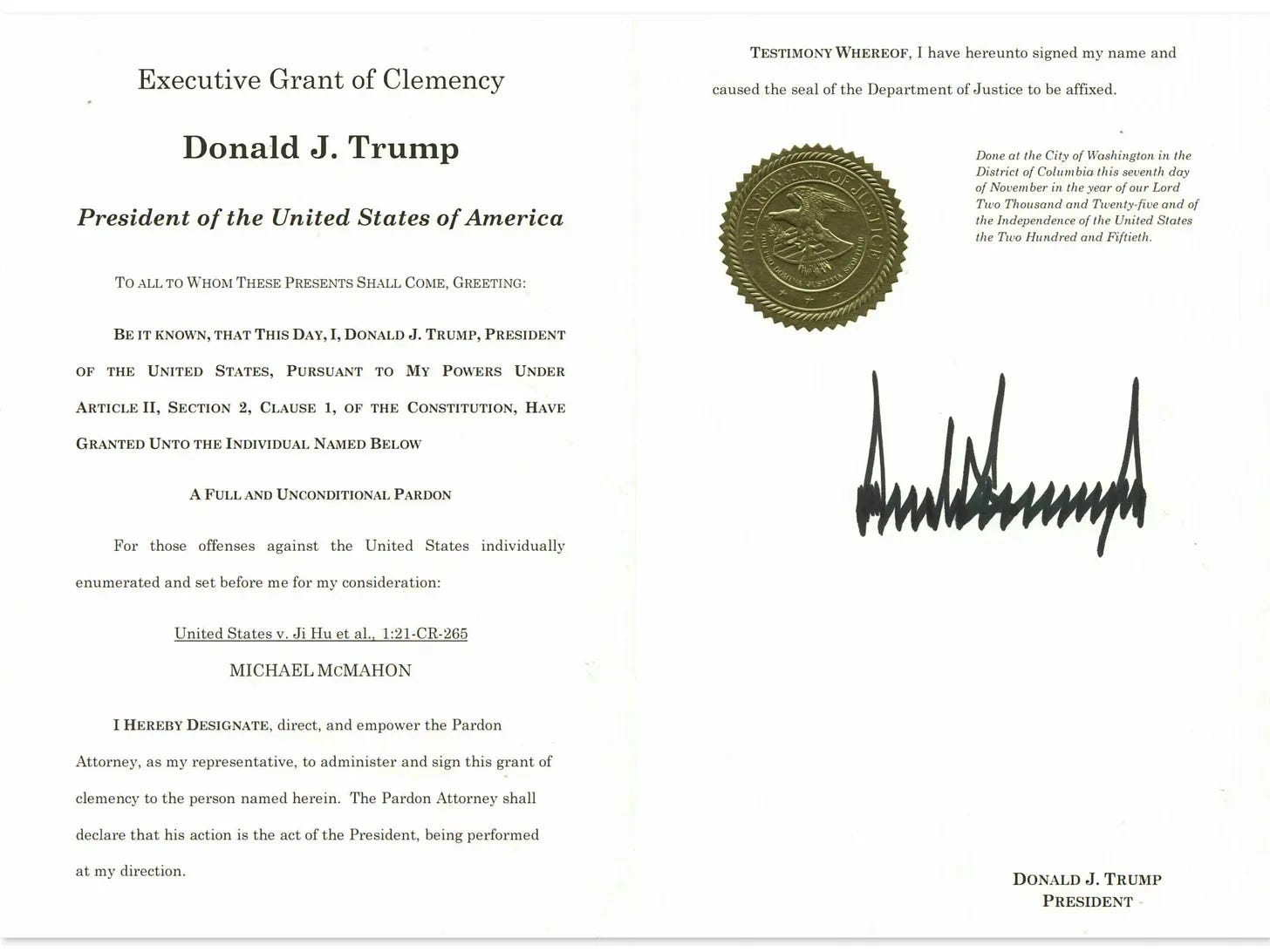
McMahon used his law‑enforcement credentials and access to restricted databases to locate the family’s address and helped coordinate surveillance, while a co‑conspirator left a threatening note urging them to return to China. Prosecutors described the campaign as transnational repression. In April 2025, he was sentenced to 18 months in prison, which the DOJ and outlets including the Associated Press, Reuters, and the New York Times held up as an early test of Washington’s willingness to punish Fox Hunt cut‑outs on American soil.
Trump’s pardon, reported by CNN, The New York Times, and The Washington Post, was defended by its supporters on the grounds that McMahon was a decorated officer who had been misled into the scheme and unfairly targeted by an aggressive Biden Justice Department.
Even a successful Fox Hunt prosecution, it turns out, can be undone.
The Spy Hunter Who Went Rogue
For more than two decades, Charles “Charlie” McGonigal was a trusted figure inside the FBI on some of its hardest counterintelligence problems. He joined the Bureau’s New York Field Office in 1996, working Russian counterintelligence and organized crime. A later posting to Washington put him over the Russian illegals investigation, and he subsequently led the FBI’s WikiLeaks Task Force after the 2010 disclosures, an effort that contributed to Chelsea Manning‘s conviction.
By early 2016, he was chief of the Cyber‑Counterintelligence Coordination Section at FBI headquarters. That summer, he sent an internal email forwarding an Australian diplomat’s report that Trump campaign adviser George Papadopoulos had claimed Russia held damaging information on Hillary Clinton. A September 2020 Senate Judiciary Committee interview with FBI Deputy Assistant Director Jonathan Moffa shows that McGonigal’s email served as the formal legal basis for opening the Trump-Russia investigation known as Crossfire Hurricane on 31 July 2016.
On 4 October 2016, FBI Director James Comey appointed McGonigal Special Agent in Charge (SAC) of the Counterintelligence Division at the New York Field Office, placing him over counterintelligence at the FBI’s largest field office. The Bureau announced it the same day, and the same release said he would take up the post at the end of the month. The inspector general later dated his tenure to October 2016. A Justice Department release in the Albanian case describes his service as SAC as beginning in August 2017, a framing that tracks the window of the charged conduct rather than the date of his arrival. No public document fixes the day he actually took the chair.
The job carries more than the title suggests. A counterintelligence SAC in New York sees the identities of human sources, the existence and direction of investigations long before they surface publicly, the technical collection running against foreign targets in the densest concentration of them in the country, and the sequence in which arrests will come. That access, rather than the cash, is what a foreign service would want from such a man.
His new brief covered Russian oligarch matters, Chinese operations including parts of Operation Fox Hunt, and a major public corruption investigation into CEFC China Energy. (Comey was himself indicted in September 2025 over his 2020 Senate testimony about the Russia investigation; the case was dismissed that November after a judge ruled the prosecutor unlawfully appointed, and the DOJ has appealed.) The New York office was already known for anti‑Clinton sentiment and leaks, including disclosures that helped push Comey to notify Congress on 28 October that the Bureau had effectively reopened the Clinton email investigation, a decision many observers believe hurt Clinton’s election chances.
After leaving the Bureau in 2018, McGonigal crossed into outright criminality. In the Southern District of New York, he pleaded guilty on 15 August 2023 to conspiring to violate the International Emergency Economic Powers Act and to money laundering by providing services to sanctioned Russian oligarch Oleg Deripaska, including investigating a rival oligarch and assisting a sanctions‑relief strategy through a Manhattan law firm. He was sentenced on 14 December 2023 to 50 months in prison. In the District of Columbia, he pleaded guilty on 22 September 2023 to concealing his receipt of $225,000 in cash from Agron Nezaj (often spelled Neza), a former Albanian intelligence officer, while using his position to benefit Nezaj and Albanian prime minister Edi Rama, who has never been charged and won a decisive fourth consecutive term in May 2025. He was sentenced on 16 February 2024 to an additional 28 months to run consecutively.
McGonigal is currently serving a combined six‑and‑a‑half‑year sentence at FCI Cumberland in Maryland, without a pardon, even as his former FBI colleague and business partner Mark Rossini, whose own work for Deripaska has been documented by Byline Times, walked free in January 2026.
A 2025 report by the Justice Department’s Office of Inspector General, summarized by Lawfare, found that as SAC, McGonigal “obstructed an important multi‑year criminal investigation” into CEFC China Energy by cultivating a secret relationship with a CEFC‑linked foreign national and disclosing “sensitive, non‑public case information” about the probe and anticipated arrests. The report concluded that his conduct was “disgraceful,” that it damaged the case, and that it “compromised the integrity of the FBI.” Heavily redacted sections appear to address additional China‑related counterintelligence matters. CEFC chairman Ye Jianming, who learned of the anticipated arrests, has not been seen publicly since March 2018 and is presumed to be in Chinese state custody. Patrick Ho, a CEFC adviser warned in advance, was convicted of bribery in December 2018 and deported to Hong Kong after serving his sentence.
At the height of his influence, McGonigal was taking Albanian cash and, the inspector general later found, leaking a China case, while sitting in one of the most sensitive counterintelligence chairs in the United States. Within a year of leaving the Bureau he was working for a sanctioned Russian oligarch.
The Network Around Him
Allison Guerriero did not enter this story as a civilian outsider. Before she met McGonigal, she had spent nine years as Vice President of US Operations for Mifram Security, an Israeli defense and security firm established in 1962 that develops projects for the Israeli Defense Force and is classified by Israel’s Ministry of Defense as an authorized contractor. The Daily Mail reported her Mifram background in January 2024; multiple Albanian outlets picked up the detail. The company manufactures blast barriers, observation towers, combat posts, mobile vehicle barriers, and fortified shelters for military and government clients. She held the VP title from 2006 to 2015, overseeing US sales to military and law‑enforcement agencies. Her archived LinkedIn profile, captured nine days after McGonigal’s arrest, lists her as “an experienced Vice President Operations” in the “Security & Investigations industry,” skilled in “Crisis Management, Intelligence Analysis, Government, Law Enforcement, and Emergency Management.”
After leaving Mifram, Guerriero became Sales Director at SRN, Inc., a small firm selling to police departments and emergency management agencies across the Northeast, a role she held from 2014 to 2021, with one year overlapping her final year at Mifram, and simultaneously served as a volunteer grants coordinator for the Federal Enforcement Homeland Security Foundation, a 501(c)(3) providing financial assistance to federal law‑enforcement officers and their families during illness, injury, or death. The role was part‑time, but it gave her direct, institutionally endorsed access to senior federal agents in crisis.
By Guerriero’s account, William Sweeney, the FBI official who would later head its New York Field Office, personally referred McGonigal to her through this foundation in 2017, the introduction that led to their relationship. Guerriero’s own account, given publicly in August 2026, adds detail and a puzzle: she says the two met at “a business lunch in the middle of the Short Hills Mall” in late spring 2017, and that she believed McGonigal “when he told me that he was going through a personal matter which I am gagged about discussing.” She has not said what instrument gags her.
Guerriero had long been embedded in a Trump‑aligned political network. She has said she first met Roger Stone at the now defunct Elaine’s bar and restaurant in Manhattan’s Upper East Side in the mid‑1990s and has maintained the friendship for decades. She met Rudy Giuliani through New York law‑enforcement circles and, after a fire at her father’s home in 2021, moved into Giuliani’s guest bedroom. Giuliani has since been disbarred in both New York and Washington, D.C., but Trump granted him a full pardon in November 2025, and the Georgia election‑interference RICO case in which he was a co‑defendant was dismissed that same month, leaving only a stalled Arizona state fake‑electors case as his remaining legal exposure.
She has described Ken Kurson as her “closest personal friend.” Appointed editor of the New York Observer by Jared Kushner in 2013 and formerly chief operating officer of Giuliani’s 2008 presidential campaign, Kurson was a bridge between the Giuliani circle and Trump’s son‑in‑law and senior White House adviser. He was federally charged with cyberstalking in 2020, pardoned by Trump on his last full day in office in January 2021, then charged again under state law in New York, with the case eventually pleaded down to a non-criminal harassment violation that was later sealed. The New York Post reported the deal wiped his criminal record clean.
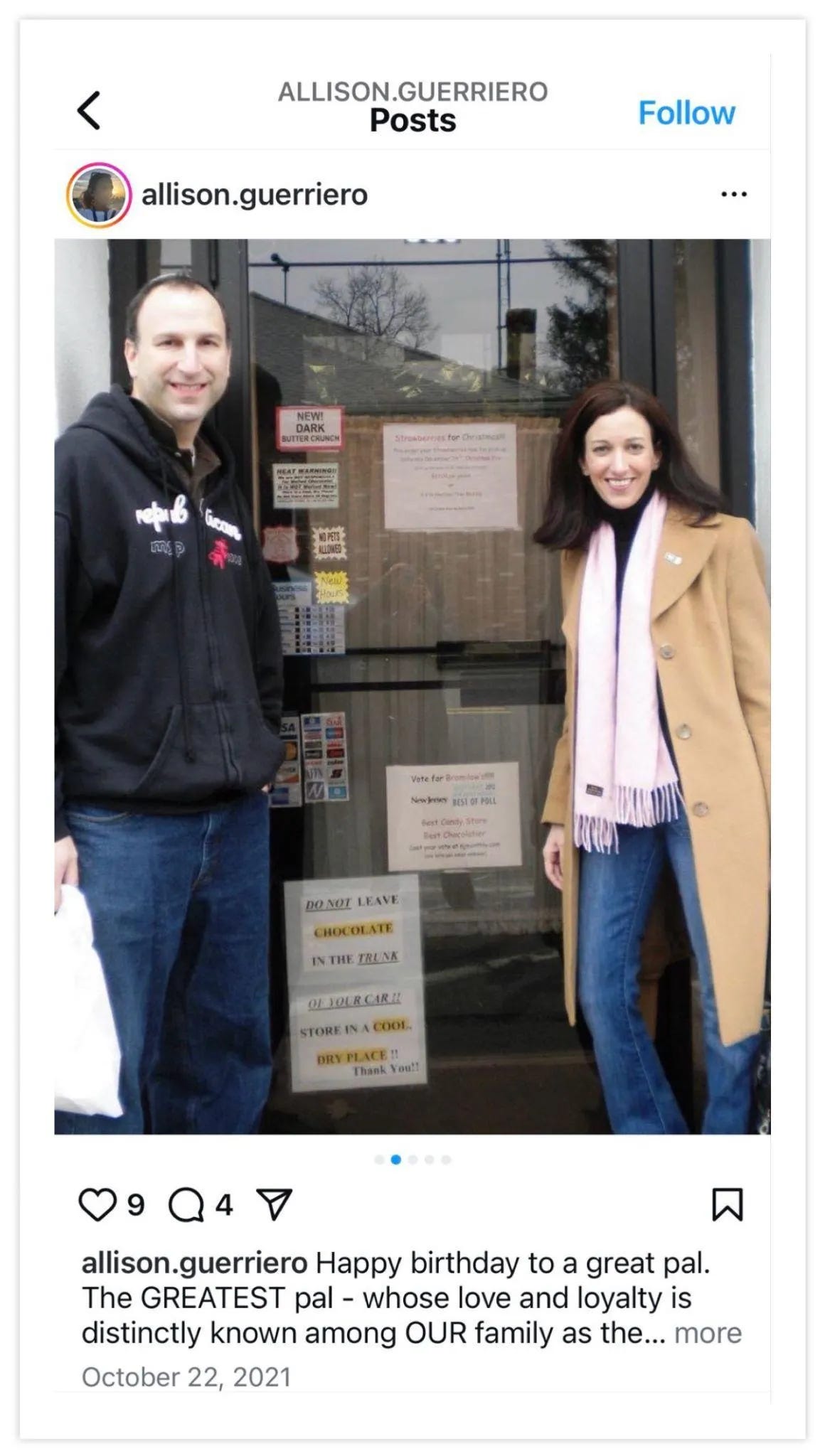
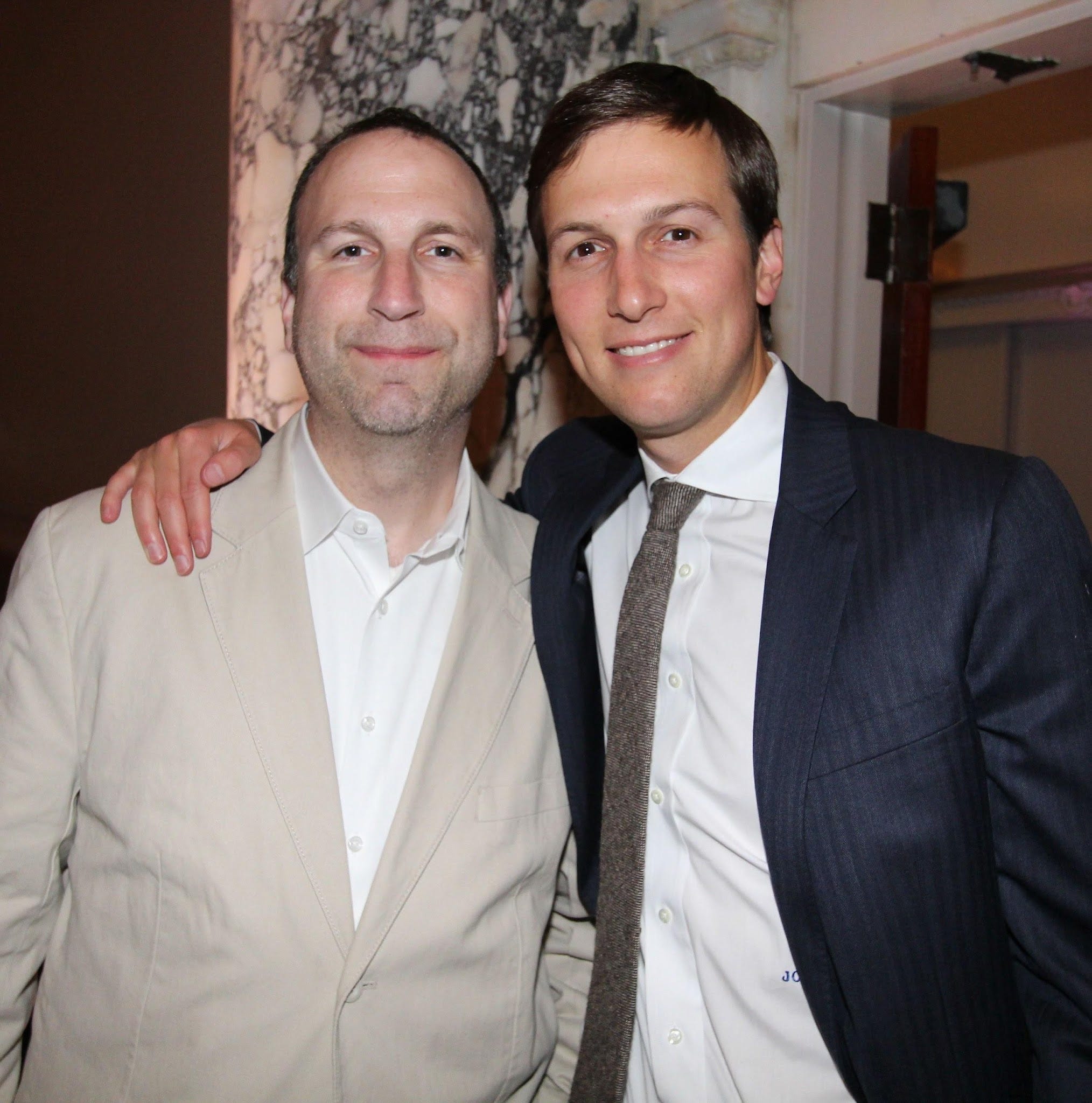
She also counted McMahon as a friend. A retired NYPD sergeant who became a private investigator in New Jersey, McMahon was convicted in 2023 of acting as an illegal agent of China and engaging in interstate stalking as part of Operation Fox Hunt, then sentenced to 18 months in prison in April 2025 before receiving Trump’s pardon that November.
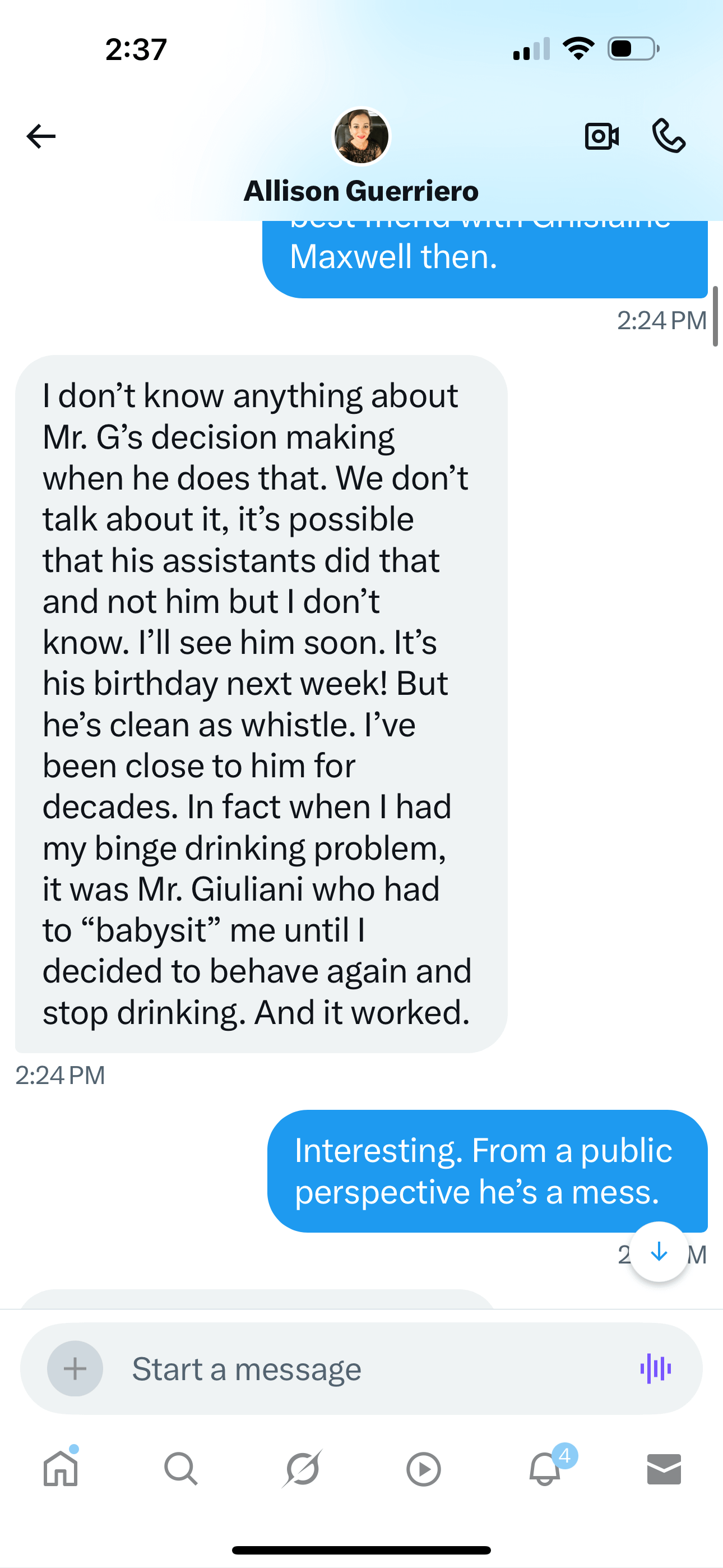
In private messages to independent researcher Anthony Andrews, the name under which he publishes and posts publicly, and who on 1 August 2026 wrote on his verified account that his name off the platform is Anthony (Tony) Gonzales, Guerriero spells out the depth of her relationship with Giuliani:
“I’ll see him soon. It’s his birthday next week! But he’s clean as whistle [sic]. I’ve been close to him for decades. In fact when I had my binge drinking problem, it was Mr. Giuliani who had to ‘babysit’ me until I decided to behave again and stop drinking. And it worked.”
Open‑source photos from Guerriero’s public Instagram account show her attending a Catholics for Catholics event in Mar‑a‑Lago, writing that she had “a nice chat with Mike Flynn” and thanking “my friend Roger Stone” for bringing her, as well as posting affectionate birthday tributes to figures in that circle, images showing she continued to appear in curated, invitation-only settings alongside senior Trump‑world figures well after McGonigal’s indictment.
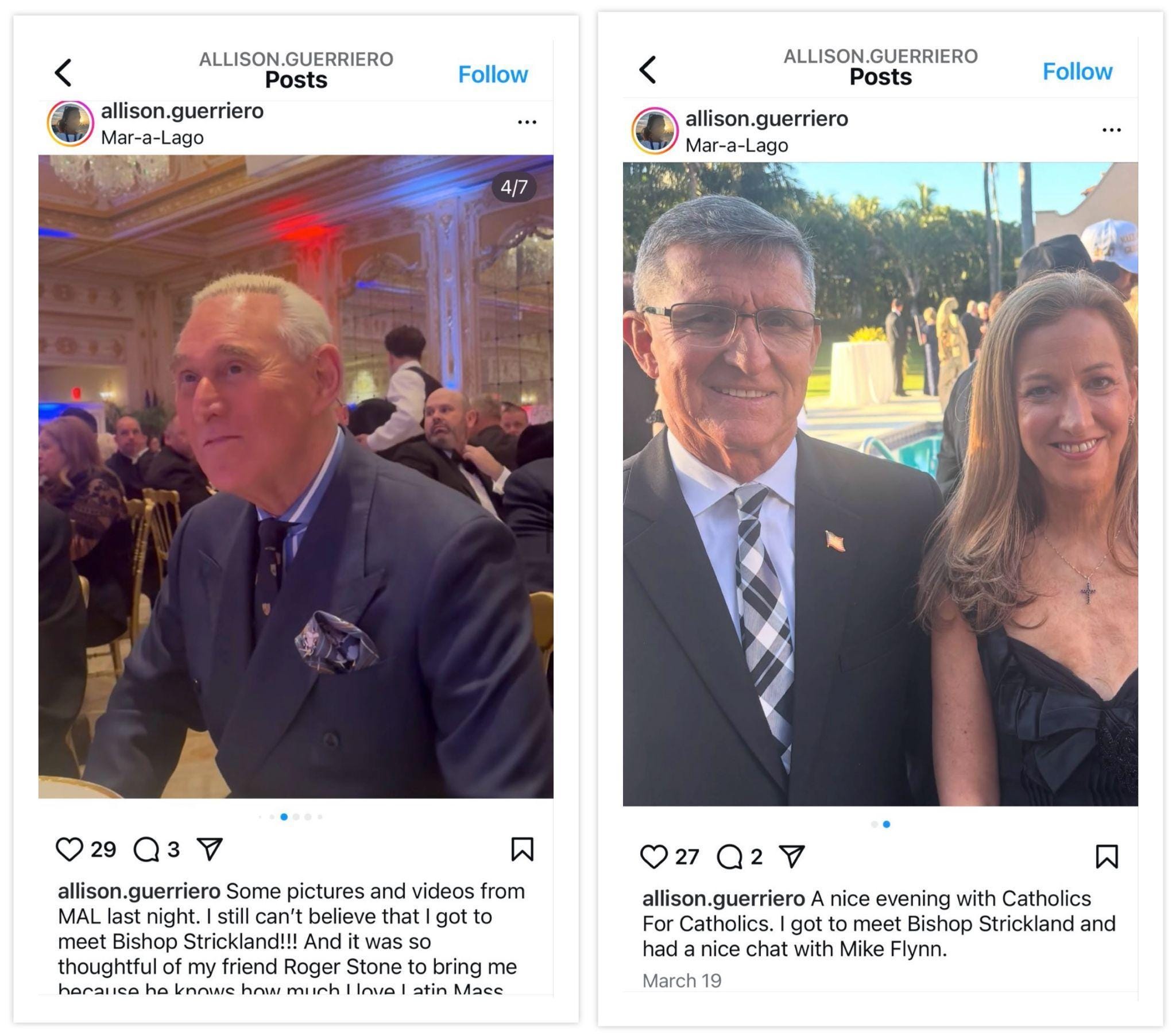
She still presumably had buyer relationships across federal law enforcement and emergency management; and from 2017, she had a direct line to the FBI’s New York counterintelligence chief through what she describes as a personal introduction from a senior FBI official.
The political figures in Guerriero’s orbit carried their own foreign-intelligence entanglements. Giuliani had ties to Paul Manafort and Ukrainian oligarchs and repeatedly pushed Kremlin‑favored narratives about Ukrainian meddling in 2016. On the China side, he was a political and financial ally of Chinese exile tycoon Guo Wengui, who has been reported to have ties to China’s security services and was convicted of large‑scale fraud in July 2024; Guo was sentenced in June 2026 to 30 years in prison and ordered to forfeit $889 million. Stone served as an intermediary with WikiLeaks during the 2016 campaign and separately amplified China‑aligned disinformation about Guo sourced from billionaire Bruno Wu, later admitting the claims were false as part of a defamation settlement. McMahon was recruited directly into Operation Fox Hunt by Chinese officials.
Ties of this kind are what allow Russian, Chinese, and Albanian interests to reach into U.S. political and law‑enforcement structures without any single participant needing to see the whole picture.
Inside the Apartment
From roughly spring 2017 through late 2018, Guerriero and McGonigal were in a romantic relationship lasting about 18 months, covering almost exactly the period in which he was pocketing Albanian cash and funneling CEFC case details to foreign‑linked actors.
In interviews with Business Insider and Albanian outlets, and in her own writing, Guerriero has described being present for several episodes that match later court filings. In October 2017, she says she saw a bag of cash on the floor of his Park Slope apartment, a timing that matches an $80,000 payment from Agron Nezaj documented in court records, one of three instalments totaling $225,000. On the October 2024 broadcast her version shifted: the sum became “a hundred thousand dollars”, found in the bedroom in the week of her birthday, collected “up to the Bronx”, and explained away by McGonigal as “a baseball bet.”
She recalls three or four dinners where she saw sealed‑envelope exchanges between McGonigal and former Soviet/Russian diplomat Sergey Shestakov, who would later be indicted alongside him in the Deripaska sanctions case. (Shestakov eventually pleaded guilty to a single count of lying to the FBI; all serious charges were dropped, and he was sentenced to two months in October 2025.) She reports that McGonigal used a second iPhone for WhatsApp after the FBI banned the app on official devices, keeping certain communications off Bureau systems. And she says she saw photographs of him with Albanian prime minister Edi Rama and heard frequent calls in which he mentioned “Agron,” likely referring to Nezaj.
The OIG report and Albanian media accounts document that McGonigal, as SAC, traveled to Albania, met Rama multiple times with Nezaj and CEFC adviser Dorian Ducka present, pressed Rama to cancel an oil exploration contract involving Russian‑linked entities, and leaked details of the FBI’s CEFC investigation to a CEFC‑linked foreign national, enabling Ye Jianming to learn of anticipated arrests and warn Patrick Ho.
The Narrator
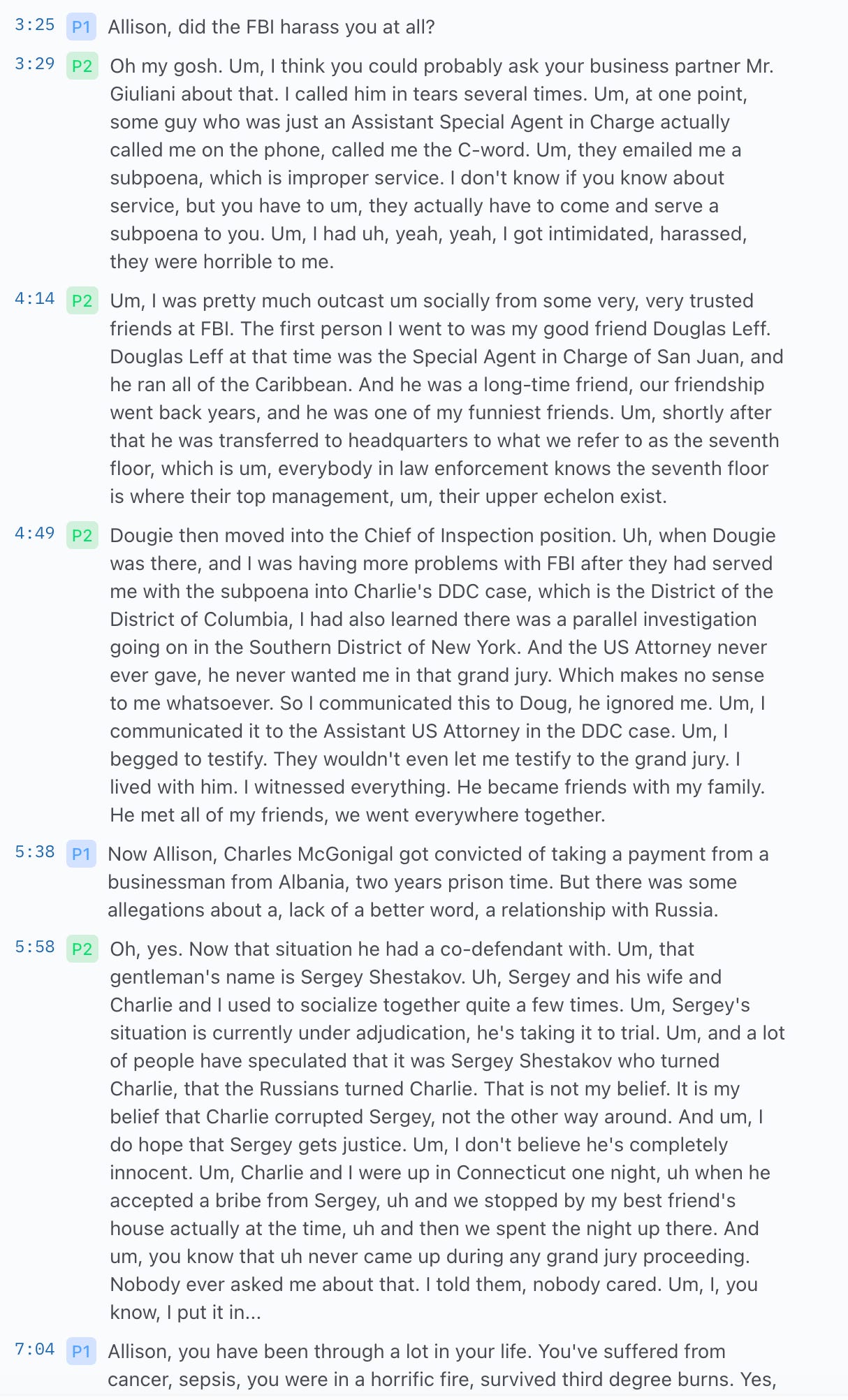
After McGonigal’s arrest in January 2023, Guerriero became one of the most prominent public narrators of his case. She gave detailed interviews to Business Insider and Euronews Albania, sat for a 2023 interview with One America News, and launched a Substack casting herself as the brave whistleblower who “turned in” a traitor and was subsequently abused by a corrupt FBI. Her last public interview aired on 31 October 2024, five days before the election, on Mike Lindell’s FrankSpeech platform: the Dr. Maria Show, hosted by Maria Ryan, the president of Giuliani Communications and Giuliani’s business partner. Guerriero drew the connection herself on air.
Asked whether the FBI had harassed her, she replied: “I think you could probably ask your business partner Mr. Giuliani about that. I called him in tears several times.” Ryan moved on without engaging the reference. She told Ryan she believed Trump had won in 2020 and hoped his return would bring “a real espionage case.” Ryan cut her off mid-sentence as she described an undocumented bribe and her exclusion from the grand juries, turned to a recitation of her hardships, and closed the interview soon after. She later explained her post-election silence in her own words:
“Then when Donald won a couple of weeks later, I knew that was when the USG would finally take this case seriously and I shut up about it.”
Publicly and privately, she describes McGonigal and his colleagues as “raging liberals” who mocked Trump supporters and wanted to “indict Jared Kushner,” recasting him as an anti‑Trump operative rather than a man who sold his access to a Russian oligarch and an Albanian intelligence officer. She calls Giuliani “clean as whistle” and insists “Mike Flynn and Roger Stone were innocent all along”; in one tweet preserved in the DMs, she attacks 2020 election workers Ruby Freeman and Shaye Moss as “lying cunts.”
The DMs show she goes further than venting. She coaches Andrews directly:
“If you think it’s helpful as an issue for all Americans take the politics out your mind and write about the issue being Free Speech and witness tampering and then maybe you will find a niche there with topics on Charlie.”
“Charlie is far from the only guy working with Russia. And that includes both sides of the political stratum.”
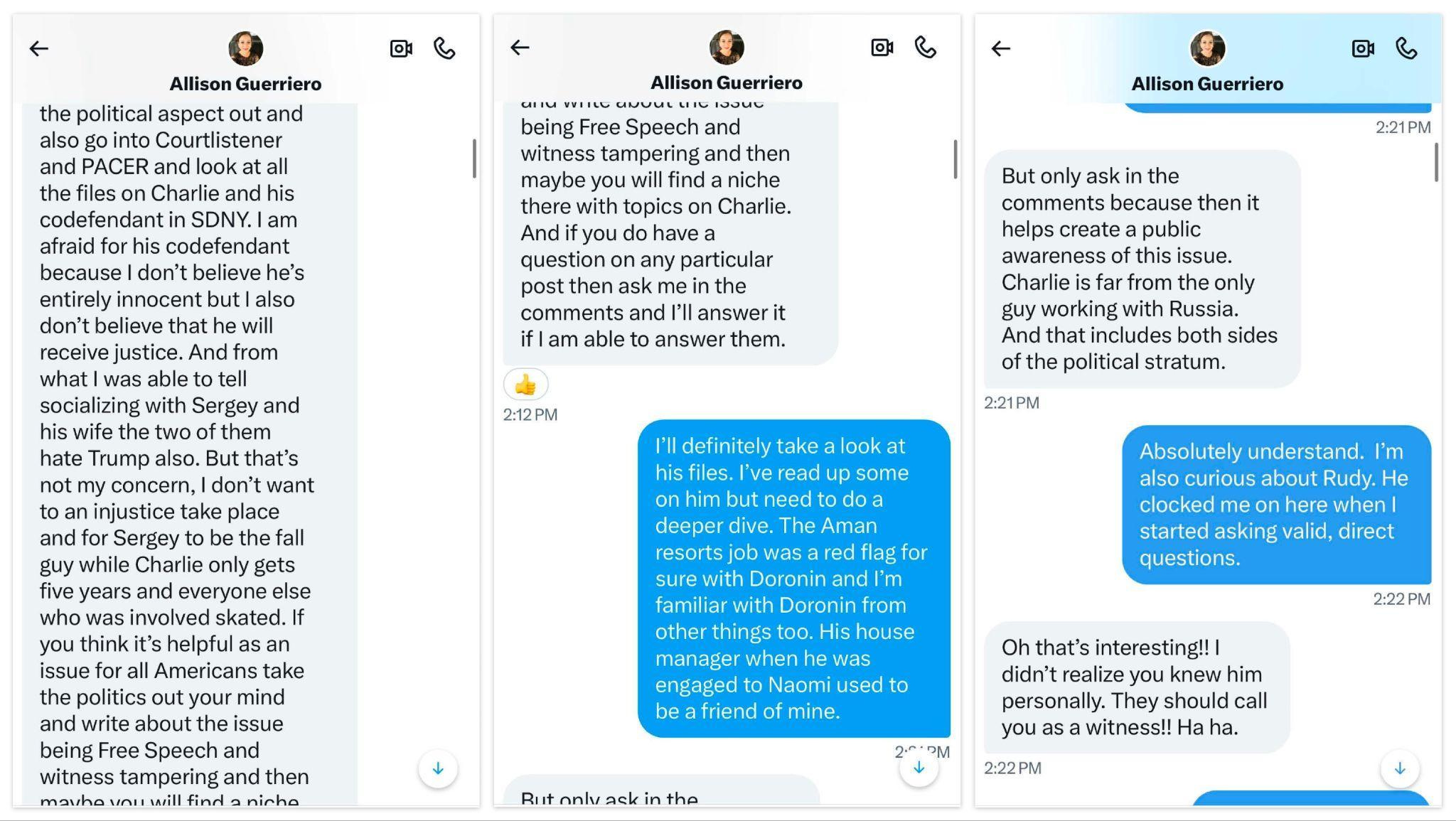
Across the exchanges, she routes him toward individual accountability stories, pointing him to court records and case databases, naming trusted journalists, steering him away from any “Illuminati”‑style framing that would get him dismissed. Whenever the conversation turns toward systemic foreign‑penetration questions, she redirects to FBI corruption and First Amendment grievance.
Andrews, who exchanged dozens of messages with Guerriero over two months beginning in May 2025, says the performance was transparent. “She clearly was trying to create a narrative that she knew I wasn’t buying,” he told this reporter. “She was too insistent that Charlie didn’t know anyone she knew — to the point it was obvious she was deflecting. Anytime I asked an uncomfortable question, she would say she was forced not to discuss it because of NDAs.”
Andrews says he tried repeatedly to explore that question, and each time Guerriero shut the door. She would discuss the cash, the envelopes, and the Albanian trips freely, but whenever he pressed on whether McGonigal had known or interacted with anyone in her political circle, she insisted they had never met, and when pressed further, claimed non‑disclosure agreements prevented her from saying more.
When Andrews persisted, the response extended beyond Guerriero. Michael Caputo, a former Trump 2016 campaign communications adviser originally recruited by Roger Stone who later served as Assistant Secretary for Public Affairs at the Department of Health and Human Services, appeared in Andrews’ comment threads in December 2025, threatened to sue him, and posted a GIF dismissing him. Guerriero joined the thread and posted Andrews’ LinkedIn profile, exposing personal details he had kept off his public accounts, and asked Caputo in a public exchange whether she had provided him with “the Threat Matrix,” “the Assessment,” or the “full ten-page background,” adding, “I can’t remember if I gave you all three of them or not.” Caputo replied: “Nah. I know a guy.”
Threat matrices, assessments, and background files are not the vocabulary of a civilian grievance. Whether the documents she describes are real or invented to intimidate, the exchange shows a response that reached beyond her to a senior Trump‑world political operative, in the targeting language of opposition research or security consulting.
The Tainted Witness
The strangest part of Guerriero’s story is how thoroughly she undermined her own usefulness as a potential witness against McGonigal, and how openly she later framed that behavior as tactical.
After their breakup in late 2018, Guerriero began calling McGonigal’s wife, as many as 20 times a day, and repeatedly contacted other family members until her arrest and a restraining order followed. Around November 2019, she sent an email to FBI New York chief William Sweeney describing the affair and the Albanian dealings, which she later said was ignored. The email did not include her knowledge relating to his Russian dealings, despite her later statements to Andrews that both she and Giuliani knew of these dealings at the time. In August 2026, she put her timeline of knowledge on the record herself, writing publicly that she “figured out very early on in the relationship that he was accepting bribes” and had assumed those bribes were “only limited to the Balkans”: by her own account, she knew of the payments while they were happening and reported nothing for more than a year.
On the October 2024 broadcast, she went further: she said she had wanted to end the relationship after finding the cash, but that unnamed “very trusted friends” advised her that “if you really think he’s betraying his oath to the Constitution and accepting bribes, then you stay in that relationship.” On her own account, people in her circle directed her to stay in place beside the FBI’s New York counterintelligence chief, and no report followed for years; she has never named them. She also said on air that she was kept out of both grand juries: “I begged to testify. They wouldn’t even let me testify to the grand jury. I lived with him. I witnessed everything.” In 2021, she leaked her grand jury subpoena to Business Insider reporters, then claimed the leak forced the FBI’s hand.
In the DMs with Andrews, she reframes these as deliberate moves in a pressure campaign. She explains that she expected a gag order and structured her social media posts accordingly:
“I was very careful to always use his name in each and every post because I knew this day would come when I may have a gag order imposed on me and I wanted to keep the evidence and posts easy to find for other people such as yourself. I was very clever about all of this.”
She describes her restraining order violation and subpoena leak as conscious tactics:
“I knew the only way I was going to get him arrested was if I leaked my subpoena into Business Insider and [talked] him to file a restraining order which I violated immediately so I can get a court hearing in family court in Morris County New Jersey. That is the key to everything.”
“I didn’t mind a few hours in a holding cell with that restraining order. I violated it on purpose to create a Court record. And it worked.”
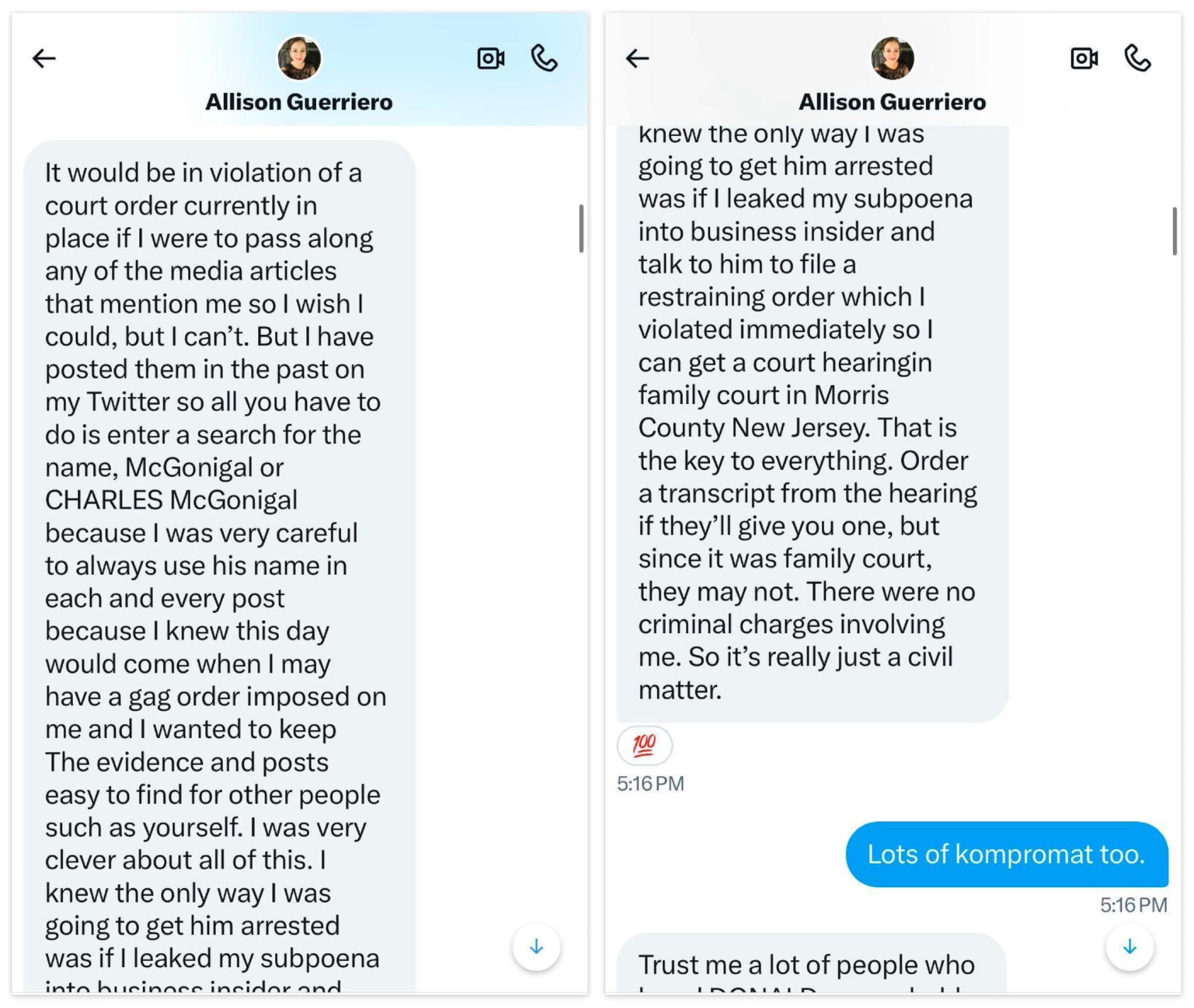
The two acts are not equivalent. Violating the order was a crime, and she was arrested for it. Leaking her own subpoena was not: grand jury secrecy binds government personnel, not witnesses, and a witness is free to disclose her own. But a self-described “great investigator” who boasted about engineering both had made herself nearly useless as a witness, handing defense lawyers ample grounds to attack her motives at every turn.
Guerriero has also described taking her complaints to an official responsible for investigating the Bureau from the inside. On the October 2024 broadcast she named Douglas Leff, a friend of years’ standing, as “the first person I went to” when she found herself cast out socially by her circle at the FBI. Leff had been named special agent in charge of the San Juan Field Office by James Comey, a post he held until 2020. Christopher Wray then made him assistant director of the FBI’s Inspection Division, the component that conducts the Bureau’s internal investigations and the special inquiries ordered by its director and deputy director, where he remained until he left the FBI in March 2022.
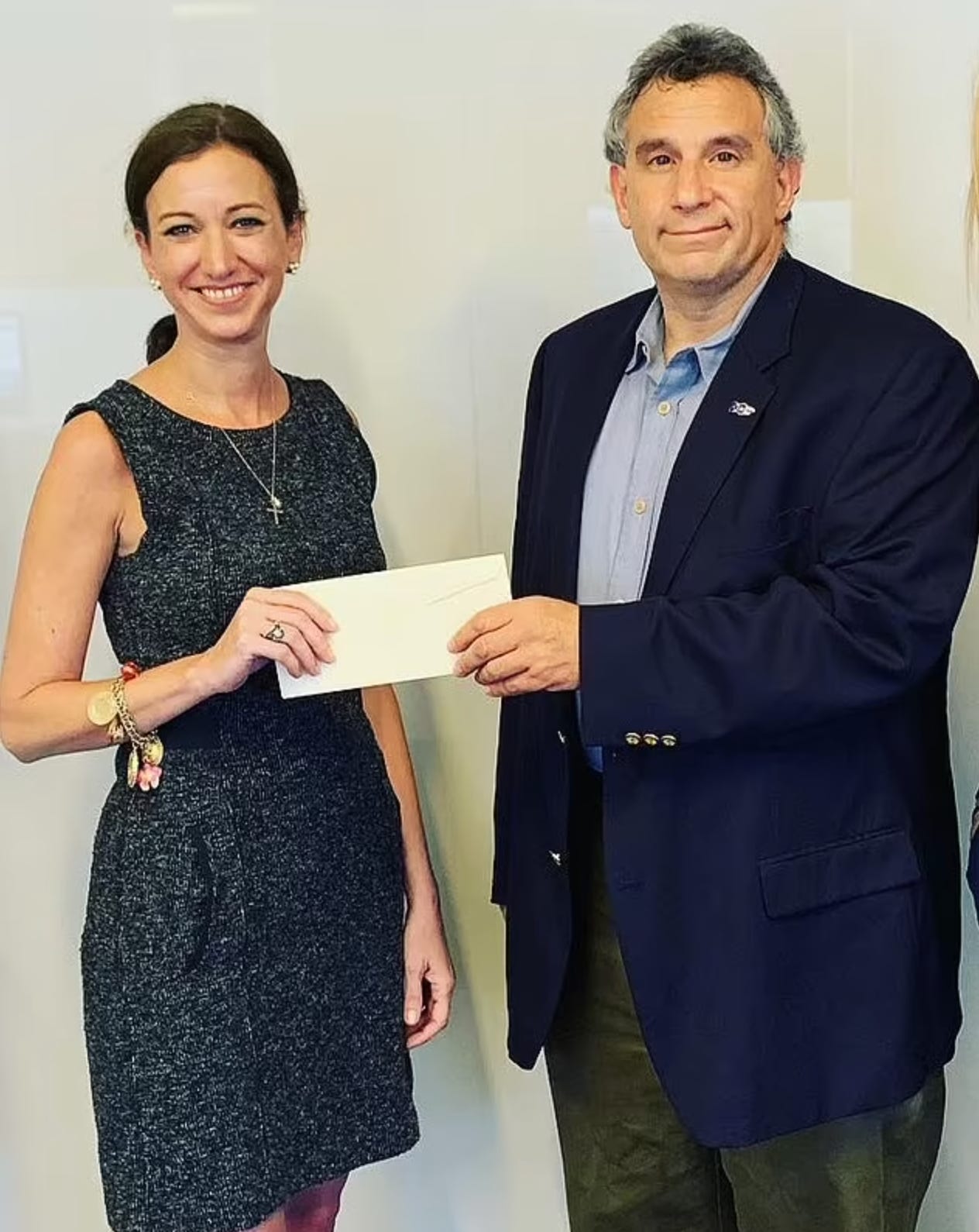
By her account she went to him again there, after she had been served with a subpoena in the District of Columbia case and had learned of the parallel investigation in the Southern District of New York from which she says she was excluded. The grand jury subpoena she leaked to Business Insider came in 2021, inside that window. “So I communicated this to Doug,” she said. “He ignored me.”
If her account is accurate, the FBI’s senior internal-investigations official was told directly about details of the McGonigal affair by a civilian witness, and so far as she knows, nothing came of it. This account is hers alone; Leff, now an assistant district attorney at the Bronx County District Attorney’s Office, was not asked for comment.
When the DOJ finally charged McGonigal, the two cases reached only his post-retirement work for Deripaska and his concealment, while still serving, of the Albanian payments. His time as New York SAC, the field-office leaks, the CEFC sabotage, anything touching Fox Hunt, remained entirely outside them.
There is an unglamorous explanation for part of that. The general federal limitations period is five years. Conduct from October 2016 was time-barred by late 2021, more than a year before McGonigal was indicted. Prosecutors in 2023 could not have charged the election period even if they had wanted to. Classification compounds the problem: counterintelligence conduct from that window is close to unprosecutable in open court without exposing sources and methods, and both cases ended in negotiated pleas, which narrows a charging document further still. None of that explains the rest.
A limitations period bars a prosecution. It does not bar an inspector general review, a congressional inquiry, or a public damage assessment, and none of those has happened either.
Since then, the enforcement picture has only narrowed.
How She Sees Herself
Guerriero does not present herself as a civilian at the edge of the security world. In the DMs, she portrays herself as operating inside it, and her documented career is consistent with that self-portrait.
In one exchange, she writes:
“Well, I work with the military, law-enforcement, and the intelligence community. We always say ‘nobody would even believe us if we told them these stories’. So I don’t even try. But I did pick up a lot of trade habits that enabled me to know how to collect the right evidence on Charlie. And it was HARD!”
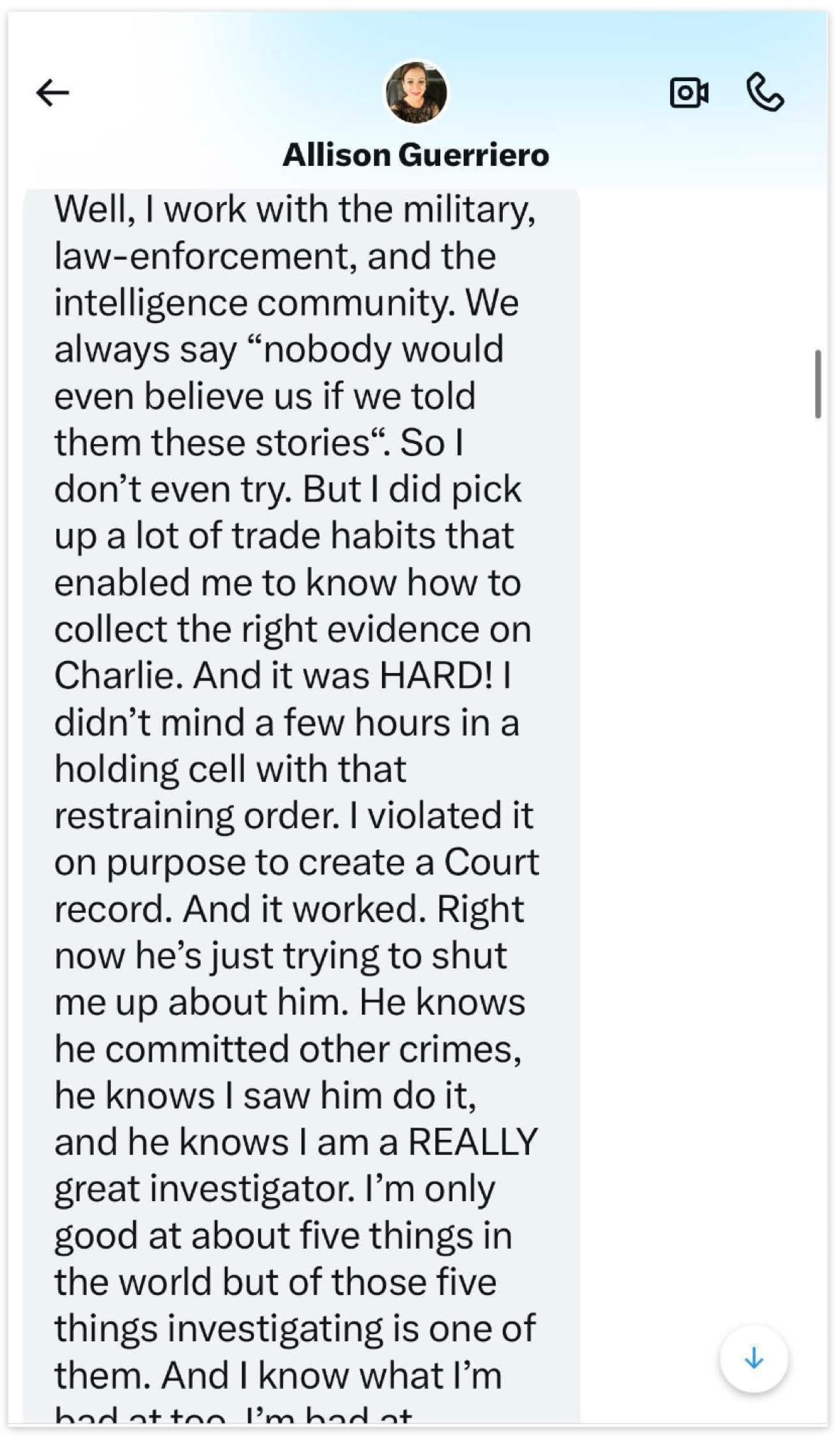
The self-portrait matches the (largely self-documented) record. Elsewhere in the DMs, she writes:
“I’m assuming they have wires up on my comms as well as Albania, Bosnia, Croatia, Serbia, etc… probably Turkey too. And definitely Mexico and Colombia because of past experiences with drug trafficking investigations I was a contractor on. Anything that you put over text messages is being intercepted by somebody. Even our own country.”
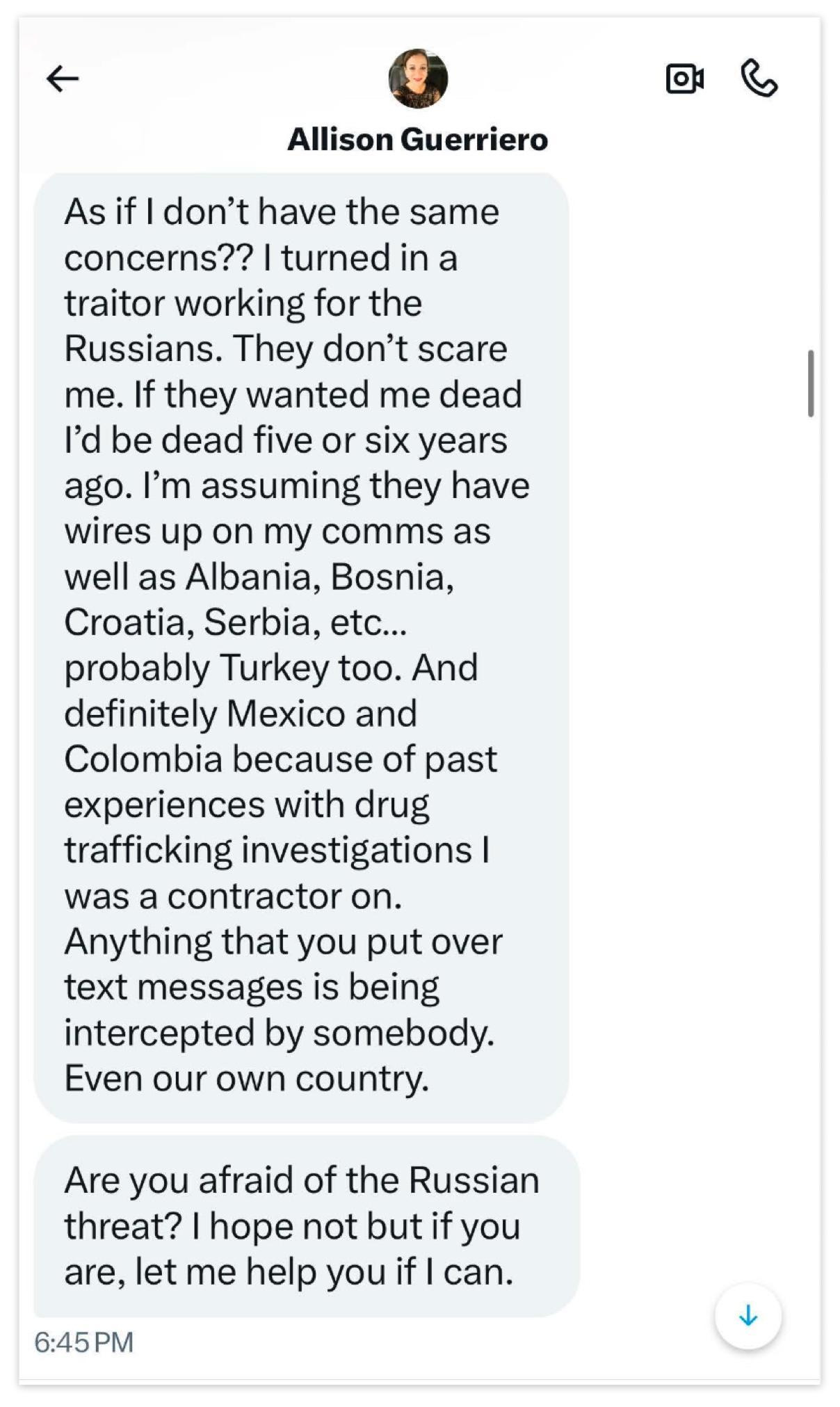
A woman who spent nine years as Vice President of US Operations for an Israeli defense contractor, who lists “Counterintelligence” and “Private Investigations” among her professional skills, and who described herself to the Daily Mail as “a platonic female in the security industry who deals with the same legal mechanisms and high levels of government” is not inventing a security-industry career. Whether every claim she makes about that work is accurate is a different question.
The pattern has continued. In public replies this August, she asserted that “the PID Squad in the 8th Floor HQ of the United States Secret Service” monitors the account of a critic, and declined to share evidence with anyone, citing “a much, much bigger espionage, AML, IRS CID” investigation involving “other people from other agencies and even other countries.”
In one DM, she offers a conceptual frame for McGonigal’s corruption, introducing the term “transactional espionage”:
“Yes, I understand why people don’t understand that and why the perception exists that Charlie is somehow aligned with Donald Trump. That’s where the nuance of ‘transactional espionage’ comes in. It was espionage in the form of financial transactions, driven by greed and not by political ideology. Charlie didn’t care who was paying him or what their politics were. He sold out the United States for money and released classified information and intelligence to our adversaries for money. It does not have anything to do with politics, which is something that has always been nagging at me because the perception is that Charlie had a political motivation and he never did.”
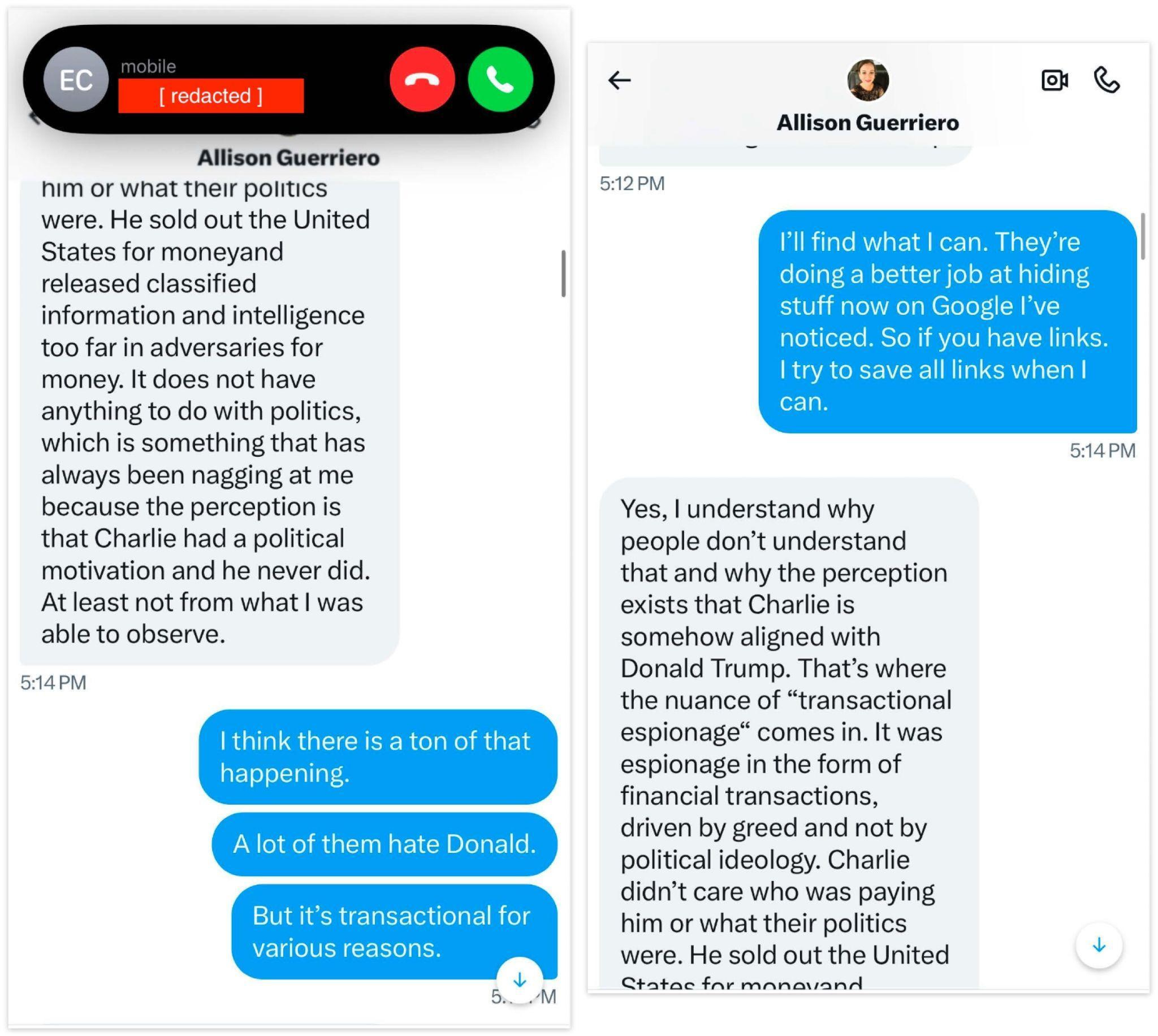
Her account of motive fits the public record. The deals with Deripaska, Nezaj, Rama, and CEFC-linked intermediaries were plainly about money rather than ideology. Her account of the conduct does not. McGonigal was never charged with espionage; what the inspector general found was the unauthorized disclosure of sensitive, non-public case information, which is a serious thing and a different thing. The word she reaches for is unsupported by the record and applied to a man whose actual convictions were for concealment and sanctions violations.
But notice how she deploys the frame: by insisting his espionage had nothing to do with politics, she cuts the Trump‑aligned network around her loose from any political consequences of his corruption and redirects blame toward a supposedly partisan FBI. That framing aligns neatly with her public portrayal of Giuliani, Stone, Flynn, Kurson, and McMahon as victims of politicized law enforcement, a portrayal since ratified by official action: pardons for Giuliani and McMahon, a sealed record for Kurson, a seat on the West Point Board of Visitors for Flynn.
The question is why a trained security professional with two decades in the defense and law-enforcement supply business has spent years shaping the public account of this case in ways that serve a specific political network, and why that professional background has not been examined by a public body investigating McGonigal’s compromises.
The October 2016 Black Box
The most politically sensitive period of McGonigal’s career is also the least examined: October 2016, when he was named to run counterintelligence in New York while that field office was working the Anthony Weiner laptop, leaking, and supplying Giuliani with his hints of a “big surprise.”
McGonigal had sent the email predicate for Crossfire Hurricane on 31 July 2016. The Bureau announced his New York appointment on 4 October, in the middle of the field office's handling of the Weiner laptop, and its release said he would take up the post at the end of that month. The squad he was taking over housed parts of the Trump-Russia investigation and elements of Fox Hunt. New York agents were known to harbor anti‑Clinton sentiment; Comey’s decision to notify Congress on 28 October was driven in part by fear of NYFO leaks. Two days before that letter, Giuliani went on Fox News and hinted that Trump had “a surprise or two” coming from “former FBI agents.” Whether McGonigal was in the chair by then, or arrived days later, is not established anywhere in the public record.
Special Counsel John Durham’s 2023 report criticized the FBI for opening a full investigation on “raw, unanalyzed, and uncorroborated” intelligence and for applying a lower threshold than it used in Clinton‑related cases, without addressing the fact that the official who sent the predicate email was later found to have taken foreign cash and leaked sensitive cases to foreign‑linked actors.
In her DMs, Guerriero insists that Giuliani and McGonigal “never actually met” beyond a handshake, that he was sent to New York “to help stop the leaks,” and that “the leak is some other guy,” whom she “suspects” was a prosecutor in the Southern District of New York:
“He’s not the leak. The leak is some other guy. Charlie was sent up there to help stop the leaks by Comey at the request of Bill Sweeney and the other anti-Trump FBI agents. I know for a fact they were never friends. Please believe me about this. I suspect I know who the leak was but it wasn’t an FBI agent, it was a prosecutor in the Southern District.”
She later calls this identification a “hunch” but adds that her hunches are “very seldom wrong” and asserts that “they all hated Trump anyway including Charlie.” She is exonerating both Giuliani and McGonigal on the most sensitive questions while redirecting suspicion toward other officials. By August 2026 she had taken the exoneration public, writing in her own name that McGonigal “wasn’t even in New York before the 2016 election,” that “they only made the announcement at the end of October 2016,” and that he “had no role” in the events surrounding the reopened Clinton email inquiry, despite the Bureau's 4 October 2016 announcement slating his arrival for the end of that month.
The McMahon Pardon Campaign
In 2025, Guerriero launched a Substack campaign urging Trump to pardon McMahon, presenting him as a falsely convicted patriot and arguing that his Fox Hunt case had been tainted by McGonigal’s misconduct and broader FBI corruption. She described Biden Justice Department prosecutors as “evil people” and alleged that exculpatory evidence had been withheld.
On Instagram, she celebrated the November 2025 pardon and urged followers to listen to Roger Stone praising the decision. In the DMs with Andrews, she framed the gag-order fight as an essential free-speech battle: “if Charlie is able to gag me that sets a precedent for others.”
The pardon gutted deterrence for Fox Hunt‑style operations. Chinese security services now know that prosecutions of American cut‑outs can be reversed through political lobbying and narrative campaigns. And the case itself has been folded into the same storyline Guerriero uses for everything else: an allegedly out‑of‑control FBI persecuting innocent patriots and Trump allies. A high‑profile Fox Hunt conviction has been erased after a pardon campaign run by the woman who once lived with the FBI’s New York counterintelligence chief while he was leaking China cases, and who now spends her time publicly attacking the legitimacy of U.S. counterintelligence.
Some of Guerriero’s claims hold up against the public record. Her description of the October 2017 cash bag matches an $80,000 Nezaj payment documented in court filings, and her account of sealed-envelope exchanges with Shestakov fits the timeline of the Deripaska conspiracy. Other claims cannot be independently verified, including her portrayal of her post-breakup conduct as deliberate tradecraft and the extent to which her public campaigns are strategically coordinated rather than instinctive.
The Recantation
In August 2026, after this reporter approached her for this story, Guerriero responded in public. Over a series of replies on X she supplied a telephone number, then said she would not sit for a telephone or video interview and would communicate only in writing; consented to the use of “whatever is in Substack”; demanded the identity of the publication, the assigning editor, “journalistic credentials”, and every allegation concerning her; and asked whether the reporter had received material from the researcher she now describes as an obsessed conspiracy theorist and a harasser. The hostility between the two is documented in both directions.
As the exchange wore on, she stated its purpose plainly. She had engaged, she wrote, “openly so that I can be able to have some sort of control over a narrative about my life.” She informed the reporter that “these are my rules and I’m in charge not you”, and that done her way, “you’ll get an accurate story out there.” Then, an offer: “If you want to negotiate, maybe we can do that and that will also take place on Twitter.” No negotiation took place.
She also moved, unprompted, to disavow the private record at the center of this story. “Most of what I told Tony Gonzales wasn’t even true anyway,” she wrote in one reply. “I was trolling him because it was funny.” In another: “I made most of what I told Anthony Gonzales (his real name) up anyway.” Asked directly whether she tells a lot of lies for laughs, she said no: “I wasn’t in the mindset that I was lying at that time. It just became out of hand, and I fell into a stupid rabbit hole of it.” She has variously described their contact as lasting five or six weeks, two months, two and a half months, and three months.
The disavowal was selective. The claims she itemized as inventions were about herself: that she knew Jeffrey Epstein, and that her husband worked in the Trump administration. She has never been married, she says. The claims she re-asserted, in her own name and knowing a journalist was reporting, were the ones that shield the network: that Giuliani and McGonigal “never even met”; that McGonigal reached New York only “after the election”; that the 2016 leak was “a prosecutor in the Southern District”; that the bribes were “only limited to the Balkans”; and that “I don’t think the Russians turned Charlie. Charlie is the one who turned Sergey.”
Among the claims Guerriero told this reporter she had fabricated for the researcher was a Connecticut trip: “I totally made it up and he believed it! What a moron.” On the October 2024 broadcast, at least six months before her documented contact with the researcher began, she had told the story herself: “Charlie and I were up in Connecticut one night when he accepted a bribe from Sergey, and we stopped by my best friend’s house at the time, and then we spent the night up there.” Unless the invented trip is a different one, a question included among the written queries she refused to receive, the two statements cannot both be true: either she has recanted a real event, or she described a fabricated bribe on national television, unprompted, months before the man she says she invented it for entered her life. Nor was the Shestakov claim minted this summer: “It is my belief that Charlie corrupted Sergey, not the other way around,” she told Ryan in 2024, the same position she restated to this reporter in August, part of a line held steady across venues while the disposable details changed.
On 23 August she wrote that when this reporter first commented to her, “I didn’t realize you were receiving your information from him.” Two days later, on camera, she said the opposite: she had known for months, because “all of us in our group text who are keeping an eye on him” had seen it. “We did know that he was talking to you.” The same video disposed of the question of whether any of her account had ever been given under oath. Her answer: at one point in her life, she had been “the deputy commissioner of the city of New York for saving water.” She has never said she testified under oath about any of it, and no public record shows that she has; whether that is her choice or, as she maintains, the government’s, is among the questions she refused to receive.
Hacking, but Legal prepared written questions covering every message quoted in this story, including whether her claim of invention extends beyond her public posts to the private messages of May to July 2025, which she has not, to date, specifically disavowed. Guerriero, who had demanded written questions, refused to provide any channel to receive them: all communication, she declared, would take place on X, she would not be answering in any case, and the reporter’s deadline created no obligation for her. She was offered email, text, and additional time, and was told the publication date. She answered with public attacks instead.
A note on sourcing. The private messages quoted in this story were provided by the researcher. Where their contents touch the documented record, the timing of the October 2017 cash, the Caputo exchange, her public campaigns, they are consistent with it; where they are hers alone, they are presented as her statements, not as established fact. Andrews was shown an earlier draft of this story for accuracy and urged its publication. He had no role in its reporting, framing, or editing, and no say in what it says or when it ran: this reporter held it for months, over questions he wanted published sooner. Guerriero calls him an obsessed conspiracy theorist and a harasser. There is documented hostility between the two in both directions.
There is a non-strategic reading of all this. Guerriero has been seriously ill for years, describes a long financial struggle, and lives much of her public life online; the oscillation between confession and stonewall may be compulsion rather than design. There is a third reading: people who have behaved chaotically often reconstruct it afterwards as strategy, because a story in which you were clever is easier to carry than one in which you were desperate, careless, or made serious mistakes. The structural facts do not depend on resolving Guerriero’s intent. Whoever benefits from a record in which the case’s origin witness has publicly declared herself unreliable while re-affirming every claim that protects the men around her, it is not the public and it is not the case for accountability.
In the final hours before publication, both principals claimed the story in advance. The researcher announced it on camera: “the universe is aligning.” Guerriero linked his video within hours, promising her followers “it’s gonna be a hoot”, and wrote as the morning arrived: “I’m perfectly willing to let history be the judge cause I know I will be vindicated.”
The End of Scrutiny
One by one, the mechanisms that might have forced answers into public view have been dismantled. KleptoCapture, the DOJ unit that enforced Deripaska-era sanctions, was dissolved at Attorney General Pam Bondi’s direction on 5 February 2025.
In March 2025, FBI whistleblower Johnathan Buma, reported in 2023 to have described McGonigal to Congress as someone who “ran interference for Giuliani”, was arrested and charged with disclosing confidential documents. Buma has pleaded not guilty and faces trial in October 2026, and the memoir he self-published in August 2026 does not mention McGonigal by name. Shestakov drew a two-month sentence after all serious charges were dropped; Rossini got a Trump pardon in January 2026.
Every political figure in the network has been insulated. Giuliani was pardoned in November 2025; the Georgia RICO case was dismissed the same month. McMahon’s conviction was erased. Kurson’s charges were sealed, and Flynn was given a seat on the West Point Board of Visitors. In Albania, Rama won a fourth consecutive term without facing charges; Nezaj and Ducka remain free.
The pardons are not evidentially alike, and the difference matters. Only one of them has a documented financial chain attached: Rossini's clemency followed millions of dollars in contributions to a pro-Trump super PAC from the daughter of his co-defendant, as this reporter reported in Byline Times in February. The others have advocacy and proximity, and no money trail that anyone has produced. One of these is a model. The rest may only be imitations of it.
McGonigal sits in FCI Cumberland, the only one of the Americans in this network who is in prison. His tenure running counterintelligence in New York during the 2016 election and the damage from his compromises have not been assessed in any public forum. It is not known whether a foreign service actively directed the network or merely exploited existing ties; whether information passed through Guerriero’s orbit, and to whom, has never been asked under oath.
Guerriero declined to comment, responding instead with public attacks on the reporter. She was told the publication date in advance and offered additional time. No approach for comment was made to the other figures named in this story; their positions, where known from court records, sworn filings, and their own public statements, are reflected throughout.
♦
Corrections and additions: contact Jackie @ this website dot com. Errors of fact will be corrected promptly and noted on this page. Anyone with information relevant to this story, including any person named in it, is invited to write.
A note on support. This piece took weeks to write and months to develop. That included obtaining and authenticating the private messages, working through court filings in multiple districts, an inspector general report, FBI personnel announcements, foreign corporate registries, and reviewing a broadcast interview frame by frame. Nobody commissioned it and nobody paid for it. Hacking, but Legal has no publisher, no advertisers and no institutional backing, which is why this story is free to read and why the reporting that follows it depends on subscribers. There is more to come on this network. If you want that work to happen, subscribe.
Thank you. This is some amazing investigative reporting!
This web of international corruption, espionage, crime, and collusion grows larger and more insidious with each new revelation. The worst part is the absolute lack of accountability. I've been waking up everyday for more than 11 years now hoping for some little shred of justice, any justice to be served, and instead we get multiple new scandals per day. The rate with which they're occurring and the severity of those injustices seems to grow larger each day as well. It's immensely infuriating and, at times, demoralizing.
With regards to Trump's pardons, I'm often surprised that the focus by most news outlets is always on the money Trump receives. I mean sure, that's unbelievably illegal and corrupt, but they neglect to consider that Trump operates like any other organized crime boss. The pardons have never been about the payments, they're just icing on the shit cake. The real purpose has always been protection and buying loyalty and future favors. Every last person that he's pardoning is being pardoned to serve a future purpose for him.
Remember, we have an election coming up that he knows he has to steal if he wants to retain power and avoid investigations. Even if those investigations will likely just be political theatre...
Important story!