

On February 28, 2026, the United States and Israel opened a coordinated air campaign on Iran that immediately blew past any plausible definition of “limited strikes.”
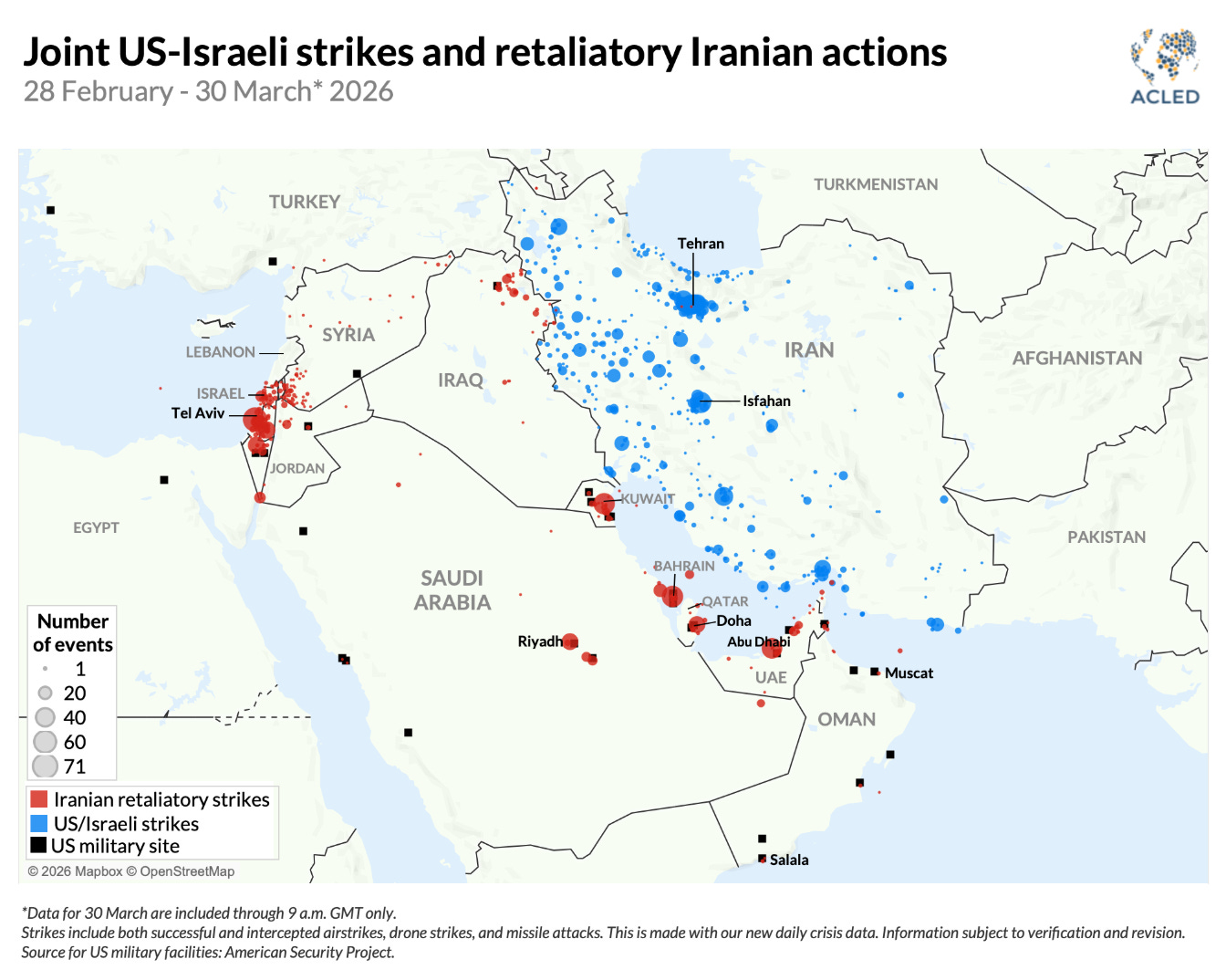
Reporting from ACLED’s March 2026 special issue shows the opening wave killed Supreme Leader Ali Khamenei and other senior figures, hit government compounds in Tehran, and targeted key elements of Iran’s air defenses, missile forces, and internal security apparatus.
Within days, ACLED was tracking hundreds of strikes across at least 26 of Iran’s 31 provinces, with Tehran the most heavily bombed, alongside central, western, and southern regions. Targets have included media facilities and detention centers, with resulting jailbreaks and large-scale displacement, as MERIP’s regional analysis documents.
In public appearances, Donald Trump has worked to shrink the war in the American imagination. Speaking to House Republicans at his Florida golf resort, he described it as a “little excursion” to “get rid of some evil,” promised it would be “short-term,” and claimed the United States had already “won in many ways,” per Military Times. In remarks captured by Al Jazeera English, he floated a timeline of a “couple weeks, few weeks,” even while threatening, as NBC News reported, to inflict damage that would make it “nearly impossible for Iran to ever rebuild as a nation again.”
A campaign that aims to shatter a state’s ability to function is, by definition, neither narrow nor brief.
Domestic fairy tale vs. operational reality
Trump’s language does more than express confidence; it manages risk perception.
Calling a war an “excursion” suggests a discrete trip, something you return from without lasting disruption. It signals to markets and voters that this conflict will not become another Iraq or Afghanistan.
Trump's language does more than express confidence; it manages two audiences at once, and it does so by design. For people who follow foreign policy closely, "excursion" reads as a malapropism for "incursion," the more precise military term. That slippage does not feel accidental. It invites educated observers to conclude that the president simply doesn't know the word he was looking for, which is a psychologically powerful move: if you believe the man ordering the war is too confused to name it correctly, you are more likely to roll your eyes than to organize. Contempt is a remarkably effective substitute for complacency.
For everyone else, the word does its other job. An excursion is a day trip. It’s what you do on a cruise ship when you dock somewhere new. It carries no weight, no dread, no implication of open-ended commitment. Both readings serve the same purpose: keep the public from treating this as the generational policy choice it actually is. One group is anesthetized by condescension, the other by reassurance. The word works precisely because it fails in two different directions at once.
The conduct of the war points in a different direction. ACLED’s conflict tracking indicates:
1,879 U.S. and Israeli strikes recorded in the first two weeks alone, with at least 73 intercepted.
Hundreds of those attacks falling across most of Iran’s provinces, including repeated hits in and around Tehran.
A campaign explicitly structured to degrade Iran’s ballistic missile forces, air defenses, and nuclear-related infrastructure, which Iranian planners treat as core regime survival assets.
Tehran’s response has also shifted. A CSIS analysis concludes that Iran has abandoned its earlier pattern of calibrated retaliation in favor of rapid escalation, with strikes and proxy attacks across the Gulf and explicit threats to “irreversibly destroy” regional infrastructure and energy facilities. The Institute for the Study of War describes Iranian operations in multiple theaters, including Lebanon, Iraq, Syria, and the Gulf, alongside cyber and maritime actions.
Human Rights Watch’s March 26 assessment frames the conflict as a stress test for the laws of war, documenting serious violations by all parties and citing inflammatory statements by officials that include open threats to destroy civilian infrastructure and dismiss the binding force of international law. Defense Secretary Pete Hegseth publicly vowed that U.S. forces would give “no quarter” to enemies in Iran, a statement that itself constitutes a war crime under international humanitarian law.
The public isn’t buying the “excursion”
American public opinion has turned against the war early. A CNN-SSRS poll conducted just after the strikes began found that nearly 60 percent of respondents disapproved of the decision to take military action in Iran, while 56 percent believed a long-term military conflict between the two countries was at least somewhat likely. More than half expected Iran to become more of a threat to the United States as a result of the strikes.
Support for regime change and ground operations is weaker still. According to the same polling, 56 percent opposed an effort to overthrow the Iranian government, and only 12 percent supported deploying U.S. ground forces into Iran. A separate analysis from the Institute for Global Affairs draws on these numbers to describe the war as “politically unsustainable” and warns it is already drifting toward the kind of open-ended, ill-defined commitment that marked earlier U.S. wars in the region.
Intentional risk, not accidental quagmire
The administration’s own stated objectives point toward a strategy that assumes, and to function requires, a willingness to risk wider war. Public statements by Trump and allied analysts describe goals that include:
Destroying large portions of Iran’s missile and naval capabilities.
Crippling or dismantling its regional proxy networks, often described as the “Axis of Resistance.”
Preventing Iran from ever obtaining a nuclear weapon, including by force.
Weakening or toppling the regime in Tehran, framed as necessary for a “decisive victory.”
As the Atlantic Council puts it, completing that mission requires sustained coercive pressure well beyond a brief air campaign. ACLED goes further, concluding that “the only clear path to a decisive victory, especially for Israel, would be regime change, a far longer, costlier, and more destabilizing undertaking than a limited air campaign is likely to achieve.” A policy that sets regime change as the real victory condition cannot honestly be described as a short, controlled operation.
Escalation specialists have warned for years, as CSIS documents, that attempting to coerce Iran on core regime interests, especially its deterrent capabilities and regional networks, produces broad retaliation rather than capitulation. When policymakers choose maximal goals in full view of that history, they are accepting the likely shape of the conflict, not stumbling into it.
Early operational choices match that reading. The decision to open with leadership decapitation and attacks on national-level infrastructure signaled an intent to shock the Iranian system. Trump’s subsequent threat to destroy Iranian power plants if the Strait of Hormuz was not reopened within 48 hours, documented by Human Rights Watch, put civilian infrastructure explicitly on the table from the outset. They note that Trump later “postponed but did not revoke his threat.”
Eschatology, power, and the “excursion” story
Religious and ideological commitments inside the administration add another layer to this picture. PBS NewsHour has documented how Hegseth built a public identity around Christian nationalism, defended the medieval Crusades, and used explicitly religious rhetoric to frame conflicts with Iran and other Muslim-majority states. His book American Crusade celebrates a narrative of civilizational struggle, and reporting has captured his use of crusader iconography, including “Deus vult” tattoos, as a sitting defense secretary. (I wrote a story about Hegseth’s body ink in July 2025.) CNN’s analysis frames all of this not as personal quirk but as ideological commitment that now shapes policy.
The administration’s closest evangelical allies bring their own theological frameworks to bear. Work from the Misgav Institute, the Washington Institute, and the Arab Center DC describes how certain strands of Christian Zionism and apocalyptic belief treat Israel’s territorial control and confrontation with Iran as steps in a prophetic timeline. Baptist News traces this end-times theology directly into the policy debate around intervention in Iran. Those same networks shaped Trump’s first-term decisions on Israel-Palestine and are again present around his second-term team.
Alongside more familiar aims like reaffirming U.S. regional primacy and tightening the Israel-Gulf alignment, these beliefs help explain why a destabilizing war can be framed inside the administration as both strategically necessary and spiritually resonant, as Hoover Institution analysis of the broader Trump doctrine makes clear. At home, describing the campaign as a “short-term excursion” reduces the friction between that vision and the domestic political need to minimize costs.
This mix of religious certainty and strategic ambition shows up in the way senior officials talk about legal constraints. In the HRW report and related coverage, statements by Trump and Hegseth treat the laws of war less as binding rules than as political annoyances. Critics who warn about escalation or civilian harm get cast as weak, defeatist, or disloyal rather than as people reading the risk landscape correctly.
Information management and ready-made excuses
The “excursion” framing does more than sell optimism; it bakes in deniability. If the conflict drags on or spreads further, the White House can claim that no one could have anticipated the depth of Iranian resistance, or that domestic and foreign saboteurs undermined an otherwise sound plan.
Trump has already declared that the U.S. has “won in many ways” and suggested, per NBC News, that only a bit more pressure is needed to finish the job. As Zeteo and ABC News have both analyzed, the “excursion” language is deployed precisely to keep public attention narrow, so that when mounting costs arrive, they can be framed as unfortunate surprises rather than predictable consequences.
The pattern is familiar. The Iraq invasion, to which I was deployed as a baby-faced soldier in 2003, was sold with promises of quick victory, low cost, and self-funding reconstruction. When that fantasy collapsed, officials blamed flawed intelligence and unforeseeable enemy resilience. Two decades later, the marketing has been updated with AI-guided munitions and space-based targeting, but the core structure remains unchanged. Project expansive objectives onto a minimized public footprint, insist that escalation is something done to the United States rather than chosen by it, and deny that initial decisions made a grinding conflict the likely outcome from the start.
This time, as MERIP’s regional correspondents make clear, the stakes include not just one country’s fate but the stability of a region already under compounding pressure from Gaza, Lebanon, and long-running crises in Iraq and Syria.
On the record we have now, the through-line is already quite visible. The war in Iran did not grow out of some misjudged “incursion” that somehow got out of hand; it emerged from a policy that treated a wider regional conflict as an acceptable, and perhaps necessary, risk, and then wrapped that choice in a story designed to make the eventual quagmire look like an accident rather than the predictable outcome of the original design.
Wow Jackie thank you for this. Terrifying but clear and careful facts that cut through the crap. Project 2025 grinds on. However, with brilliant people like you telling us what they are doing it is easy to see the pattern of overthrow and subjugation. And extreme violence at home and abroad.
Great reporting! It's unbelievable how long our country and Israel have been meddling in the affairs of the other middle eastern countries, especially Iran and Iraq. Not to say that those countries haven't committed their share of heinous atrocities too, but when you start to dig into the history of our country's meddling over there, you begin to realize that we were the aggressors that catalyzed most of the awful that followed.
Interestingly,in my growing interest into researching Epstein's extensive ties to intelligence ops here and abroad, I just stumbled upon this wild Dropsite News reporting (linked below) from back in December. I was born in 1980, so I never learned much about the Iran/Contra scandal. This article provides a lot of details into that scandal while also exposing Epstein's many connections to it, and to the CIA/Israeli ops behind it as well. It's a crazy read that provides a good introduction to our meddling with Iran 50 years ago. The included CIA map from 1980 showing the straight of Hormuz, kinda says it all...
https://dropsitenews.substack.com/p/jeffrey-epstein-iran-contra-planes-leslie-wexner-pottinger-leese-arms-weapons-smuggling?utm_source=share&utm_medium=android&r=4otx7o