
DOGE Has the Draft List
How automatic Selective Service registration, government data-mining, and two active wars converge on a single database.

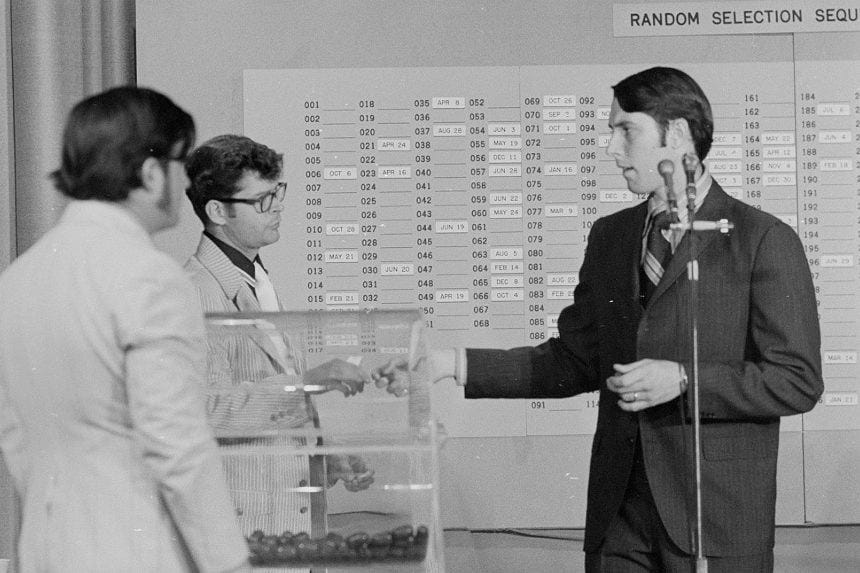
In February 2025, I wrote about something that almost happened. A provision in the House-passed FY2025 NDAA would have transformed the Selective Service System from voluntary self-registration into automatic, database-driven enrollment of every draft-age male in the country. It was stripped from the final bill before President Biden signed it in December 2024. I argued at the time that its removal didn’t mean the idea was dead. The 57-1 vote in the House Armed Services Committee, the bipartisan enthusiasm, the obvious political utility of keeping a draft on a hair trigger—all of it pointed toward a second attempt.
That second attempt succeeded, and in a context far worse than I anticipated.
On December 18, 2025, President Trump signed the FY2026 National Defense Authorization Act into law. Section 535 mandates that the Selective Service System automatically register all male U.S. residents aged 18 to 26 using existing federal databases. The provision takes effect in one year. It passed 312-112 in the House and 77-20 in the Senate. Nobody held a press conference about it.
Between my original article and this one, the United States bombed Iran’s nuclear facilities, intervened militarily in Venezuela, deployed the National Guard to American cities, and authorized the largest defense budget in history. A new National Defense Strategy explicitly prepares for “prolonged, multi-domain conflicts.”
Quiet draft plans are now law, being implemented against a backdrop of active warfare.
What Section 535 Actually Does
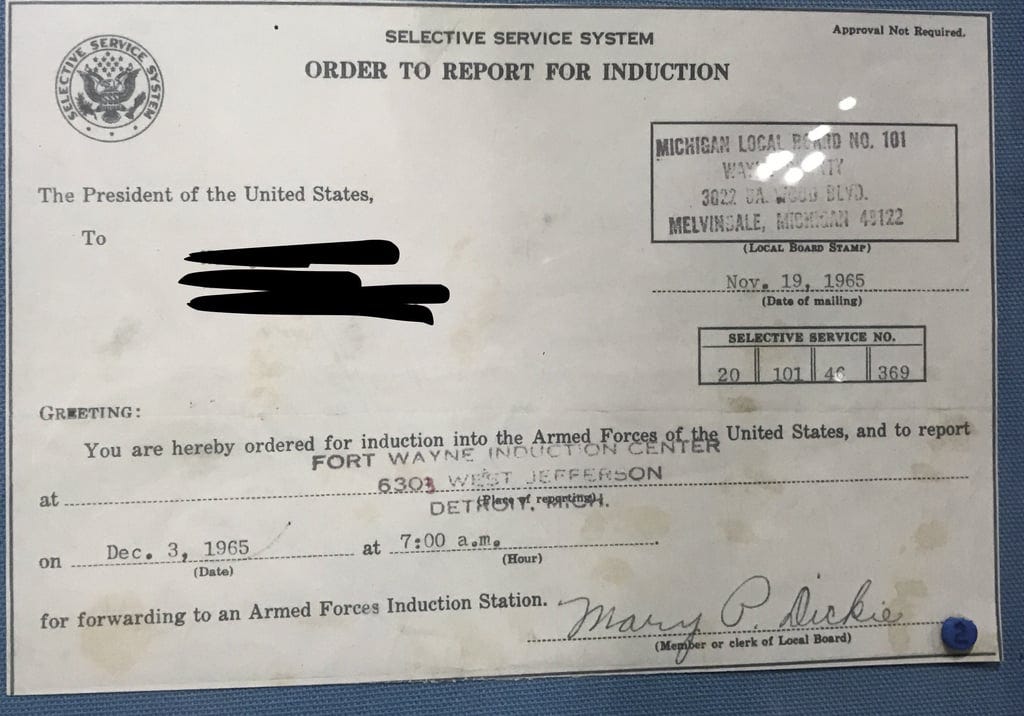
Under the new law, the SSS must “identify, locate, and register” every male person residing in the United States between 18 and 26 by aggregating data from other federal agencies—Social Security, IRS, immigration records, whatever else the SSS Director “determines necessary.”
This replaces a self-registration system in place since 1980. Under that framework, young men were supposed to sign up voluntarily; most didn’t. Compliance has been abysmal for decades. Bernard Rostker, who ran the SSS from 1979 to 1981, testified in 2019 that the existing database would be “less than useless” for an actual draft.
Congress had an obvious alternative: abolish a system that hasn’t worked in 45 years. Instead, it chose to expand the system’s reach and its access to Americans’ personal data.
Edward Hasbrouck, the most knowledgeable independent expert on draft registration in the country, put the change in stark terms when the conference bill emerged in December 2025: this:
“will move the USA closer to activation of a draft, or at least to being able to claim to be ready to activate a draft ‘on demand,’ than at any time in the half century since draft registration was suspended and draft boards were deactivated in 1975.”
A revealing detail is buried in the legislation itself. Despite the word “automatic,” the law still requires potential draftees to provide personal information on demand of the SSS. If the system could truly identify and locate everyone on its own, that provision wouldn’t be necessary. It exists because the premise of constructing a comprehensive, accurate list of every draft-eligible person by merging federal databases doesn’t hold up. Federal databases don’t agree with each other. They don’t track current addresses. They don’t reliably record sex as assigned at birth. None of them were designed for this purpose.
So what the law actually creates is not an automated registration system but a sweeping new authority for the SSS to demand data from every other federal agency and to demand personal information from individuals.
Automation is the sales pitch; the surveillance architecture it enables is the product.
How It Got Through
The legislative path reveals how Congress handles provisions with major civil liberties implications when nobody is paying attention.
Automatic registration language originated within the SSS itself during the Biden administration, championed in Congress by Rep. Chrissy Houlahan (D-PA). Her bill sailed through the House Armed Services Committee in May 2024 on a voice vote without audible opposition, endorsed “wholeheartedly“ by Chairman Mike Rogers (R-AL). Democrats got to look tough on national service. Republicans got expanded government data collection that could be weaponized for other purposes. Everyone won except the people who’d eventually be registered.
When the provision was stripped from the FY2025 NDAA in conference, I flagged it as a temporary setback, and ten months later it resurfaced in the FY2026 bill.
In September 2025, Rep. Warren Davidson (R-OH), a West Point graduate and Army veteran, tried to bring a floor amendment that would have replaced automatic registration with outright repeal of the Military Selective Service Act. The House Rules Committee blocked it, foreclosing any debate on whether the Selective Service should exist at all. Only the question of how aggressively it should operate was permitted.

By December 2025, the House-Senate conference committee had folded the provision into the final FY2026 NDAA. Public discussion around its passage focused on the $901 billion topline, the 3.8% military pay raise, Golden Dome missile defense authorization, and $400 million for Ukraine. Automatic draft registration was a footnote.
The Friends Committee on National Legislation had flagged the provision before it passed, calling it “dangerous draft automation.”
Their warning went largely unheard.
DOGE Walks Into the Selective Service
In April 2025, before the automatic registration provision was even enacted, the Department of Government Efficiency showed up at SSS headquarters.
The SSS confirmed to Edward Hasbrouck that “a DOGE representative visited our Agency this week. We’ve established a great working relationship. They asked us about our data and requested access, which we gave in compliance with the President’s Executive Order on Establishing and Implementing the Department of Government Efficiency.”
The registration database contains records on all male U.S. citizens or residents born on or after January 1, 1960, who have registered or been registered by state driver’s license agencies. Enormous and inaccurate, as of that April visit it was open to an organization with no statutory authority and no obligation to explain what it intended to do with the data.
When Hasbrouck asked whether new computer matching programs had been carried out by DOGE, the SSS said no, but acknowledged it wasn’t clear whether the agency would “even know what DOGE has done with SSS data, once DOGE has gotten access to it and possibly exfiltrated it.”
Once data leaves an agency and enters DOGE’s orbit, no mechanism exists to track it, constrain it, or recall it. DOGE’s entire operational model is built on aggregating and cross-referencing federal databases.
That model now includes the draft registration list.
From Database to Weapon
If DOGE’s access was the opening move, the SSS’s subsequent rulemaking was the follow-through.
After Section 535 was enacted, the SSS’s first official regulatory action was a proposal to expand “routine uses” of registration data. Under the new proposed rules, SSS records could be disclosed to federal, state, and local agencies and to private entities for purposes including immigration enforcement.
The Heritage Foundation had signaled earlier in 2025 that it wanted SSS registration data turned against immigrants, leveraging threats of prosecution for “knowing and willful” non-registration to pressure undocumented individuals to self-deport. The legal basis for such threats is thin because you can’t prosecute someone for “knowingly” failing to do something they didn’t know they were required to do. But the coercive potential is real, especially for populations already living under threat of deportation.
In January 2026, a coalition of civil liberties and peace organizations pushed back. The Military Law Task Force, the Electronic Privacy Information Center (EPIC), Restore the Fourth, the Committee Opposed to Militarism and the Draft, Project YANO, the Episcopal Peace Fellowship, the Jewish C.O. Project, and the Center on Conscience & War submitted joint comments opposing the proposed data-sharing expansion. Their filing warned that DOGE had already been given access to the SSS database “for undisclosed purposes and with no apparent legal basis” and that the proposed rules were a precursor to the far broader data-sharing regime that automatic registration would require.
The coalition also flagged the populations most vulnerable: transgender and non-binary youth, who risk being misgendered or misregistered by databases that don’t track sex assigned at birth, and immigrant youth, whose data would flow directly into infrastructure already being repurposed for enforcement operations.
As someone who has spent years studying how government data systems get repurposed, I’ve seen this cycle before. A database gets built for a narrow purpose. Access creeps outward, new “routine uses” get proposed, and by the time the public notices, the architecture is already operational. The SSS registration database is mid-cycle right now.
A System That Can’t Draft Anyone
Here’s the paradox. The Selective Service System is simultaneously being granted unprecedented data collection powers and remains institutionally incapable of executing an actual draft.
Between March 2021 and March 2025, draft board membership declined from 9,596 to 5,802. When the SSS conducted outreach to its own board members, it discovered that “many” had died without the agency’s knowledge. The SSS had so little contact with the people responsible for processing draft claims that it didn’t know they were dead.
Many local boards now lack the three members required by law to constitute a quorum. Without a quorum, a board cannot legally hear deferment or exemption claims. If a draft were activated tomorrow, residents in those jurisdictions would have no functioning board to appeal to. The National Appeal Board, which hears appeals of deferment and exemption decisions, had a single member as of March 2025. Three are needed for a quorum, so no functioning national appeals process exists.
The SSS was considering asking Congress to let it consolidate boards across entire Congressional districts rather than counties, which would reduce the number of boards needed but overload survivors with cases they’d be unprepared to handle, staffed by rushed appointees with minimal training.
Congress just entrusted this agency with building a comprehensive national database of every draft-eligible person in the country.
Meanwhile, the Wars
While Congress debated subcommittee markup language, the United States was fighting.
On June 22, 2025, the U.S. launched Operation Midnight Hammer, striking three Iranian nuclear facilities at Natanz, Fordow, and Isfahan with B-2 stealth bombers and over 100 aircraft. Trump declared Iran’s enrichment capabilities “obliterated.”
In late February 2026, the U.S. and Israel launched a second, larger campaign against Iran, Operation Epic Fury, engaging over 1,700 targets including command centers, ballistic missile sites, naval vessels, and military infrastructure. Trump declared a “major combat operation.” As of this writing, Iran has retaliated with missile strikes on U.S. bases across the Gulf, and fighting continues.
In the Caribbean, the largest U.S. naval concentration since the Cuban Missile Crisis took shape over summer 2025. Since September, the U.S. has carried out dozens of strikes on suspected drug-smuggling vessels, killing scores of people. Defense Secretary Pete Hegseth announced many of these personally on social media, declaring that targets would be treated “EXACTLY how we treated Al-Qaeda.”
A congressional crisis erupted in November after it was reported that Hegseth had allegedly ordered a second strike to eliminate survivors of a September 2 attack, raising serious questions under the Geneva Conventions that congressional investigators are still pursuing. The FY2026 NDAA itself contains a provision withholding 25% of Hegseth’s travel budget until the Pentagon provides Congress with unedited video of the Caribbean strikes.
By January 2026, Venezuela escalated from naval buildup to full intervention with Operation Absolute Resolve, in which U.S. forces bombed infrastructure across northern Venezuela and Delta Force operators captured President Maduro.
On the domestic front, National Guard troops deployed to Washington D.C. in August 2025, then to Los Angeles, Memphis, Charlotte, New Orleans, and Portland. In August 2025, Trump signed an executive order directing the Pentagon to create standing National Guard units in every state for “rapid nationwide deployment.” In a meeting with over 800 generals, he described America as waging “a war from within.” (The Supreme Court ruled against the Chicago deployment in December, and Trump withdrew troops from three cities before signaling they could return.)
The 2026 National Defense Strategy: Saying the Quiet Part
Released in January 2026, the new National Defense Strategy is the most telling document in this sequence. Previous defense strategies talked about “preventing war” or “integrated deterrence.” This one organizes around preparation for “prolonged, dispersed, and multi-domain conflicts.”
Homeland and hemispheric defense became Priority #1, with “homeland” now encompassing the entire Western Hemisphere under what the Pentagon calls a “Trump Corollary to the Monroe Doctrine.” China remains the “pacing threat,” but operational focus has shifted to the Caribbean, the Arctic, and the Gulf of America. Officials describe the defense industrial base as being placed on “a wartime footing,” with calls for a “once-in-a-century revival of American industry.”
CSIS analyst Mark Cancian, a retired Marine colonel, noted the strategy warns of “an increased risk of America itself being drawn into simultaneous major wars across theaters — a third World War.” The answer offered is a “one plus” conflict model: the U.S. fights one major war while allies handle the second. Those allies, described in the document as “freeloading dependents,” are expected to shoulder frontline roles, logistics, and risk.
One conspicuous absence: the NDS does not mention the all-volunteer force. Every previous QDR and NDS had a section on sustaining the AVF. Its disappearance from a document that otherwise touches every major defense topic is hard to read as an oversight.
You don’t build automatic draft registration, expand the surveillance apparatus around it, rename the Department of Defense to the “Department of War,” and stop talking about the all-volunteer force (all while fighting on two continents) unless conscription is being kept very close to the surface.
What Comes Next
The SSS has until December 18, 2026, to stand up the automatic registration system. That means publishing regulations, completing Privacy Act and Computer Matching Act notices, obtaining OMB approval for new data collection instruments, and building the technical infrastructure to pull and reconcile data across multiple federal agencies. All of this by an agency that can’t keep track of whether its own draft board members are alive.
States could complicate the process. The automatic registration law grants the SSS authority to compel data from federal agencies, but imposes no such obligation on state governments. Eleven states currently have no Selective Service registration tie-in with driver’s licenses. Any state that doesn’t want its residents’ data funneled into a DOGE-accessible draft database could end its data-sharing agreement with the SSS entirely.
The coalition that submitted comments in January is planning continued opposition and calling for repeal of the Military Selective Service Act before automatic registration takes effect. They have nine months.
Congress could still repeal the MSSA with a one-sentence bill. But 389 House members and 77 senators just voted to expand the system, so repeal is not a near-term prospect.
What is a near-term prospect: by December 2026, the federal government will possess a continuously updated database of every draft-eligible male in the country, constructed from cross-referenced federal records, accessible to agencies with no clear data protection obligations, and maintained by an institution that has already shown it cannot be trusted with the data it has.
That database will exist in a country actively bombing Iran, intervening in Venezuela, operating under a defense strategy premised on prolonged warfare, and no longer mentioning the all-volunteer force in its strategic planning.
I wrote a year ago that the GOP’s draft plans were quiet. They aren’t quiet anymore. They are law, and the nine months between now and implementation are the last window to stop them.