

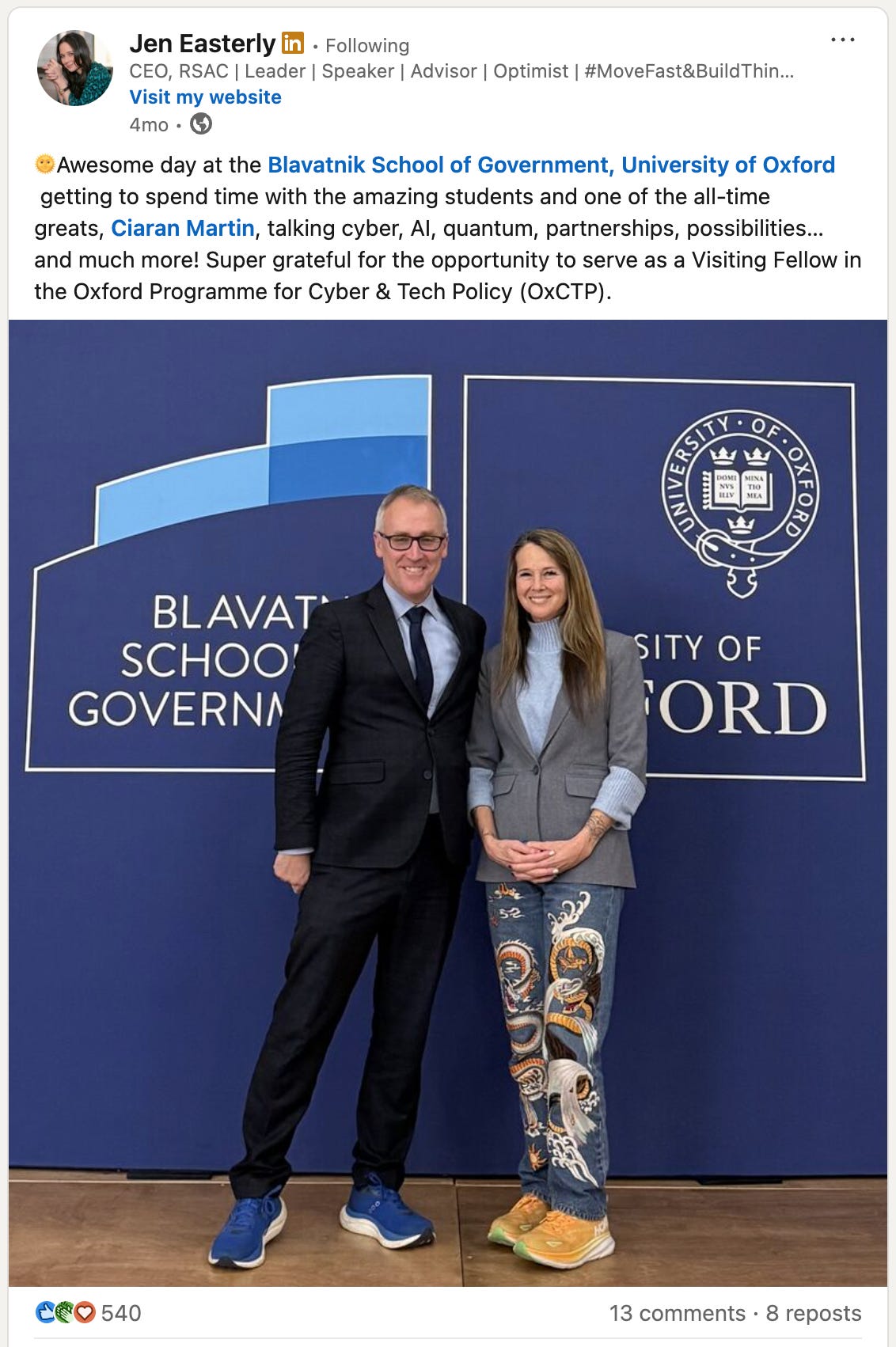
In June 2025, Jen Easterly, the former Director of the Cybersecurity and Infrastructure Security Agency, the federal body responsible for defending American civilian networks, accepted a position as Visiting Fellow of Practice at the Blavatnik School of Government at the University of Oxford.
She joined the Oxford Programme for Cyber and Technology Policy, known as OxCTP, which is co-directed by Ciaran Martin, the founding CEO of the United Kingdom’s National Cyber Security Centre, an operational cyber arm of GCHQ. Martin had joined the Blavatnik School as Professor of Practice in September 2020, the day after stepping down from his government role.
The two most recent leaders of civilian cyber defense in the United States and the United Kingdom now work in the same program, at the same school, under the same name. That name belongs to a Soviet-born billionaire whose business history, according to former senior Treasury sanctions officials, places him alongside sanctioned Russian oligarchs in every respect except his U.S. passport: Len Blavatnik.
That characterization is contested. Blavatnik’s representatives reject the oligarch label, and as this piece will discuss, several major news outlets have published corrections after using it. But in November 2020, two former senior U.S. government officials with direct sanctions expertise published an Atlantic Council report stating plainly that Blavatnik’s “funding can hardly be considered legitimate” and that he escapes sanctions only because he is a U.S. citizen.
There are reasons this convergence has gone unreported that have nothing to do with its importance. Blavatnik’s reputation apparatus — PR responses within hours of publication, legal letters, and corrections extracted from major outlets — makes writing about his network expensive. The facts are public; the cost of a single imprecise phrase is not. Institutional capture becomes invisible not because no one sees it, but because describing it carefully exceeds what most deadlines allow.
What follows is an accounting of what it means that the people the sanctions machinery could not touch are now funding the institutional home of the most senior Western cyber officials.
The Donor
Len Blavatnik was born in Odessa in 1957, when it was part of the Ukrainian Soviet Socialist Republic. His family moved to Yaroslavl, north of Moscow, where he attended the Moscow State University of Railway Engineering before emigrating to the United States in 1978. He earned a master’s in computer science from Columbia University and an MBA from Harvard Business School. In 1986, he founded Access Industries, the holding company through which he conducts most of his business operations, and which now controls Warner Music Group.
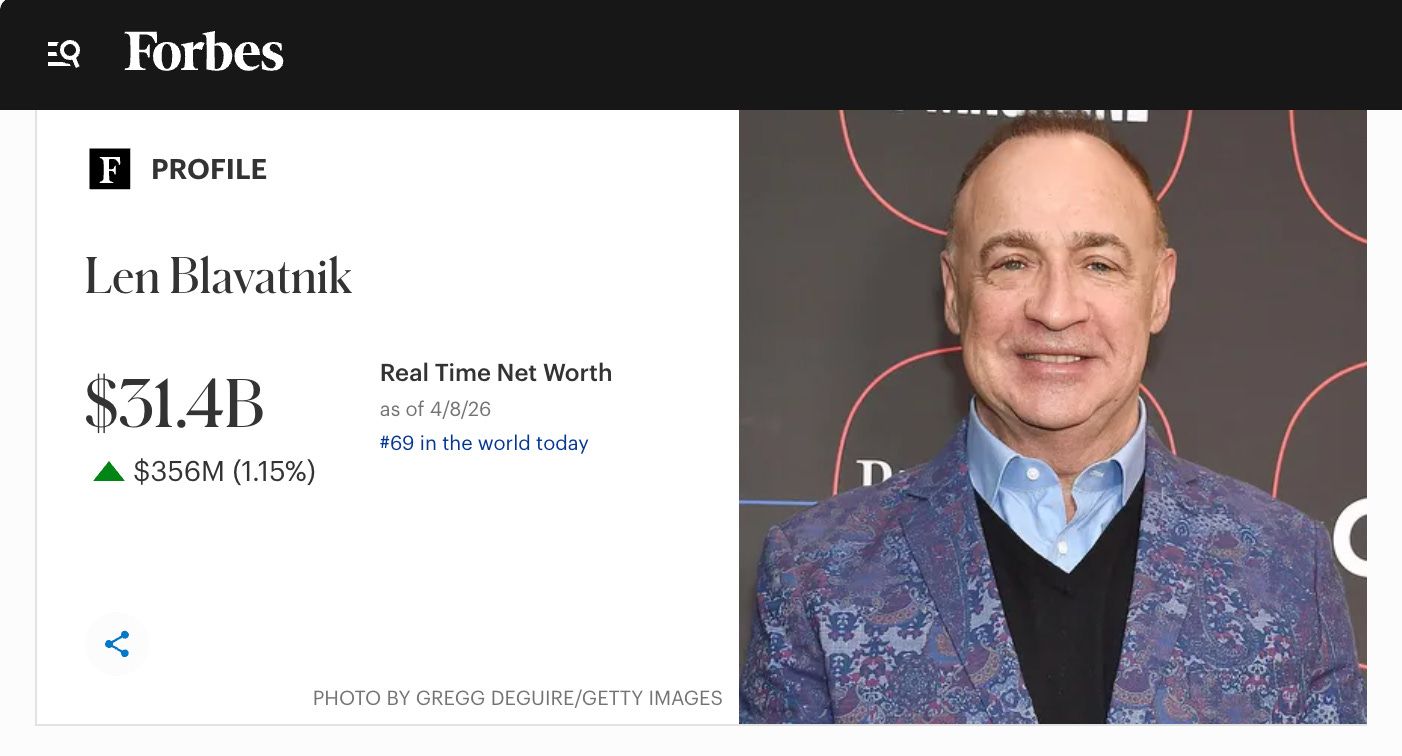
After the collapse of the Soviet Union, Blavatnik used Access Industries to acquire former state assets during Russia’s privatization era, accumulating shares in aluminum smelters and energy companies that became the foundation of his fortune. As of April 2026, Forbes estimates his net worth at $31.4 billion, making him the sixty-ninth richest person in the world. He holds dual American and British citizenship and was knighted by Queen Elizabeth II in 2017.
His early business partnerships are what counterintelligence professionals would focus on. This is not a matter of individual bad actors. As former Bush administration official Philip Zelikow and three co-authors argued in Foreign Affairs in mid-2020, the Kremlin has transformed corruption itself “into an instrument of national strategy,” a doctrine under which ostensibly private business relationships, philanthropic giving, and elite social access are tools of statecraft rather than peripheral side effects of it.
Blavatnik reportedly became close friends with Viktor Vekselberg at the Moscow State University of Railway Engineering. Together, they co-founded the Renova investment vehicle and accumulated stakes in Russian aluminum smelters. In 1997, Blavatnik’s Access Industries joined with Vekselberg’s Renova Group and Mikhail Fridman’s Alfa Group to form the AAR consortium, which acquired a 40% stake in Tyumen Oil Company (TNK) for $800 million. AAR later partnered with BP to form TNK-BP, one of the largest oil companies in Russia.
The venture was enormously profitable: when the state-owned Rosneft purchased AAR’s stake in 2013, the consortium received $28 billion in cash, having already collected $19 billion in dividends. Blavatnik was also a board member of Rusal, one of the world’s largest aluminum producers, from 2007 to 2016. The company was founded by Oleg Deripaska and controlled through his EN+ Group; Blavatnik held an indirect minority stake of approximately 8% through SUAL Partners (jointly with Vekselberg), which held ~22%.
Vekselberg was sanctioned by the U.S. Treasury in April 2018 under E.O. 13662 “for operating in the energy sector of the Russian Federation economy.” Deripaska was sanctioned “for having acted or purported to act for or on behalf of, directly or indirectly, a senior official of the Government of the Russian Federation” under E.O. 13661 and 13662.
Blavatnik himself has not been sanctioned by the United States or the United Kingdom, and his representatives have been aggressive in defending that distinction. Spokespersons for Access Industries have said repeatedly that he “hasn’t had any contact with president Vladimir Putin since 2000,” “plays no role in Russian politics,” and “is not Russian,” emphasizing that he has been an American citizen since the 1980s, was born in Soviet Ukraine, and holds dual U.S.–U.K. citizenship.
Despite this, in December 2023, Ukrainian President Volodymyr Zelensky signed a decree imposing sanctions on 51 individuals, Blavatnik among them. He remains off the U.S. OFAC Specially Designated Nationals list and the U.K. OFSI sanctions list, but the country of his birth has formally sanctioned him. Blavatnik’s fortune was built alongside and intertwined with individuals who have since been sanctioned, and his business history in post-Soviet Russia appears inseparable from the political economy of the oligarch era.
Two former senior Treasury and National Security Council officials made the same assessment explicitly in a 2020 Atlantic Council report on Russian dark money. Anders Åslund, a former economic adviser to the Russian government from 1991 to 1994, and Julia Friedlander, who served as Senior Policy Advisor for Europe in Treasury’s Office of Terrorism and Financial Intelligence during the period when Vekselberg and Deripaska were sanctioned, wrote that Blavatnik “became a naturalized US citizen in 1984” but “made his big money much later on in the Russian heavy industry, notably in TNK-BP, in partnership with Viktor Vekselberg, who was sanctioned by the US government as a Kremlin oligarch in April 2018.”
Their conclusion: “Blavatnik is a US citizen and cannot be sanctioned by the United States, but his funding can hardly be considered legitimate.” That sentence, written by someone who sat inside Treasury’s sanctions apparatus during the relevant period, is the clearest public statement from a former U.S. government official that the only thing separating Blavatnik from his sanctioned partners is his passport.
In 2019, Quartz published Panama Papers–based reporting describing an indirect business link between Blavatnik and a Russian Interior Ministry official. The connection ran through Amediateka, a Russian streaming company majority-owned by Access Industries, which had outsourced services to Nemo TV, a company in which Alexander Makhonov, then Russia’s Deputy Minister of Internal Affairs, held a stake via offshore entities.
Quartz was careful to note that “it’s unclear whether Blavatnik had any interaction with Makhonov” and that “there is no allegation of any illegality.” The relationship was a vendor arrangement between a subsidiary and a company part-owned by a Russian official, not a direct partnership — perhaps a meaningful distinction on paper, though one that still places a Russian Interior Ministry figure inside Blavatnik’s corporate supply chain during a period when his holdings remained deeply embedded in Russia.
Access Industries has described his donations as driven by a “pro-business, pro-Israel agenda” — a framing that is only partially borne out by the FEC record. Blavatnik’s political giving spans both American parties and multiple countries, but is bipartisan in name only. Between 2009 and 2014, his federal donations were modest and roughly balanced, peaking at $273,600 in the 2013–2014 cycle, according to FEC data compiled by the Dallas Morning News and Quartz.
Starting in 2015, his spending transformed: he poured at least $6.35 million into Republican committees and PACs during the 2015–2016 cycle with the overwhelming majority directed at the Senate GOP leadership and the PACs of presidential and Senate candidates. Mitch McConnell’s Senate Leadership Fund received roughly $2.5 million in that cycle and approximately $3.5 million total between 2015 and 2017, by far the largest single destination.
The McConnell donations sit alongside a sequence of events the Atlantic Council report describes as “public and legal” but impossible to ignore.
Blavatnik was a minority owner of Rusal when the Treasury Department sanctioned Rusal along with its controlling owners in April 2018. After what Åslund and Friedlander describe as “intense lobbying by Rusal” in a campaign led by Lord Gregory Barker, the new British CEO of Rusal’s parent company EN+, and including former Senator David Vitter of Louisiana, then at the lobbying firm Mercury Public Affairs, the Treasury lifted the sanctions against Rusal in January 2019. “Almost immediately afterward,” Åslund and Friedlander write, “Rusal committed to investing $200 million in a company in Kentucky, McConnell’s home state.”
McConnell led the Senate effort to block Chuck Schumer’s resolution of disapproval, which would have kept the Rusal sanctions in place. The resolution narrowly failed, 57-42, falling three votes short of the 60 needed to overcome a filibuster. Eleven Republicans crossed McConnell to vote with Democrats — including, notably, Marco Rubio, who had received $1.5 million in Blavatnik-connected contributions through his Conservative Solutions PAC and Florida First Project. Blavatnik’s donations did not purchase Rubio’s vote on this specific question. They appear, however, to have had a different effect on the Republican leadership: according to TIME magazine’s August 2019 investigation, two of the three votes needed to save the sanctions came from Kentucky’s own delegation: McConnell himself and junior Senator Rand Paul.
There is no public record of Blavatnik personally lobbying McConnell on the Rusal question; the documented relationship between them is financial. What is documented, through TIME’s reporting, is that Braidy Industries CEO Craig Bouchard met with a Rusal sales executive in Zurich in January 2019, while Rusal was still under U.S. sanctions, and was told: “If we get the sanctions off, let’s meet again.” The next day, McConnell blocked the Schumer resolution on the Senate floor. Ten days later, Treasury formally lifted the sanctions. Eleven weeks after that, Braidy and Rusal announced a $200 million partnership in Ashland, Kentucky. Senate Finance ranking member Ron Wyden opened an investigation in October 2019 asking whether the Braidy-Rusal discussions had taken place while sanctions were still in force. Bouchard never fully answered on the record.
McConnell told reporters in May 2019 that his position on Rusal was “completely unrelated to anything that might happen in my home state.” Michael McFaul, the former U.S. Ambassador to Russia under the Obama administration, told the Washington Post: “It is shocking how blatantly transactional this arrangement looks.” Heather Conley, a former Deputy Assistant Secretary of State under George W. Bush, put it more structurally in TIME:
“You cannot go against them in a policy decision, even though it’s in our national interest, when they have infiltrated you economically. They use our laws, our rules, our banks, our lawyers, our lobbyists — it’s a strategy from within.”
The Kentucky mill was never built. Rusal ultimately invested approximately $65 million of its $200 million pledge before suspending further investment in March 2021. Braidy Industries was renamed Unity Aluminum, eventually merged with Steel Dynamics, and the mill project moved elsewhere. Kentucky recouped its $15 million taxpayer investment in September 2022, and the site was donated back to the regional industrial authority. The political function of the Rusal-Kentucky deal — the lifting of sanctions through the promise of American jobs — appears to have outlived its economic function by several years.
Beyond McConnell, Blavatnik’s Republican giving continued down the ticket: $1.1 million to Scott Walker’s PAC, $800,000 to Lindsey Graham’s PAC, $250,000 to John Kasich, and $200,000 to John McCain. Blavatnik then added $1 million to Donald Trump’s 2017 inaugural committee. His donations to Democrats over the same period to Kamala Harris, Chuck Schumer, Ron Wyden, Bob Menendez, and Hillary Clinton were described by Quartz as “relatively small sums” totaling in the low hundreds of thousands across multiple recipients. In the 2020 cycle, he gave $5,200 to Pete Buttigieg and $5,600 to Joe Biden.
Framing this as “bipartisan” would obscure a donation ratio of at least ten to one in favor of Republicans during the pivotal 2015–2017 period, concentrated in the hands of GOP leadership. The identities of the recipients, including the top foreign policy official in the United States government and the chairman of the Senate committee responsible for the federal budget blueprint, matter more now than they did when the donations were made.
Marco Rubio was confirmed as the 72nd Secretary of State on January 20, 2025 by a 99–0 Senate vote, and was sworn in the following day; since May 1, 2025, he has also served concurrently as acting National Security Advisor, the first person to hold both positions simultaneously since Henry Kissinger. Lindsey Graham was elected Chairman of the Senate Budget Committee for the 119th Congress on December 20, 2024, and has since used that chair to shepherd the FY 2025 budget resolution and the “One Big Beautiful Bill Act” through the Senate.
In 2024, the Washington Post reported that Blavatnik belonged to a WhatsApp group of powerful U.S. business leaders, whose stated goals included shifting public opinion in favor of Israel and coordinating with Israeli government officials after October 7th. Members discussed receiving private briefings from Israeli officials and pressuring Columbia University’s administration to permit police action against student protesters.
The Washington Post’s reporting drew pushback. NYC Deputy Mayor for Communications Fabien Levy, who is Jewish, called the framing “offensive” and “antisemitic” in a post on X:


None of this is secret; it is the documented financial and political biography of the man whose name is on the school where America’s and Britain’s top cyber officials now work. With that said, billionaires have deep pockets with which to handle legal and media matters. Blavatnik’s representatives have publicly rejected the “oligarch” label as “both highly inaccurate and offensive,” and major outlets including the Guardian and the Times of London have published formal corrections after describing him as a “Putin pal” or “Putin associate.”
His lawyer, Martin Singer, told Quartz in a December 2018 letter that Blavatnik had “zero” involvement in Russian politics.
Blavatnik takes great pains to distance himself from Russian politics. Within hours of describing Blavatnik as an “oligarch” when breaking the news of his donation to Trump’s inaugural committee in 2017, Quartz received an email from his PR representative. An outside spokesperson for Blavatnik’s Access Industries called the term oligarch “both highly inaccurate and offensive,” arguing that it implied having a “great deal of political influence” in Russia. The spokesperson said that Blavatnik hadn’t had any contact with president Vladimir Putin since 2000 and that he “plays no role in Russian politics.”
Bloomberg wrote in May 2023 that “naturalized US citizen” Blavatnik had divested “his last major asset in the country where he seeded his fortune,” exiting a chapter that began with TNK-BP’s sale to Rosneft in 2013 and his departure from the Rusal board in 2016.
The Institutional Network
The Blavatnik philanthropic footprint across Western academic institutions is extraordinary in both scale and strategic positioning.
The Blavatnik School of Government at the University of Oxford was founded in 2010 with a £75 million donation from the Blavatnik Family Foundation, one of the largest gifts in Oxford’s nine-hundred-year history. The original donation came from “Len Blavatnik and a trust associated with him” per Oxford’s Council Regulations; the “Blavatnik Family Foundation” was formally incorporated as a 501(c)(3) later, though the Foundation’s website now claims the gift.
The university contributed an additional £26 million. The school’s purpose-built headquarters, designed by the famous Swiss architectural firm Herzog and de Meuron, was inaugurated by Prince William in 2016. It trains future government leaders through its Master of Public Policy program, hosts senior practitioners as visiting fellows, and conducts research on governance and public policy. It is, by design, a pipeline for the people who will run governments.
Oxford’s own governance regulations for the school are clear: Regulation 3 states “the academic direction and day-to-day management of the School shall be entirely and exclusively the responsibility of the University,” and Regulation 8 affirms Oxford’s “duty to preserve and protect the academic freedom of its academic staff.” But the same regulations contain a more unusual provision: the appointment of the Dean “shall be made by Council, with the approval in writing of the Blavatnik School of Government Foundation, such approval not to be unreasonably withheld.” The donor’s foundation holds a contractual say over who leads the institution. This arrangement is unusual in academic governance, where donor influence over senior appointments is typically resisted.
The Blavatnik Interdisciplinary Cyber Research Center (ICRC) at Tel Aviv University was established as a joint initiative with the Israel National Cyber Directorate under the Prime Minister’s Office. $65 million funded the entire “Blavatnik Initiative” at TAU — encompassing the ICRC in addition to a drug discovery center, computer science fund, and other programs. ICRC is led by Major General (Ret.) Isaac Ben-Israel, former Director of Defense R&D at Israel’s Ministry of Defense. The center hosts Cyber Week, one of the world’s largest cybersecurity conferences drawing over 11,000 attendees from 99 countries, and runs DefenseTech Week in collaboration with the Israeli Ministry of Defense.
Beyond these two cyber-specific institutions, the Blavatnik Foundation has donated at least $270 million to Harvard (including $200 million to Harvard Medical School, the largest gift in HMS history), roughly $75 million to Yale, and tens of millions more to Columbia, Stanford, Brown, the University of Pennsylvania, the University of Cambridge, the Royal Academy of Engineering, and the New York Academy of Sciences. The Blavatnik Family Foundation’s own website now reports contributions exceeding $1.3 billion to over 250 institutions.
The pattern is clear: Blavatnik’s money does not simply support academic research. It names buildings, names schools, names programs, and in the case of the Oxford school, grants contractual influence over leadership appointments. The institutions receiving this funding are the ones that train government officials, conduct cyber policy research, and host leaders who recently held some of the most sensitive civilian cyber defense positions in the Western alliance.
The Cyber Leadership Pipeline
The appointments at the Blavatnik School follow a pattern: government cyber leaders depart their positions and land at Oxford, where they receive academic prestige, a platform for continued policy influence, and proximity to the Blavatnik network, while simultaneously taking on private-sector roles.
Ciaran Martin stepped down as CEO of NCSC on August 31, 2020, and joined the Blavatnik School as Professor of Practice on September 1. He is the founding director of OxCTP, the cyber policy program Easterly later joined, which he now co-directs with Dr Brianna Rosen. Simultaneously, Martin serves as Managing Director at Paladin Capital Group, a venture capital firm investing in early-stage cybersecurity companies, and sits on the Global Advisory Board of CyberCX, Australia and New Zealand’s largest cybersecurity services provider. The Blavatnik academic appointment provides the credibility platform; the private-sector positions provide the commercial channel. The knowledge and relationships cultivated during four years running NCSC (and longer still in GCHQ’s cyber leadership) now flow through both.
Jen Easterly left CISA on January 20, 2025, when the Trump administration took office. Her career before CISA included service in NSA’s Tailored Access Operations, the agency’s elite offensive hacking unit; helping establish U.S. Cyber Command in 2009-2010; serving as Deputy for Counterterrorism at NSA; and over two years as Special Assistant to President Obama and Senior Director for Counterterrorism on the National Security Council. Between government stints, she spent more than four years at Morgan Stanley as global head of their cybersecurity fusion center. She is a West Point graduate and Rhodes Scholar who earned her Oxford master’s degree at Pembroke College.
In July 2025, Easterly was appointed to the Robert F. McDermott Distinguished Chair at West Point’s Department of Social Sciences. Less than 24 hours after far-right activist Laura Loomer criticized the appointment, Secretary of the Army Daniel Driscoll rescinded the offer, posted a public announcement on X, and ordered a review of hiring practices.


Easterly responded to the rescission, describing herself as a “casualty of casually manufactured outrage” and a victim of cynicism that “corrodes our institutions”.
The full statement is available on LinkedIn, but I quote from it here:
“As a lifelong independent, I’ve served our nation in peacetime and combat under Republican and Democratic administrations. I’ve led missions at home and abroad to protect all Americans from vicious terrorists, rogue nations, and cybercriminals. I’ve worked my entire career not as a partisan, but as a patriot—not in pursuit of power, but in service to the country I love and in loyalty to the Constitution I swore to protect and defend, against all enemies.
But this isn’t about me. This is about something larger.
It’s about the sacred trust we place in those who wear the uniform—and the damage threatened when that trust is eroded by partisanship. The U.S. military—including its academies—must remain an institution above politics, grounded in service to the Constitution. When outrage is weaponized and truth discarded, it tears at the fabric of unity and undermines the very ethos that draws brave young men and women to serve and sacrifice: Duty, Honor, Country. We must guard against the corrosive force of division—and stand firm in defense of these values that should bind us together.
It’s also about what we teach the next generation—about moral courage, judgment, and most importantly, character. It is not in comfort but in challenge that the warrior spirit is called forth—and the soul’s compass tested.
The Warrior Ethos was forged into me long ago, and it does not waver now. And though I will not walk the grounds of West Point this fall, I will continue advancing its mission—by leading with honor and integrity.
Every member of the Long Gray Line knows the Cadet Prayer. It asks that we “choose the harder right instead of the easier wrong.” That line—so simple, yet so powerful—has been my North Star for more than three decades. In boardrooms and war rooms. In quiet moments of doubt and in public acts of leadership.
The harder right is never easy. That’s the whole point.
To lead in this moment is to believe that with unshakeable certainty, to resist the cynicism that corrodes our institutions, to meet falsehoods with fidelity to truth and adversity with resilience.”
The same official who rescinded Easterly’s West Point appointment has since become one of the most consequential figures in U.S. national security.
In November 2025, President Trump tapped Driscoll (a Yale Law classmate of Vice President JD Vance with no prior diplomatic experience) to lead American negotiations to end the Russian war in Ukraine. Driscoll flew to Kyiv, then Geneva for talks alongside Rubio, Special Envoy Steve Witkoff, and Jared Kushner, then to Abu Dhabi for secret talks with a Russian delegation. The Army secretary is now the United States’ primary point of contact with the Russian government on the most consequential foreign policy question of Trump’s second term, working off a 28-point peace plan originally drafted behind closed doors by Witkoff and Kremlin envoy Kirill Dmitriev.
His own position, however, is reportedly fragile. The Washington Post reported on April 7, 2026 that Driscoll has been engaged in a months-long conflict with Defense Secretary Pete Hegseth over personnel decisions, including Hegseth’s attempts to block the promotions of four Army officers (two women, two Black) to one-star generals, and Hegseth’s forced retirement of Army Chief of Staff General Randy George in early April ahead of schedule. Driscoll told the Post he has “no plans to depart or resign as the Secretary of the Army” and remains “laser focused” on Army readiness, but sources told the paper that tensions ran high enough last fall that Driscoll asked Vance to intervene on his behalf.
The same political dynamic that ended Easterly’s West Point appointment — outrage cultivated on partisan media, personnel decisions driven by loyalty rather than credentials — is now operating at the top of the Pentagon itself against the man who executed the Easterly rescission. The difference is that Driscoll has Vance; Easterly did not.
Easterly’s Blavatnik School fellowship was announced the following month. This political exclusion from a traditional government-military academic role left the Blavatnik School as her primary institutional home, illustrating how private philanthropic institutions can become the only viable platform for elite experts who fall out of political favor in their home countries.
The convergence is now complete. The person who ran America’s civilian cyber defense and the person who ran Britain’s national cyber security center are working in the same program, at the same school, funded by the same individual, contributing to the same research and teaching on cyber policy.
The Structural Concern
The question this arrangement raises is not about the individual integrity of Easterly or Martin. Both are widely respected professionals with distinguished records of public service. There is no evidence that either has been compromised or that their work at the Blavatnik School is anything other than legitimate academic engagement.
The concern is structural, and it operates at four levels.
First, there is the question of institutional dependence. When a single donor’s foundation holds contractual approval over the Dean of a school of government, and that school becomes the preferred destination for the most senior Western cyber officials, the donor’s interests become ambient. They need not be expressed through directives or conditions. They are embedded in the architecture. The scholars and fellows at the school know who funds it. The institution’s continued prestige depends on continued funding. The donor’s political and financial interests, documented in public filings, news reporting, and his own statements, form the background against which all programming decisions are made.
Second, there is the question of knowledge concentration. Easterly and Martin collectively possess the most comprehensive understanding of U.S. and UK cyber defense capabilities, vulnerabilities, and strategic doctrines held by any two people outside of current government service. Easterly worked in Tailored Access Operations, helped build Cyber Command, ran counterterrorism at NSA, and directed CISA. Martin built and ran NCSC for four years. The classified knowledge they carry does not expire when they leave government. Housing both of them under the same institutional roof, funded by a single individual with documented connections to sanctioned Russian entities, creates a concentration of strategic knowledge in a space that is neither government nor private sector, and is subject to neither classification controls nor corporate compliance regimes.
Third, the Atlantic Council report explains why Blavatnik’s alleged personal innocence may be beside the point. Åslund and Friedlander describe a mechanism that applies to wealthy Russian-born businessmen even when they hold Western passports and live outside Russia: the richer they get, the more leverage the Kremlin has over them. Their assets sit in two places: Russia, which Putin controls directly, and the West, where Western sanctions can freeze them. The Kremlin can squeeze either end.
The Mueller Report documented exactly this dynamic playing out with one of Blavatnik’s original business partners. Petr Aven, head of Alfa-Bank and a partner in the 1997 AAR consortium that Blavatnik co-founded, told Mueller’s team that he met with Putin roughly every three months. Aven said he treated anything Putin raised in those meetings as an order, and that refusing would have consequences. The specific threat Putin made to Aven in late 2016, according to Mueller, was that the United States might sanction Alfa-Bank, and that Aven needed to do something about it. In other words: Putin was using the threat of American sanctions to pressure a Russian oligarch into doing the Kremlin’s bidding.
None of this means Blavatnik operates under the same pressure Aven does, but people with whom Blavatnik built his fortune are on the record in sworn federal investigations as people who take orders from Putin because they simply cannot afford not to. Blavatnik maintained financial relationships with some of them until as recently as 2022. Åslund and Friedlander describe this kind of Kremlin pressure on wealthy Russians as “standard procedure.” The question is not whether Blavatnik himself takes orders from Moscow. It is whether the people around him do, and what that proximity means for the institution funding Easterly and Martin’s shared academic home.
Fourth, there is the question of the three-country bridge. The Blavatnik institutional network now spans the United States, the United Kingdom, and Israel. Easterly’s career and Blavatnik’s donations to Harvard, Yale, and Columbia anchor the American node. The Oxford school and Martin’s appointment anchor the British node. The ICRC at Tel Aviv University, jointly operated with the Israeli Prime Minister’s Office, anchors the Israeli node. These three countries are among the most important intelligence-sharing partners in the Western alliance.
The structural implications of these questions extend far beyond any individual appointment.
The Precedent
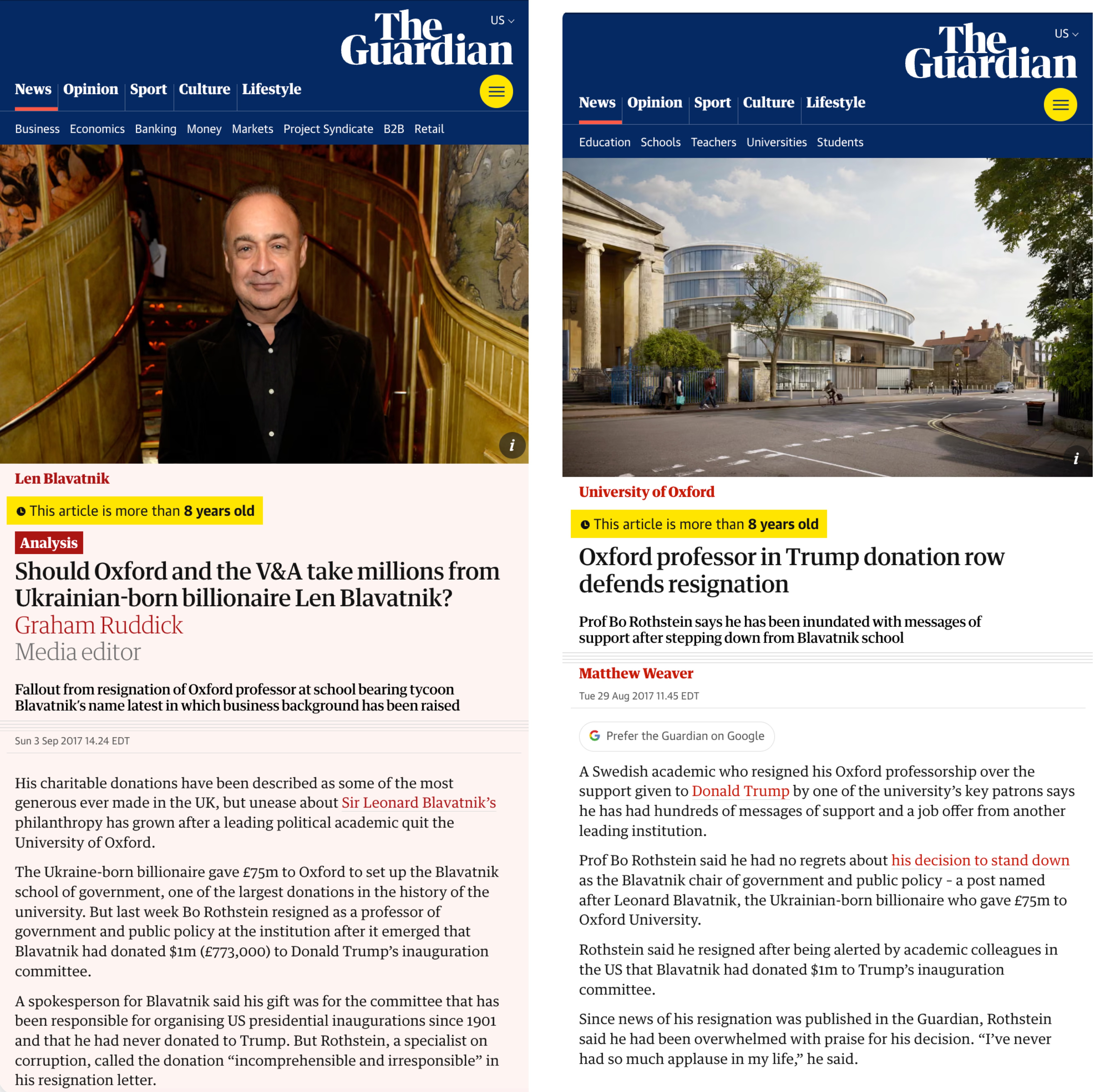
In August 2017, Bo Rothstein resigned his position as Professor of Government and Public Policy at the Blavatnik School in protest over Blavatnik’s $1 million contribution to Donald Trump’s inaugural committee. “I cannot give legitimacy and credibility to a person who is supporting Donald Trump,” he wrote in his resignation letter to Oxford’s Vice Chancellor Louise Richardson.
ProMarket, a publication of the George J. Stigler Center at the University of Chicago’s Booth School of Business interviewed him at the time, noting that “Rothstein is one of the most influential political scientists in the world today, having spent decades studying corruption and quality of government.”
Cherwell, Oxford’s student newspaper, obtained Rothstein’s letter on October 31, 2017, and published a story quoting it the following day:
“My duties as a teacher and supervisor have been cancelled. I have also been asked to vacate the responsibility I have had for the School’s weekly research seminar. And I have been asked not to appear in person at the School, and to vacate my office.
This policy of excommunication stands in conflict with the principles of academic freedom and freedom of expression.”
Rothstein told Cherwell that he had been “excommunicated” from the school and barred from his office and students after the resignation. The Blavatnik school disputed his characterization, calling his allegations “false.” NPR and The Guardian covered the resignation extensively.
Rothstein returned to Sweden.
Two years earlier, in November 2015, a group of academics, Oxford alumni, and Russian dissidents including physicist and human rights activist Pavel Litvinov had published an open letter in The Guardian urging Oxford to “stop selling its reputation and prestige to Putin’s associates,” as reported by the Oxford Student and covered in detail by Cherwell.
The letter was organized by Ilya Zaslavskiy, a specialist in due diligence, sanctions, and kleptocracy who holds an MPhil in International Relations from the University of Oxford. Zaslavskiy held positions in TNK-BP's international affairs and gas business units between 2006 and 2010 — the Blavatnik-Vekselberg-Fridman oil venture central to this piece — before being arrested by the FSB in March 2008 in what the Washington Post reported at the time was widely viewed as part of an effort to force TNK-BP's foreign partners out of the venture. The FSB initially accused Zaslavskiy and his brother of state treason; the charge was later downgraded to industrial espionage, and then to “failed attempt of industrial espionage,” before a 2009 trial that Zaslavskiy described as a show trial, which ended with a conviction and a sentence of two years of probation. More than 100 Western managers were forced out of TNK-BP during the same period, and TNK-BP's British CEO Robert Dudley was forced to leave the country.
Zaslavskiy has since served as head of research at the Free Russia Foundation, as a fellow at Chatham House, and as senior program manager at the Center for International Private Enterprise. He heads Underminers.info, a research project exposing Eurasian kleptocrats in the West, and has written research papers for the Atlantic Council, Hudson Institute, Martens Centre, and other leading think tanks. His April 2021 paper “Which Kremligarchs Should Be Sanctioned by the Biden Administration?” introduced the term Kremligarchs to describe a litany of individuals who “should be added to the US Treasury sanctions’ lists due to their close involvement in the Kremlin’s infrastructure designed to harm the US and its allies.”
In May 2022, CNN reported that a group of fifty-five American and European foreign policy experts and anti-corruption activists had written a letter in September 2019 to the board of the Council on Foreign Relations to protest CFR’s acceptance of a $12 million donation, stating that Blavatnik “uses his ‘philanthropy’ at leading western academic and cultural institutions to advance his access to political circles,” calling such giving a vehicle for “the infiltration of the US and UK political and economic establishments at the highest levels.”
CNN further contextualized the situation:
“Potanin […] isn’t the first or only oligarch to use his wealth to attempt to sway the opinion of Western elite. In fact, it’s a page straight out of an old American playbook.
Nineteenth century robber barons famously splashed their names across orchestra halls and museums to shed their reputations as ethically dubious industrialists who amassed enormous wealth on the backs of America’s most vulnerable. It worked: When most Americans hear the name Andrew Carnegie, they probably think of Carnegie Hall or Carnegie Mellon and not one of the deadliest labor confrontations in American history, which occurred at one of his steel plants in 1892.
[…]
In much the same way, Putin’s inner circle – many of whom are oligarchs who have profited off corruption and made their wealth in illicit ways – use philanthropy in the West to launder their reputations and gain access to American and European high society, according to experts.
Dartmouth sociology professor Brooke Harrington said oligarchs of any nationality typically target three kinds of institutions with their donations – cultural, political, and educational.”
These concerns predate the cyber dimension entirely. The question of whether Blavatnik’s money buys influence at Oxford has been debated since 2010. What has changed is the nature of the people now accepting his hospitality. When the school hosted political scientists and public policy scholars, the stakes were academic.
Now that it hosts the former heads of CISA and NCSC — people who possess the most sensitive knowledge about Western cyber defense — the stakes have become both a matter of national security and perceptions of the same.
What Comes Next
The Oxford Programme for Cyber and Technology Policy is expanding. Its inaugural Oxford Cyber Forum has already taken place in June 2024. Easterly has contributed to classes, seminars, and public events, including a panel at OxCTP’s Global Tech Policy Seminar Series alongside former Executive Vice President of the European Commission Margrethe Vestager. The program aims to “help governments navigate the cyber frontier and encourage the responsible adoption of emerging technologies.”
This is, on its face, valuable work. Democratic societies need thoughtful cyber policy. Academic institutions play an important role in developing it. The question is not whether this work should be done, but whether it should be done under the name and with the money of a single private individual whose financial biography includes partnerships with sanctioned Russian oligarchs, offshore entanglements with Russian government officials, and documented participation in coordinated influence campaigns.
There are other places where these leaders could have landed. Easterly is a West Point graduate who could have returned there, and nearly did. Martin could have joined any number of British universities or think tanks. Both chose, or accepted, the institution that offered the most prestige, the most resources, and the most ambitious cyber policy program, which happens to be the one funded by Len Blavatnik.
The individual decisions are rational, but the systemic outcome warrants scrutiny.
When a single billionaire with documented Russian oligarch ties funds the academic home of both the American and British cyber chiefs, the school that trains future government leaders, and a cyber research center jointly operated with the Israeli Prime Minister’s Office, the resulting structure is not a conspiracy. It is something more durable: an institution. Institutions do not need to conspire. They shape behavior through incentives, access, and prestige, and they outlast any individual appointment.
The question for policymakers, for the intelligence community, and for the public is whether this particular institution, with this particular funding source, in this particular configuration, is something Western democracies should be comfortable with, or whether the concentration of cyber leadership under a single private benefactor represents a structural vulnerability that no one has been willing to name at the intersection where it matters most: the pipeline of departing cyber chiefs into a single donor-funded institution.
Correction, April 9, 2026: An earlier version of this piece described Ilya Zaslavskiy as “a former Russian politician.” Zaslavskiy is in fact a specialist in due diligence, sanctions, and kleptocracy who held positions in TNK-BP's international affairs and gas business units between 2006 and 2010 and was prosecuted in 2008-9 in what the Washington Post reported at the time was widely viewed as part of an effort to force TNK-BP's foreign partners out of the venture. The reference has been updated. I regret the error.