

On July 1, a new Florida law voided contracts and rewrote a chunk of the state’s criminal code. It extinguished decades of municipal friendship with cities abroad. If you’re, say, a Chinese green card holder in Miami hoping to build a family through surrogacy, word of this may reach you through a call from your fertility clinic, which as of this month cannot write you an enforceable contract because Florida now files your family plans under national security.
Lawmakers named it the Foreign Interference Restriction and Enforcement (FIRE) Act. It moved through the Legislature as HB 905 and collected Governor Ron DeSantis’s signature on May 8. While hostile foreign governments are the advertised target, its reach runs to legal immigrants decades into their Florida lives and to protesters whose politics irritate a prosecutor. Even students got swept in; a public school’s exchange program with a partner classroom abroad is terminated the moment it runs through an agreement with the wrong country’s institutions.
Nothing this sweeping has ever passed in any state under a banner of national security. It passed anyway, 86 to 20 in the House and 28 to 11 in the Senate, over objections that never had the votes to matter and never found much of an audience beyond the chamber.
Give the law’s defenders their due; the threat they describe really does exist. Beijing runs influence operations against American state and local officials; the FBI has been saying so for years, and the United Front Work Department that Florida’s new ethics training calls out by name is a functioning arm of an authoritarian party. Foreign intelligence services recruit sources here and move money here, and exiled dissidents are harassed on American streets by the governments they fled. A state stocked with ports and research universities has honest reasons to want defenses, and counterintelligence is real work that somebody has to do.
What this law does to that mission is the problem. Handed a genuine threat, Florida reached for tools that will hurt bystanders and let the connected off with a slap on the wrist, borrowing along the way from the procedural habits of the closed and oppressive societies it claims to oppose.
An open society that copies its enemies’ paperwork has lost the plot.
Here is what the FIRE Act does, in plain terms.
Fifteen years for a state of mind
Deep in the Act sits a new criminal statute, section 775.08255.
Any crime on Florida’s books, from petty theft up through the gravest felony, can be upgraded one full level of severity if a prosecutor chooses to charge it that way and persuades a jury it was committed “for the purpose of benefiting, promoting, or furthering the interests of” a foreign government or terrorist organization. The statute’s operative word is “may.” Nothing about the enhancement is automatic; it is an option sitting on the desk of each of Florida’s twenty elected state attorneys, and identical conduct by two defendants can end fifteen years apart depending on which of them the state decides deserves it. The mandatory minimum is not reserved for the worst cases: it attaches to any first-degree felony or life felony under the section, so a second-degree felony reclassified upward walks straight into a fifteen-year floor beneath which a judge cannot go.
Review the trigger for this crime. Actual espionage isn’t required, and neither is foreign money or so much as an email to a foreign agent; the enhancement turns on purpose, a state of mind, and the statute never explains what is specifically involved in “furthering the interests” of a foreign government.
Actual adversaries aren’t required. Elsewhere in the text, the law confines itself to seven named “countries of concern” (China, Russia, Iran, North Korea, Cuba, Venezuela under Maduro, and Syria), but the criminal enhancement borrows a wider definition, sweeping in every government on Earth.
Even Canada counts.
Run the scenario. A demonstrator at a Gaza protest gets arrested for blocking a road, the sort of charge that normally ends in a fine, and a prosecutor argues the act was meant to further a foreign government’s interests. Suddenly, the misdemeanor has grown teeth, and what fed it was the defendant’s politics. Against that outcome, the statute’s text offers no obstacle. American history, with its vague security laws and inconsistent enforcement, offers no comfort. Mandatory minimums sharpen the danger by shifting sentencing power from judges to prosecutors, who can now dangle fifteen years over a defendant until a plea looks rational, even to the innocent.
Serious espionage statutes read differently. Federal law goes after conduct, acting at a foreign power’s direction or concealing foreign funding, and describes what spies do. Florida’s enhancement describes nothing at all. Hanging fifteen years on a thought suggests less a confident democracy hunting foreign agents than a nervous one hunting its critics.
Twenty elected state attorneys now have this weapon within reach. Whoever gets charged first will tell us what it was built for.
Your passport, your family
The cruelest provision is also the one that broke the bill. HB 905 moved through its committees unanimously, 16 to 0 in the House and 11 to 0 in the Senate, a national-security package both parties could sign. Then the surrogacy amendment arrived on the floor, and the coalition cracked along its seam. Democrats objected that the language had never been vetted by adoption or surrogacy attorneys and could reach families adopting from countries like China; Senator Tina Polsky protested that lawmakers had heard zero expert testimony and had no way to understand the complexity of the agreements they were about to void. They were outvoted, the amendment stayed, and the bipartisan bill became a party line bill. The objections were made, recorded, and then amplified by no one: no national civil-liberties organization, no editorial board outside Florida, no institution with the reach to make a legislature care.
Losing an argument is ordinary. What happened here is that the argument was held in an empty room.
What the amendment did: surrogacy contracts and preplanned adoption agreements are banned for anyone who is a citizen or resident of a country of concern, and such contracts are now “void and unenforceable” in Florida as a matter of official public policy.
Citizen or resident. Under that wording, a Chinese intelligence officer and a Chinese-born cancer researcher, twenty years in Tampa with a green card and a tax bill heavier than most legislators’, stand equally barred. So does a Cuban citizen in Hialeah, the city with the highest concentration of Cuban Americans in the country. Whether a couple may build a family through surrogacy, an option open to every other Floridian, now hangs on their passports. No hearing gets offered and no individual assessment made, and nowhere does the law account for what threat to anyone’s security a surrogacy contract could conceivably pose.
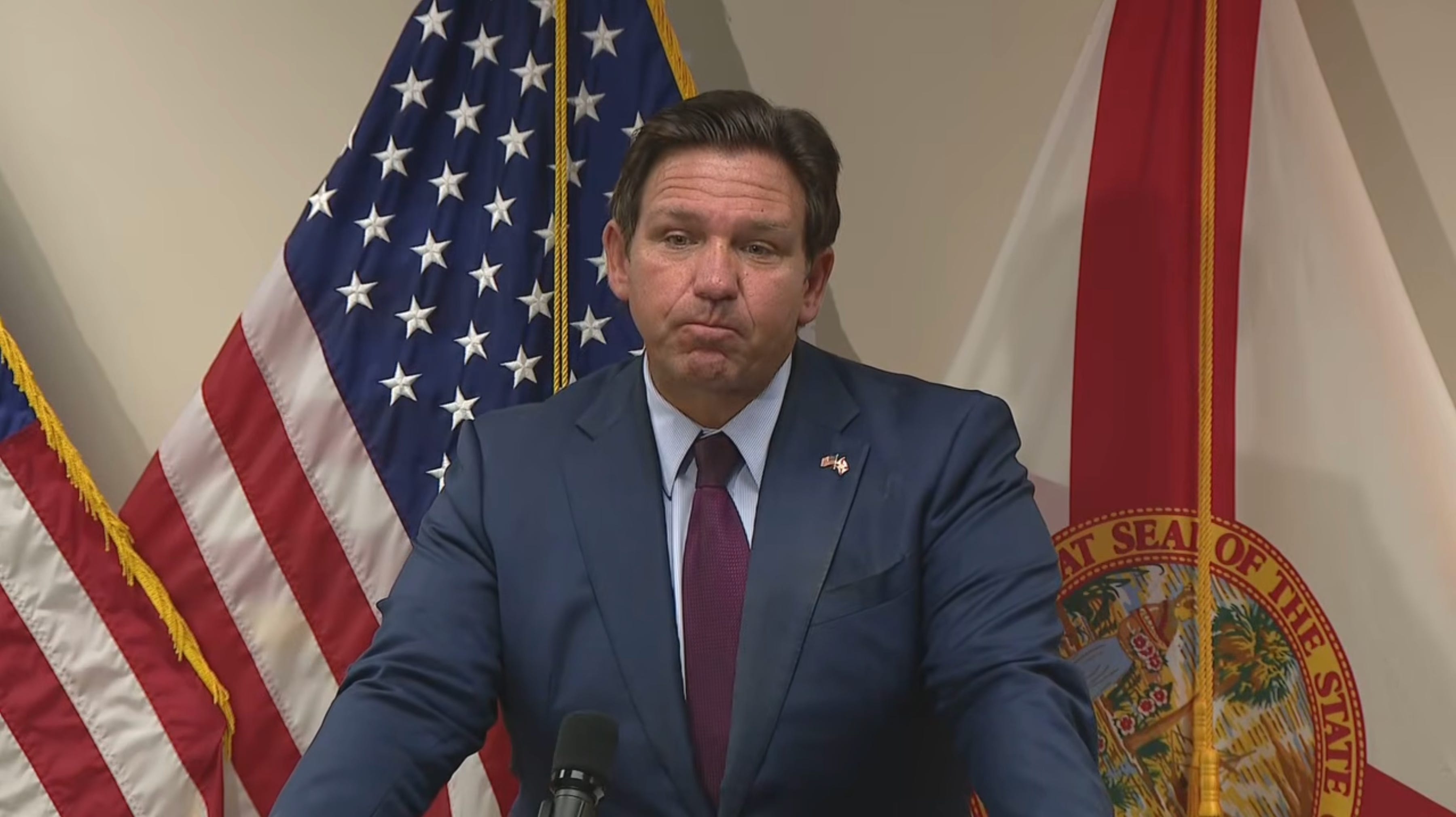
The legislative record never explains it, but the Governor did, at the signing, in his own words:
“I know we’re hoping that the Supreme Court is going to interpret the 14th Amendment so that we can put a stop to some of the people that are coming here for a month, having birth, and then going back to China.
That’s part of an operation. Why would we let that that happen and grant citizenship under those circumstances?”
There is the provision’s purpose, stated by the man whose signature enacted it: not espionage or infrastructure, but birth and the citizenship it confers.
The state said the quiet part at the podium.
Security policy that can’t sort a spy from a taxpayer has stopped being security policy and become something else wearing the uniform. It also kneecaps its own mission because the immigrants it punishes are frequently the very people who fled these regimes, and their rough handling by American governments makes propaganda gold for Beijing and Havana. Each green card holder turned away from a Florida clinic amounts to a talking point manufactured free of charge on behalf of those regimes.
The idea behind the provision has a long pedigree — none of it flattering. A century ago, states wrote alien land laws to keep Asian immigrants from owning property. These statutes are now taught as a national embarrassment. Florida exhumed that logic in 2023 with SB 264 to restrict land ownership by citizens of these same countries; Chinese immigrants sued with ACLU backing, calling the law racial exclusion in national security costume. That challenge died in November 2025, when a divided federal appeals panel ruled the plaintiffs lacked standing to sue and left the law in force without ever deciding whether it was constitutional; the plaintiffs folded their case soon after. No court has upheld this architecture on the merits, and no court has been permitted to examine it. Florida read the silence as permission and extended the design from property into parenthood.
First they came for the house. Now they’re back for the family.
Diplomacy, deleted
Elsewhere, the Act proceeds by amputation. Every agreement between a Florida public body and a country of concern, sister-city relationships included, died by operation of law on July 1; cultural exchanges that outlasted the Cold War were unwritten by a single statutory sentence. Grants from those countries or from entities they control are now off limits to school districts and cities alike.
University “linkage institutes,” assembled over decades to trade students and commerce with partner countries, can no longer legally touch a country of concern, and the Florida-China Institute was struck from state law altogether. And yes, these institutes deliver foreign soft power; that is what cultural diplomacy is. So does every Fulbright and every Alliance Française classroom, and the exchange runs both ways, with Florida’s own soft power riding out on every student it sent abroad. Influence of that kind operates in daylight, which is exactly what the covert operations the FBI warns about are built to avoid. A law that cannot tell an exchange program from an influence operation has the same defect as one that cannot tell a spy from a taxpayer.
Officials caught accepting something of value from those countries’ agents on an understanding that their official actions would be influenced, which is to say caught taking a bribe from a hostile foreign power, owe back double its worth. Not prison or removal from office, but a refund at a penalty rate. It remains one of the few provisions pointed at people holding actual power rather than immigrants without any, and it treats them the most gently. Come November, every Florida official’s ethics training must cover foreign influence campaigns, with the Chinese Communist Party’s “United Front” strategy named in the statute itself.
I am no fan of Beijing, but when a state law starts quoting think tank vocabulary, someone ought to ask whose pen produced the draft.
Sister-city termination bills have been a signature product of State Armor, a hawkish group most Floridians have never heard of. State Armor is the creation of Michael Lucci, a political operative the Wall Street Journal has called “China’s biggest adversary in U.S. statehouses.” His group launched in early 2024 with a blessing from Robert O’Brien, Trump’s former national security advisor, and applause from the chairman of the House select committee on the Chinese Communist Party, and it arrived carrying more than a dozen model bills and three model executive orders ready for any legislature that wanted them. The catalog runs from stripping Huawei hardware out of state telecom networks to barring Chinese companies from state procurement, from foreign-agent registries to land restrictions near critical infrastructure, and on to a “Pacific Conflict Stress Test” inviting states to wargame a Taiwan crisis, which Nebraska adopted first. Lucci has worked legislatures across the country since founding the group, and by this June he was in front of Congress testifying about his wins in Nebraska and Texas.
Ask who pays for all this, and the answers thin out. State Armor discloses no funder list. Tax filings reviewed by Responsible Statecraft show the group has been financed largely by the Concord Fund, a nonprofit tied to Leonard Leo, the conservative legal activist best known for steering the federal judiciary rightward through a web of anonymously funded organizations.
So an outfit crusading against covert foreign influence in American statehouses declines to say whose money powers its own campaign of influence, and the paper trail that does surface runs to the most sophisticated dark-money network in American politics.
Lucci appeared before the Florida House Judiciary Committee in February to testify in support of HB 905, warning of vulnerabilities tied to foreign-controlled technology, on the record and on camera. Florida’s Voice wrote up the testimony approvingly; among outlets with any distance from the project, only the Orlando Sentinel examined the group’s role. The connection between the model-bill shop and the statute is not a buried thread some reporter had to pull. It is a public record that the national press never bothered to read. Florida outsourced a piece of its foreign policy to an out-of-state pressure group that will not name its funders, the group’s founder said so from a witness chair in Tallahassee, and the Legislature never blinked.
One provision requires a close read. Should Washington change Cuba’s diplomatic status, the Governor may suspend Florida’s Cuba restrictions by executive order, though the power is smaller than it sounds. Any suspension dies when the Legislature next adjourns, it cannot be renewed or extended, the same statute cannot be suspended twice without lawmakers’ express blessing, and the authority itself is repealed on October 2, 2028 unless reenacted. Still, this narrow valve exists for exactly one of the seven countries of concern, the one whose diaspora votes extensively in Florida elections, and its expiration date sits comfortably inside the current presidential term.
Six adversaries got a wall, while Cuba was given a wall with a door.
Nobody was watching
How does a law like this pass in our third largest state without becoming a national story? Not for lack of consequence, as it attaches years of prison time to a defendant’s beliefs and sorts family rights by birthplace.
Yet, as of this writing, the Associated Press, Reuters, the New York Times, the Washington Post, and Politico have run no dedicated coverage of it. The local press did its job in pieces: the Miami stations covered the signing, Florida Politics and Florida Phoenix tracked the votes, the public-radio affiliates explained the surrogacy ban to anyone listening. What never arrived was the national desk. The bill traveled through committee under the eyes of Florida’s shrunken statehouse press corps, wire service and metro papers that have shed half their staff in a decade, and local journalism’s collapse presented its invoice. Laws that would once have commanded a correspondent’s full attention now pass without national notice, and that half-light, local coverage without national consequence is the light in which provisions like the surrogacy ban grow best.
Special mention goes to one outlet that embraced the Act warmly.
The Epoch Times, the Falun Gong-affiliated media empire whose brand rests on exposing Chinese Communist influence, cheered the law along. Its former chief financial officer, Weidong “Bill” Guan, was indicted by federal prosecutors in 2024 over an alleged scheme to launder at least $67 million in criminal proceeds, much of it stolen unemployment benefits, into company accounts. Prosecutors say his team bought crime money with cryptocurrency and rinsed it through accounts opened under stolen identities while the company’s reported revenue leapt roughly 410 percent in a year. Guan pleaded not guilty and the company suspended him; prosecutors have noted that the charges sit apart from the outlet’s journalism. His trial was last on the calendar for May 2026. A media company allegedly fattened on laundered fraud proceeds, lecturing the country about foreign financial infiltration, stands as the purest artifact this whole story coughs up.
The groups you’d expect to man the barricades have supplied the loudest silence. When the land law passed in 2023, the ACLU and Asian American civil-rights organizations mobilized inside a month. HB 905 reaches even more deeply into private life on the same discriminatory logic, and so far the coalition has said nothing specific about it. Triage is the likeliest interpretation; the same organizations spent two years litigating the last Florida law only to be turned away at the courthouse door on standing, and are rationing themselves for a legal system that punishes overreach.
Meanwhile, immigrant Floridians have been left to discover their new legal standing one voided contract at a time.
The test ahead
Enforcement is where laws confess, and two confessions are pending. Watch who draws the first prosecution under the sentencing enhancement; if the fifteen-year hammer lands on a protester or a student first rather than an actual foreign operative, no further commentary will be needed. And watch for the first family broken on the surrogacy ban, some lawful resident turned away over a passport who will make an uncommonly sympathetic plaintiff in front of a federal judge.
None of what I’ve said here argues against countering foreign interference. A state serious about the problem could fund counterintelligence coordination with federal task forces and drag foreign money in state politics and universities, where the influence problem lives, into daylight. Diaspora communities could be better shielded from the transnational repression that genuine foreign agents seek to inflict; a Chinese or Cuban dissident in Florida stands in more danger from Beijing or Havana than any legislator ever will. A law along those lines would deserve support, not least from the people this one targets.
Florida chose otherwise by assembling a miniature security state that aims downward at immigrants and protesters while officials who profit from foreign influence get a seminar and a repayment schedule.
Trace the lineage of that choice and you arrive not at counterintelligence but at the alien land laws, loyalty oaths, and the long American tradition of nativism dressed up as security. Provisions that will wreck real lives took effect largely unopposed because the institutions we have built to catch such things, the national press and the civil liberties bar, happened to be facing the other direction.
Florida has become a foreign country of concern in its own right, the kind where sweeping security laws pass without debate and the people underneath them find out afterward.
I appreciate you bringing this to everybody's attention. As a Floridian myself, one who's especially attentive to the asinine laws that this state proposes and far too often passes, I hadn't even heard about this law. I regularly support and donate to the Florida ACLU, Common Cause, and others here, as well as join their webinars and zoom meetings when I can and even I heard nothing about this specific law.
What makes this far more concerning still is when you take what this law enacted and combine it with what HB1471 just set in place, conveniently starting 4 days ago as well. I'm attaching a quote of of the short AI summary of that bill as a reply to this comment to give people an idea just how awful it truly is. When you add its provisions together with the bill you wrote about here, it becomes significantly more alarming.
As far as passing blatantly unconstitutional laws, this white Christofascist controlled state wrote the book. They know that our state Supreme Court is stacked with Federalist Society groomed, Desantis appointed hacks who will proudly greenlight any plainly unconstitutional garbage they pass. Therefore, they pass them and hope that any would-be plaintiffs will be unable to afford to sue and survive through all the appeals.
The little carve out for Cuba, just this one time, is par for the course. Finally, Jason Garcia's Substack 'Seeking Rents' is an amazing source for everything related to Florida legislation, budget, dark money, and corruption.