

On May 1, 2020, at 11:11 in the morning, Elon Musk tweeted five words that vaporized $13 billion in Tesla’s market value before lunch. “Tesla stock price is too high imo.” The stock cratered 10.3% in hours. Just days earlier, the company had posted a strong quarter.
On a Saturday in November 2021, he asked his 62.5 million Twitter followers whether he should sell 10% of his stake. They said yes. The following Monday, $60 billion vanished. Over the next five days, $200 billion more followed.
In December of that same year, he debuted a haircut that social media immediately likened to a style associated with 1930s European fascist movements. Tesla fell 11.3% in three days while the Nasdaq recovered.
In July 2024, on an earnings call, he told shareholders who doubted his vision to sell their stock. They obliged: Tesla dropped 12.3% in a single session, 3.4 times the decline of the broader tech sector.
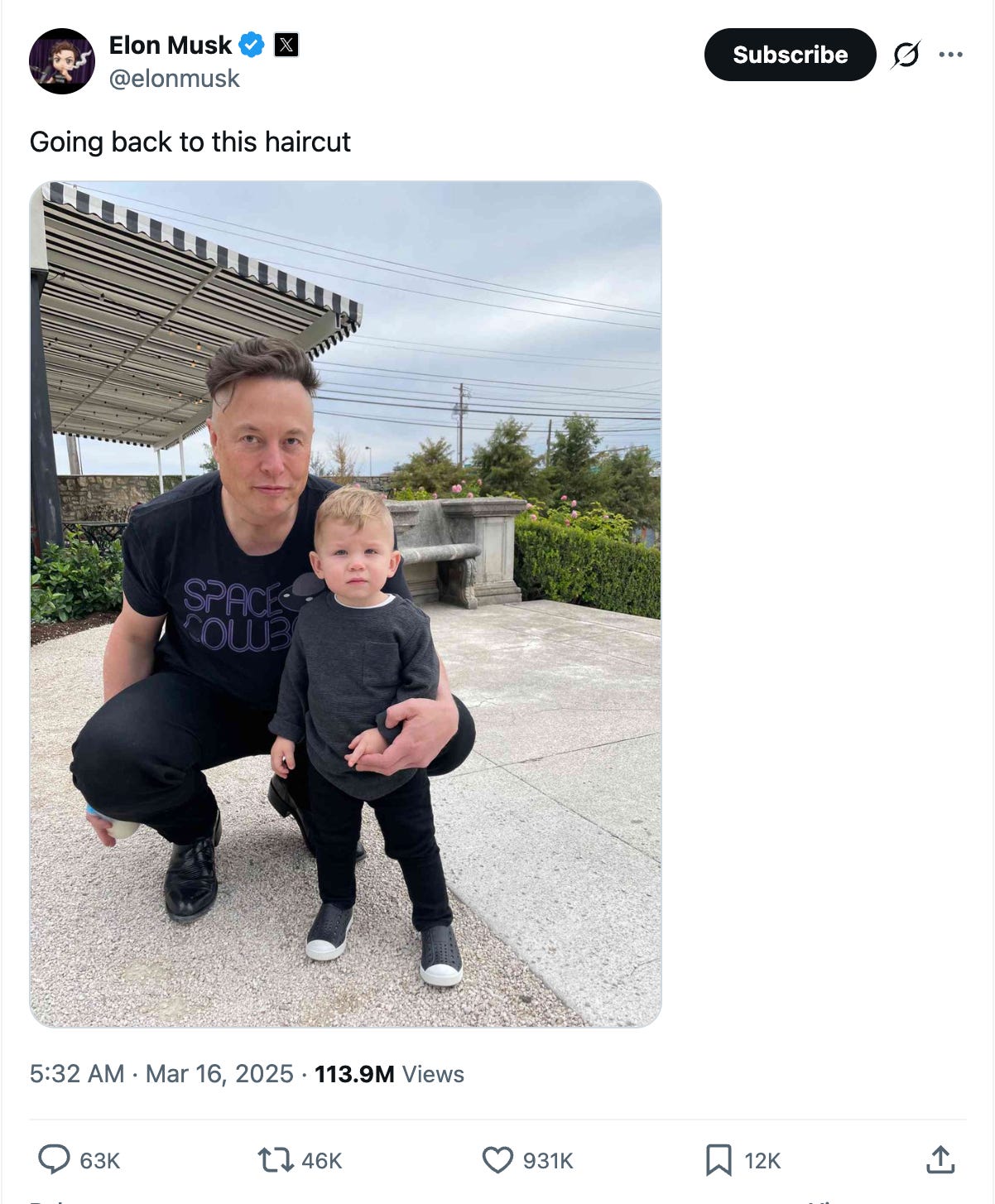
Last March, he tweeted that he was “going back to this haircut,” attaching a photo of the 2021 look. Tesla fell 4.8% the next trading day while the broader market was up.
I used two separate AI models to assist me in analyzing each of these events against market benchmarks while isolating Tesla’s stock performance from broader index movements to suss out what portion of each decline was attributable to Musk’s behavior, not macroeconomic conditions. My methodology here is simple: compare Tesla’s returns against the Nasdaq-100 (QQQ) and S&P 500 (SPY) over one-day and five-day windows following each signal. Any gap between Tesla’s performance and the benchmark highlights an idiosyncratic move where the market was punishing Tesla specifically, not tech stocks or equities in general.
The cumulative toll across five qualifying events: roughly 35 percentage points of excess loss against the Nasdaq. I make the case that this is not attributable to earnings misses, interest rate hikes, or competitive pressure from BYD, but to the public conduct of one key man.
On March 20, 2026, a nine-member federal jury in San Francisco found that Musk had made materially misleading statements to investors during his Twitter acquisition, in violation of Section 10(b) of the Securities Exchange Act and SEC Rule 10b-5. The jury awarded approximately $2.1 billion in stock damages, with potentially $500 million more in options losses still to be resolved. In closing arguments, plaintiffs’ attorney Mark Molumphy told the jury that Musk’s tweets were not innocent mistakes but were “carefully calculated to drive down” Twitter’s stock price. The jury found him liable for misrepresentation on two of three challenged statements and rejected the broader claim that he had engaged in a deliberate scheme to defraud.
That verdict, partial as it is, reframes everything that came before it.
The Anatomy of a Clean Signal
Not every Musk provocation qualifies. Tesla is a volatile stock, and much of its movement on any given day tracks broader tech sector dynamics or responds to legitimate business catalysts: delivery numbers, margin compression, Federal Reserve policy. The question is not whether Tesla’s stock goes down after Musk says something inflammatory but whether it goes down more than the rest of the market in a way that only Musk’s conduct can explain.
I set the bar conservatively. To qualify for this analysis, an event needed to produce an excess return of at least negative 5% against QQQ within one trading day. Events where Tesla declined roughly in lockstep with tech stocks were discarded, regardless of how dramatic the drop looked in isolation. The filter eliminated a number of candidates, including Musk’s April Fools “Tesla Goes Bankrupt” tweet in 2018 and his Hertz deal skepticism in November 2021. It also eliminated the current March 2026 selloff, which, severe as it has been, is substantially explained by macro weakness: the Nasdaq fell 5.2% over the same window, leaving Tesla with only 2.3% of excess decline, and the jury verdict on March 20 introduced a second concurrent catalyst that makes the signal impossible to isolate cleanly.
Five events survived the cut. Together, they tell a story about how the world’s richest man communicates with markets.
“Tesla stock price is too high imo”
May 1, 2020.
The tweet arrived mid-session, part of a barrage that included “Selling almost all physical possessions” and lines from the national anthem. Tesla had been trading at roughly $760. Within minutes of the 11:11 AM post, it fell below $700. It closed down 10.3%.
The Nasdaq dropped 2.8% that day on COVID-related uncertainty. The S&P fell 2.6%. Tesla’s excess loss against QQQ was 7.5 percentage points, meaning the broader market explained less than a third of the decline.
The rest belonged entirely to Musk.
What makes that episode instructive is the recovery. Within five trading days, the stock had recouped all the losses, and then some. The market absorbed the tweet as a one-off disruption, limited to a CEO mouthing off — nothing structural. But the 7.5% excess loss on the day itself is unambiguous. A CEO publicly called his own stock overvalued, and the market repriced accordingly, in minutes.
Musk later testified under oath, during the “funding secured” trial in January 2023, that his tweets do not move Tesla’s stock price. He pointed to this exact episode as evidence, noting that the shares recovered. Three years later, in a different courtroom and a different case, a jury in Pampena v. Musk found that two of his tweets about the Twitter acquisition constituted material misrepresentations under federal securities law.
His defense that these posts were harmless and ephemeral, without predictable market consequences, has now been tested before a jury and found wanting.
The Twitter Poll
November 6-7, 2021.
The cleanest signal in the dataset, and one that deserves a close read.
On a Saturday afternoon, Musk posted a poll to Twitter: “Much is made lately of unrealized gains being a means of tax avoidance, so I propose selling 10% of my Tesla stock. Do you support this?” Over 3.5 million accounts voted. 57.9% said yes. Musk pledged to abide by the result.
On Monday, Tesla fell 4.8%. By Friday, it was down 15.4%.
The S&P 500 was up 0.1% on that Monday. The Nasdaq was essentially flat, down one-tenth of a percent. The 14.5% excess five-day loss against QQQ is the largest in the dataset. Every point of it belongs to Musk, and Musk alone.
Beneath the performance art lay a drier reality. SEC filings show that Musk had established a 10b5-1 pre-arranged trading plan in September 2021, two months before the poll, to sell shares tied to stock options expiring in August 2022. He was going to sell these shares regardless of any poll. He told the Code Conference in September that “a huge block of options will sell in Q4.”
The poll created the appearance of a democratic, crowd-sourced decision for a course of action already set in motion.
One more thing. Kimbal Musk, Elon’s brother and a Tesla board member, sold 88,500 Tesla shares on November 5 across 14 separate tranches at prices averaging roughly $1,229 per share, for a total of approximately $108.8 million. The Form 4 was filed with the SEC that same evening at 9:22 PM Eastern.
The poll went up the next afternoon.
The filing contains no notation indicating the sales were made under a pre-arranged Rule 10b5-1 trading plan. Kimbal’s later Tesla stock filings, in April 2023 and November 2024, prominently state that transactions were effected pursuant to a 10b5-1 plan. The November 5, 2021 filing carries no such language, and the SEC noticed. The Wall Street Journal reported in February 2022 that the agency had opened a formal investigation into whether Kimbal’s sale constituted insider trading. Elon’s public response was that his brother “wasn’t aware” of the poll, but that Tesla’s lawyers did know about it.
That distinction made between familial awareness and corporate-counsel awareness is the kind of parsing that securities attorneys are likely to remember.
The Haircut
December 1-3, 2021.
Accepting that a CEO’s hairstyle can function as a market-moving event requires a certain flexibility of mind. The data, at any rate, is uncooperative with skeptics.
Musk appeared at The Wall Street Journal’s CEO Council event in early December 2021 sporting a look that broke sharply from his usual style: closely shaved sides, a longer swept-over top. Social media responses ranged from Gary Oldman’s villain in The Fifth Element to less charitable historical comparisons. Musk responded to the attention with a laughing emoji and the claim that he had cut it himself.
By Friday, December 3, the haircut had gone viral. Tesla fell 11.3% from its November 30 close. Volume on that Friday spiked 58% above normal levels.
The immediate objection is that the Federal Reserve was turning hawkish at the same time. Jerome Powell had testified before the Senate on November 30 and retired the word “transitory” from his description of inflation. True enough. The Nasdaq fell 2.7% over the same November 30 to December 3 window. Then, over the five-day window through December 10, the Nasdaq recovered and finished up 1.1%. The S&P finished up 3.3%. Tesla kept falling, posting a negative 12.2% excess return against QQQ over that span. The Fed’s actual policy announcement, the accelerated taper and three projected rate hikes for 2022, did not come until the FOMC meeting on December 15, two full weeks after the selloff began.
The market was punishing Tesla for something it was not doing to tech stocks broadly. And that haircut was no isolated gesture. It was the visible edge of a political alignment that was about to become explicit.
On Thursday, December 16, Musk casually replied to an email from The Babylon Bee, a right-wing satire site whose content has been documented by Ohio State researchers as among the most shared factually inaccurate material on social media, inviting their team to Austin “this weekend.” On Sunday, December 19, Babylon Bee CEO Seth Dillon, Editor-in-Chief Kyle Mann, and Creative Director Ethan Nicolle flew to Austin and sat down with Musk for a rambling, hundred-minute interview covering “wokeness,” Elizabeth Warren, and the Metaverse. The next day, Monday, December 20, Tesla hit its monthly low: $299.98 — a 17.8% drawdown from the haircut’s debut.
The interview was published on YouTube and as a podcast on December 21 and 22. In it, Musk told the hosts he had sold “roughly 10%” of his Tesla holdings and was “almost done.” The stock, which had closed at $312.84 on December 21, surged to $355.67 by December 23. The Bee Weekly recap, released December 24, confirmed the Sunday recording date, with Nicolle noting it had worked out around a Disneyland trip because “we interviewed him on Sunday.”
The selling did not actually stop. SEC filings show Musk sold approximately 934,000 shares on December 21, another 934,000 on December 22, and a final 934,090 on December 28, when the Form 4 explicitly stated: “THIS RULE 10b5-1 TRADING PLAN WAS COMPLETED ON DECEMBER 28, 2021.” Nearly 2.8 million shares were sold after the interview was recorded and after the stock hit its bottom. The 10b5-1 plan ran on its pre-arranged schedule regardless.
The stock recovered anyway, surging 13.7% in two days on the strength of the “almost done” statement alone. The market did not wait for the selling to actually finish; it heard the signal and repriced. What moved the stock was not the cessation of sales but the communication that cessation was imminent, a forward-looking announcement delivered through a media channel that would reach Tesla’s most devoted retail holders. The selling continued for another week. The market did not care as it had heard what it needed to hear.
Tesla closed the year at $352.26, roughly where it started the month. Tesla closed at $365.00 on December 1, 2021, the day the haircut debuted. On March 27, 2026, it closed at $361.83. Within three dollars.
After four years and three months, the stock has gone nowhere.
“They should sell their Tesla stock.”
July 23, 2024.
During Tesla’s second-quarter earnings call, Musk did something that, to my knowledge, no other sitting CEO of a publicly traded company has ever done on a recorded investor call: he told shareholders to sell.
“I recommend anyone who doesn’t believe that Tesla would solve vehicle autonomy should not hold Tesla stock,” Musk said. “They should sell their Tesla stock.”
The next day, Tesla dropped 12.3%. The Nasdaq fell 3.6%. The S&P lost 2.3%. Tesla’s excess loss against QQQ: 8.7 percentage points. Volume spiked 50%.
The quarter itself was weak, with declining automotive margins that were widely expected. Weak quarters alone do not produce 8.7 points of excess decline. The broader tech selloff explains about 30% of the move, with the remaining 70% as the market pricing in the spectacle of a CEO issuing an explicit sell recommendation for his own company.
Musk operates under a 2018 SEC consent decree, amended in April 2019, that requires him to have an experienced securities lawyer pre-approve public communications on an enumerated list of topics before he posts them. That list includes Tesla’s financial condition, production numbers, projections about the business, and “events regarding the company’s securities.” An explicit recommendation to sell Tesla stock, tied to a forward-looking projection about autonomous driving capability, falls squarely within at least two of those categories. The decree remains in force: Musk moved to terminate it in 2021, was denied by Judge Liman in SDNY in 2022, lost the appeal at the Second Circuit in 2023, and petitioned the Supreme Court in Musk v. SEC (No. 23-626) without obtaining relief.
No enforcement action followed the earnings call statement, just as none had followed the “stock price is too high” tweet in May 2020, which Musk told the Wall Street Journal was not vetted in advance by Tesla counsel. The SEC declined to comment to WSJ on the May 2020 tweet. No contempt motion was filed, nor was any sanction issued. Compliance Week ran a piece at the time headlined “Elon Musk again tests SEC with ‘stock price is too high’ tweet,” framing the episode as a test of the agency’s willingness to enforce. Reuters, summarizing the pattern in 2022, was more blunt: in its faceoff with Musk, the SEC had “blinked.” Columbia law professor John Coffee told CNN he did not expect repercussions, viewing the tweet as opinion rather than factual misstatement. The SDNY docket confirms there is no entry in 2020 referencing the May 1 tweet, no show-cause order, and no contempt proceeding.
A consent decree that is never enforced obviously functions less as a constraint and more as a decoration.
“Going back to this haircut”
March 16, 2025.
Thirteen months after the earnings call, with Tesla shares having already lost 48% of their value from a January 2025 high of $428.22, Musk posted the photograph of himself and his son from the December 2021 period with the caption: “Going back to this haircut.” The tweet went up at 5:32 AM Eastern on a Sunday morning. X reported it received 113.9 million views.
Monday, Tesla fell 4.8%. The Nasdaq rose 0.6%. The S&P rose 0.8%. The excess loss against QQQ was 5.4 percentage points, clearing the threshold. Unlike every previous signal, though, the five-day excess was negligible. The stock was already so beaten down from the DOGE backlash and the collapse of European sales that the marginal damage was absorbed within days.
Two features of this signal set it apart from its predecessors.
First, Musk owns X. He controls its algorithms, its trending mechanics, its content distribution pipeline, and the view-count metrics that the platform reports to the public. No independent body audits how X calculates or displays view counts, and Musk has a documented history of altering platform mechanics to amplify his own content. When X reports that a market-moving tweet from its owner reached 113.9 million accounts, that figure should be understood as a claim made by the interested party, not a verified measurement. The count may well reflect engineered amplification with distribution tuned to ensure saturation of financial media and institutional investor feeds.
Then there is the timing. The 2020 “stock price is too high” tweet went out at 11:11 AM on a Friday, causing a real-time intraday crash that at least gave traders the chance to react in the moment. The haircut callback went out before dawn on a Sunday. By Monday’s open, every financial outlet had covered it. Institutional risk desks had run their models, options market makers had adjusted their quotes, and algorithmic trading systems had processed the signal through Sunday evening futures. Monday’s open was a fait accompli.
Retail investors, who cannot trade pre-market and rely on liquidity available during market-hours to exit positions, bore the full brunt of a gap-down that institutional participants had a full overnight window to position themselves around.
The Pattern
Five signals over five years. Each is structured differently, but all share a set of features that, taken together, do not appear purely impulsive.
Insider positioning precedes the signal. In the Twitter poll case, Kimbal Musk liquidated $108.8 million in Tesla shares across 14 tranches on November 5, filed the Form 4 at 9:22 PM that evening, and the poll went up the next afternoon. His filing carried no 10b5-1 safe-harbor language, unlike his later Tesla sales in 2023 and 2024 which did. The SEC opened a formal investigation into whether the trade constituted insider trading. During the December 2021 haircut period, multiple insiders were executing sales. By early 2025, Tesla board members and executives had offloaded over $100 million in shares across a matter of weeks, with board chair Robyn Denholm alone moving $558 million worth of stock since 2020. After insiders sell, the signal drops.
Every qualifying signal produced a volume spike. The smallest was 12%, the largest 58%. These are not retail panic-sell volumes. Spikes of that magnitude indicate institutional participation: pension funds, index rebalancers, risk-parity models, hedge fund desks, all responding to the same trigger simultaneously. The signal is not aimed at day traders on Reddit; it is aimed at the algorithmic layer of the market that treats CEO behavior as a quantifiable risk input.
The signals hit hardest near highs. The Twitter poll and the haircut debut, both issued when Tesla hovered near its all-time highs around $400 (split-adjusted), produced 14.5% and 12.2% excess five-day losses respectively. The March 2025 tweet that was issued when the stock sat at $250 barely left a mark beyond the first day. A signal aimed at triggering corrections from elevated levels, where the most value can be extracted by anyone positioned short or holding puts ahead of the event, would behave exactly this way.
Each signal is deniable. “Stock price is too high” is just an opinion. The Twitter poll was about his taxes. The haircut is just a haircut. The earnings call was actually about strategic conviction. “Going back to this haircut” is a simple joke about grooming. The signals he drops come wrapped in a layer of plausible deniability thick enough to keep regulators at bay but thin enough for anyone paying attention to read the message. Deniability is not a flaw in the signal; it is the actual mechanism by which the signal operates. And consider: Musk’s 2018 consent decree with the SEC requires pre-approval of communications about Tesla’s financial condition, securities, or projections. A tweet about a haircut does not appear on that list. The two signals in this dataset that produced the largest excess losses against the Nasdaq, the haircut debut at 12.2% and the haircut callback at 5.4%, are the two that most cleanly evade the decree’s enumerated categories. Draw your own conclusions.
The distribution channel is now captive. When Musk tweeted “stock price is too high” in May 2020, Twitter was an independent platform with its own algorithms and editorial decisions. He was broadcasting through someone else’s infrastructure. After the October 2022 acquisition, every subsequent signal has been distributed through a platform he owns outright. Algorithmic amplification, trending curation, view-count reporting, etcetera — Musk controls all of it. No independent check exists on whether his posts receive preferential distribution, and there is no third-party verification of reported engagement metrics.
The man who moves markets with his posts also owns the printing press.
What the Jury Said
On March 20, 2026, nine days after Musk’s latest haircut-related post began circulating, a nine-member federal jury in San Francisco returned its verdict in Pampena v. Musk, the class action shareholder lawsuit over his 2022 Twitter acquisition. After nearly four days of deliberation, they delivered a split decision.
The jury found Musk liable under Section 10(b) of the Securities Exchange Act and SEC Rule 10b-5(b) for two specific tweets: his May 13, 2022 statement that the Twitter deal was “temporarily on hold,” and a May 17 tweet claiming the deal could not proceed without bot data. Both were found to be materially misleading. A third challenged statement, made on a podcast, was deemed opinion and not actionable. The jury rejected the plaintiffs’ broader theory under Rule 10b-5(a) that Musk had engaged in an intentional “scheme to defraud” investors.
Damages rose to approximately $2.1 billion in stock losses, with plaintiffs’ attorneys estimating an additional $500 million in options losses for a potential total near $2.6 billion. Shareholders are set to receive between $3 and $8 per share per day for the class period. Musk’s attorneys at Quinn Emanuel announced an appeal immediately, called the verdict “a bump in the road,” and noted the jury had “found both for and against the plaintiffs and found no fraud scheme.”
The plaintiffs’ attorney Joseph Cotchett told reporters afterward that the verdict “sends a strong message that just because you’re a rich and powerful person, you still have to obey the law, and no man is above the law.”
The significance reaches well beyond the acquisition of Twitter and well beyond the two counts on which Musk prevailed. For the first time, a federal jury had examined specific tweets by Elon Musk under the framework of securities fraud and concluded that two of those constituted material misrepresentations made with the requisite mental state. They did not find a coordinated scheme, but they did find that individual tweets, standing alone, were false enough and consequential enough to warrant billions in damages.
None of that proves the five Tesla sell signals documented above were intentional misrepresentations.
A verdict about Twitter shares does not establish liability for Tesla share movements. It does, however, resolve a predicate question that Musk has contested in courtrooms for nearly a decade: does he understand that his public statements move stock prices, and does he make them with awareness of their consequences? Nine jurors heard his defense and rejected it on two out of three counts.
The proposition that Elon Musk posts without understanding what his posts do to stock prices is, as of March 20, 2026, something a jury weighed and declined to believe.
The Cumulative Cost
Across five qualifying events, measured conservatively against the Nasdaq-100, Musk’s public actions have produced approximately 35 percentage points of idiosyncratic loss in Tesla’s stock. These are not losses caused by the Federal Reserve, Chinese competition, declining EV demand, or any of the dozens of legitimate headwinds that every automotive company faces. They are losses caused specifically and measurably by the CEO’s tweets, statements, and personal aesthetic choices in periods where the broader market was flat or rising.
At Tesla’s current market capitalization of roughly $1.4 trillion, a single percentage point of movement represents approximately $14 billion in shareholder value. The math is approximate, because the market cap has fluctuated over the five-year period in question, but the order of magnitude speaks for itself.
This accounting captures only the five cleanest events. It leaves out the slow bleed of the DOGE period, when Tesla’s association with Musk’s political activities cost the stock roughly half its value from December 2024 to April 2025. It leaves out the dozens of smaller provocations that fell below my methodology’s 5% excess threshold, as well as the opportunity cost of investors who exited Tesla entirely because they could no longer stomach Musk’s governance style.
What it does capture, rigorously and defensibly, are five moments when the wealthiest individual used his public platform to communicate something to the market, the market responded with overwhelming and precisely timed selling pressure, and the rest of the market did not.
What Comes Next
Tesla’s next earnings call is scheduled for April 28, 2026.
Musk has signaled that capital expenditures will exceed $20 billion this year, more than double the 2025 figure. Automotive revenue fell 10% last year. The company is discontinuing the Model S and Model X. The robotaxi fleet operates only about a dozen vehicles in Austin with human safety chaperones riding side-saddle. The Cybercab, which has no steering wheel, is supposed to begin production in April and expected to reach volume production by year’s end.
The Pampena v. Musk verdict will be appealed, and Quinn Emanuel will argue that a mixed decision vindicates their client. Despite this framing, the factual core of the jury’s finding stands until it is overturned: two tweets by Elon Musk constituted material misrepresentations under federal securities law, and they cost shareholders billions. For anyone holding TSLA, the question is no longer whether the CEO’s public behavior affects the stock — The data settles that. The question is whether the next signal has already been sent.
Tesla closed at $361.83 on March 27. That is just $3.17 away from where it stood on December 1, 2021, the day Elon Musk debuted a Hitler Youth-style haircut and the market started selling.
Some patterns repeat because the underlying conditions recur. Others, because someone wants them to.
Jackie Singh is an information security professional and investigative journalist.
This analysis is based on publicly available market data, SEC filings, court records, and contemporaneous media reporting. It does not constitute investment advice. All price data has been split-adjusted.
The fact that this South African immigrant, and his equally reprehensible immigrant buddy, have grossly enriched themselves off of our tax dollars, our infrastructure, and our labor, while simultaneously using their taxpayer funded fortunes to decimate American discourse and democracy should have every American demanding their immediate exile.
Instead, we have millions who literally worship these soulless, neofascist con-artists like they're gods. In that regard, that type of pathetic and pitiful behavior perfectly mirrors that which propelled Trump to power twice.
Until regular Americans wakeup and recognize that the sociopathic, billionaire grifters that they worship are actually the ones with their steel toed boots buried deeply in their necks, I fear nothing here will ever improve...