

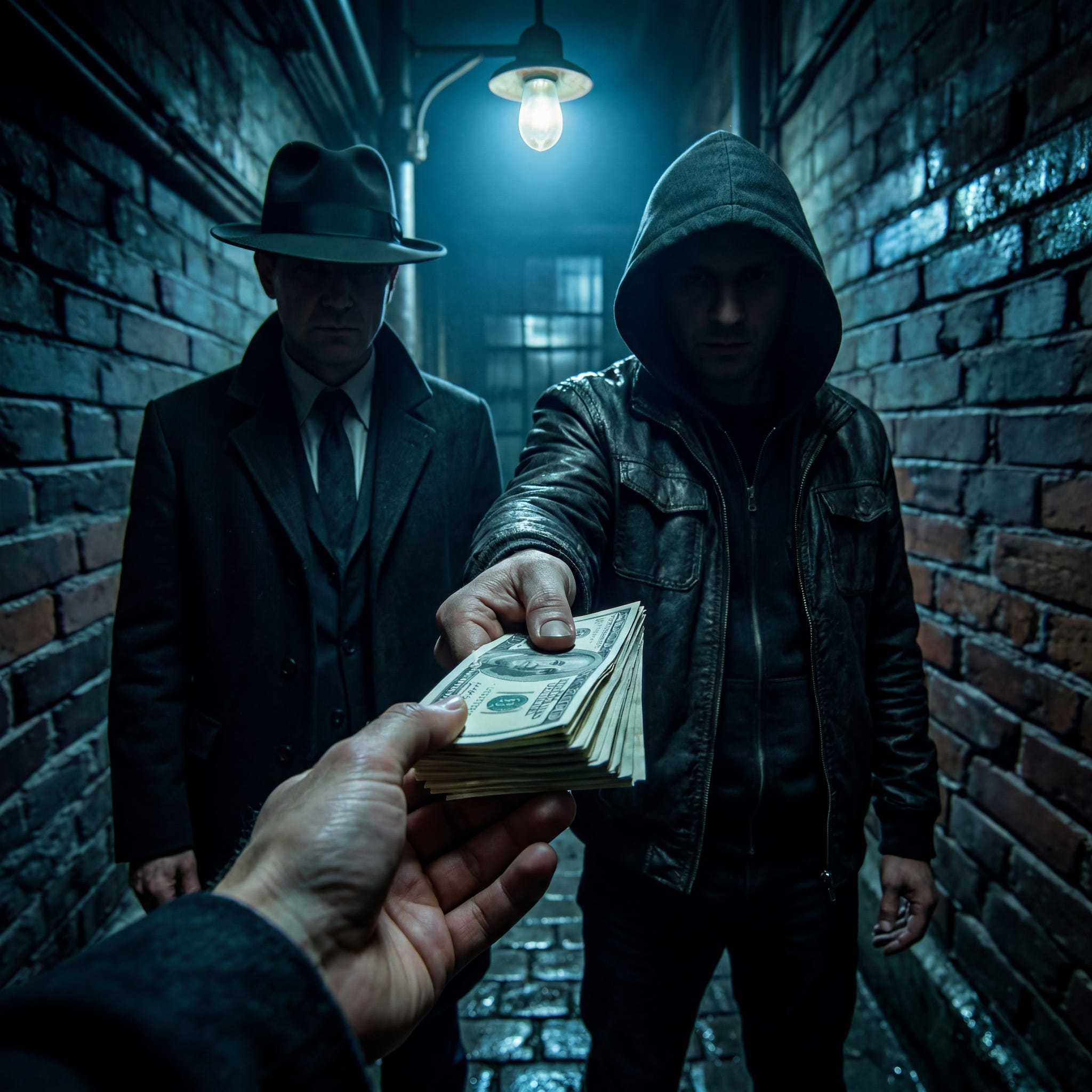
A federal grand jury in the Southern District of New York handed up an indictment on September 4, 2024, charging two employees of the Russian state broadcaster RT with routing close to $10 million, by way of offshore shell companies, to a Tennessee outfit called Tenet Media. Tenet in turn paid a roster of American conservative commentators (Tim Pool, Dave Rubin, Benny Johnson, and others) to make videos for YouTube and X. One contract called for four weekly videos in exchange for $400,000 per month, plus a $100,000 signing bonus. Of the roughly 2,000 videos the company posted, not one disclosed a Russian connection. Its founders, the indictment alleges, assured each other in private that their “investors” were “the Russians,” even while telling everyone else the money came from a European financier who did not exist, one Eduard Grigoriann.
The case landed only because RT sat at the top of the chain, and the Foreign Agents Registration Act was written precisely to expose anyone working in this country for a foreign principal. Swap RT for an American billionaire who pushes the same money through the same shells and hides his hand from the commentators and their audiences in just the same way, and nothing happens. No statute is available. FARA falls away the instant the principal is domestic. The Federal Election Commission has twice studied the adjacent problem and twice walked away from it. By 2025, the very agencies that might have closed the gap by rule had been pared back or left unable to function.
Hidden foreign money is a felony; identical hidden domestic money is perfectly lawful. The distinction shapes the whole modern business of paid persuasion. Its domestic half is almost certainly the larger one, and the one no law on the books seems to reliably touch.
At the FEC, the relevant verb has been to decline. Its December 2023 “Technological Modernization” rulemaking refused to require disclaimers on paid political content that operators place on influencers’ own social media accounts. An influencer posting to her own feed, the majority reasoned, resembles a celebrity volunteering an endorsement to a fan base more than she resembles “paid advertising,” even though, as the two Democratic commissioners noted in a separate statement, the campaign cuts her a check the same way it cuts one to a staffer. Ellen Weintraub and Shana Broussard called the result a missed “golden opportunity” to write rules that would reach “behind-the-scenes payments to social media influencers.” Payments of that kind, the majority concluded, fall outside the statutory category of a regulated “public communication.”
None of this is an aberration. When the Commission updated its internet-disclaimer rules in 2022, three commissioners attached statements to an otherwise bipartisan order to make a point of preserving the old “small items” and “impracticability” carve-outs for the online world. Chairman Allen Dickerson and Commissioner Trey Trainor cast those exemptions as backstops suited to a medium where the favored advertising platforms turn over from one election to the next; Commissioner Sean Cooksey, concurring, called those exceptions “critical to maintaining regulatory flexibility for political campaigning online.” Add the two rulemakings together and a good deal of small paid online advertising carries no disclaimer obligation whatsoever, while the practical disclosure floor for paid influencer posts on personal accounts hovers near zero.
In hindsight those two refusals stand as the last fully functioning decisions the Commission would make. It lost its policymaking quorum on the first of May 2025, and by October only two of six seats were filled, short of the four votes the law requires before it can open a case, issue a rule, or hold a hearing. One of the empty chairs belonged to Weintraub, the Democratic chair whom the President had purported to fire by letter in January 2025 and whose seat he has left vacant since. A 2025 petition from the Campaign Legal Center, asking the Commission to do the one thing at issue here and require disclaimers on paid influencer content, now sits with no one able to grant or deny it. The two nominees the President finally sent to the Senate in February 2026, Ashley Stow and Andrew Woodson, are both Republicans, slotted into the two Republican vacancies; he advanced neither the Democrat that congressional leaders had recommended nor anyone for Weintraub’s seat. Their confirmation would restore a bare quorum, though a working Commission would only find itself back at a definitional question it has answered twice already, both times against disclosure.
In the space between that indictment and the Commission’s current silence lies the largest unpoliced channel of paid political persuasion in American life. Tenet was catchable because of the foreign state sitting at the top of it; FARA exists to reach agents who serve a foreign principal. Strip the foreign principal out and you are left with the wider phenomenon, the domestic operator who buys the look of independent civic speech, and that phenomenon has no apparent home in any existing regime. FARA cannot touch a purely domestic principal. The FEC, having begged off twice, now lacks the votes to do anything at all. The Federal Trade Commission polices commercial endorsements, not candidate advocacy or issue speech. Wire- and mail-fraud statutes demand a scheme to obtain money or property, an element covert influence rarely supplies. Campaign-finance disclosure fastens onto committees and expenditures rather than onto the paid speaker who dresses an expenditure up as personal conviction.
A narrow federal crime could fill the gap, though not the crime people usually reach for. Outlaw “disinformation” and you build the very machinery for adjudicating truth that the First Amendment shuts down; conscript the platforms to police contested speech, and you make the problem worse. Missing from the toolkit is a statute aimed at deception about who is paying, one that reaches covert paid influence in a handful of high-stakes settings when it travels alongside knowing or reckless falsehoods of fact. A law like that has to clear serious First Amendment review, steer wide of both the dragnet and the censor’s office, and fit without friction against Section 230, FARA, and the campaign-finance statutes. The constraints are real. Not one of them is fatal.
The gap itself is well charted, and nearly every map ends at the same destination: disclosure. The Brennan Center and the Campaign Legal Center have pressed the FEC to make campaigns label the influencers they pay; the Harvard Law Review has worked out how a disclaimer rule might reach sockpuppets and boosted posts; bills from the Honest Ads Act to the REAL Political Advertisements Act would widen online-ad transparency; and states from Texas to California have written influencer-disclaimer laws of their own. Alicia Wanless has shown how thoroughly the influence industry is built for deniability while FARA’s penalties barely sting. The reflex everywhere is to compel a label rather than write a crime, and the leading election-law scholarship, Richard Hasen’s included, is right to be wary of any freestanding offense of disinformation.
Where a criminal idea does surface, it chases a different lie. The Deceptive Practices and Voter Intimidation Prevention Act would punish a materially false claim about an endorsement, but only when it is deployed to keep someone from voting, and the recent run of state deepfake statutes reaches deception about what a candidate appears to have said or done. Neither touches the deception at issue here, which is not about the ballot or the medium, but about who is paying.
That opening is the one the statute I propose here is built to fill. It leaves disclosure to handle the ordinary case and, above it, adds a narrow criminal layer for the operator who hides his paymaster and lies on the paymaster’s behalf when the stakes run highest.
Where FARA Stops
Congress passed FARA in 1938 to drag Nazi propaganda, then moving through American front men, into the open, and the law works by forcing attribution. Anyone operating inside the United States on behalf of a foreign principal, whether by lobbying, running public relations, or pushing out informational material, must register and lay bare the relationship, the work performed, and the money behind it. FARA assumes, reasonably enough, that a listener deserves to know when a voice that sounds homegrown is really carrying water for a foreign government, a party, or some other foreign principal.
For decades the statute mostly slept. The Mueller investigation woke it, and a run of criminal cases followed through the back half of the 2010s and into the 2020s, among them the superseding indictment of Senator Robert Menendez in October 2023, the prosecution of Linda Sun in September 2024, and Tenet. In the Biden administration’s closing weeks the Justice Department pressed the advantage, issuing a Notice of Proposed Rulemaking on January 2, 2025, the first real rewrite of the FARA regulations in close to twenty years, which set out to shrink the “commercial” exemption, rework the labeling rules for “informational materials” so they fit a world of social-media distribution, and widen the statute’s reach considerably.
The new administration changed course within weeks, though not by killing the rule outright. The January NPRM was expressly spared from the automatic-withdrawal sweep of Inauguration Day’s regulatory freeze, and when the Department scrapped dozens of pending rulemakings in a September 2025 deregulatory purge, it pointedly left the FARA rule off the list. It had survived the purge only to be left for dead. The Department posted the public comments, said nothing further, and let the rule sit in limbo. Around it, the enforcement posture shifted hard. In February 2025 Attorney General Pam Bondi circulated a memorandum steering the FARA Unit toward “civil enforcement, regulatory initiatives, and public guidance” and narrowing criminal cases to conduct resembling traditional espionage by foreign-government actors, all of which represented a pronounced step back from the prosecutions of the preceding years. The FBI’s Foreign Influence Task Force, stood up in 2017 to chase precisely the species of operation Tenet turned out to be, was disbanded. For the foreign-operation cases it had been built around, a statute eight years in the rebuilding was, almost overnight, sheathed.
Sheathed, but not for long, and not for everyone. On September 25, 2025, the President issued a National Security Presidential Memorandum titled “Countering Domestic Terrorism and Organized Political Violence,” NSPM-7, that switched FARA back on and aimed it somewhere new. The memo directs investigations under FARA of non-governmental organizations and American citizens with close ties to foreign governments, agents, foundations, or influence networks, and it landed the same day the Department announced a FARA-flavored inquiry into the Open Society Foundations. The redirection cut straight against Bondi’s own limiting instruction. The cases the FARA Unit had been told to drop were the foreign-operation prosecutions; the cases now urged on it run toward domestic nonprofits and the President’s political opponents. Inside a single year the same statute was narrowed against the next Tenet and pointed at the administration’s adversaries. The enforcement power has been redirected toward whichever targets the party in power prefers.
The PAID OFF Act, which would void the trade and Lobbying Disclosure Act exemptions whenever the foreign principal is a government formally designated an adversary, remains a bill and not a law. And the limits that matter most are older than any of this churn; they sit in the architecture of the statute itself. FARA needs a foreign principal to bite. It compels registration and disclosure, backed by civil and criminal penalties for staying quiet, but does not forbid covert paid influence as such. Hand the Tenet fact pattern to a domestic backer, and FARA simply has nothing to say — and no other federal law steps in to demand disclosure. The 2023 FEC ruling drives it further. Dress the same money up as express electoral advocacy and, so long as the influencer posts from her own account rather than paying for placement, no disclaimer is owed.
Tenet also shows how little reaching a foreign operation can amount to. The indictment charged two RT employees who sit in Moscow and will never stand trial here, and it charged no one in the U.S. — not the commentators the government calls victims, and not the company that paid them. That asymmetry is the model. Foreign operations hire domestic talent precisely so the visible speakers are Americans, insulated from the foreign principal and often kept ignorant of it, which is the configuration FARA handles worst. Criminal FARA has to prove the speaker knew he was acting for a foreign principal, and a deceived front man or a walled-off cutout defeats that proof; the foreign string-puller is reachable in theory while the domestic hands doing the actual talking almost never are. An offense that turns on the hidden paymaster rather than on his nationality reaches the witting domestic middleman missed by FARA: the organizer who knows there is concealed money behind the message and buries it, whether that money is foreign or domestic. It leaves the genuine dupe alone, which is the one place FARA and this proposed statute already agree.
No account of why FARA exists can justify drawing the line at the water’s edge. Our stake in knowing who is paying to move American opinion does not shrink because the payer banks in Delaware instead of a foreign bank.
The Supreme Court recognized exactly this stake in Citizens United v. FEC. Striking down limits on independent expenditures, it nonetheless kept disclosure intact, reasoning that “transparency enables the electorate to make informed decisions and give proper weight to different speakers and messages.” Disclosure has the Court’s blessing. The statutes and agencies meant to carry it out have not kept pace with the way persuasion now travels online, and in the last year several of them have actively run the other way.
💡 The next two sections work through the legal objections to a statute like this, the First Amendment first and platform-liability law after. The short of it is that the offense punishes the concealed payment, not the message it pays for, and that line is what keeps it constitutional.
Readers content to take that on trust can skip to "Building the Case Without Building a Dragnet" and lose nothing essential.
Clearing the First Amendment
United States v. Alvarez sets the outer wall, and a proposal like this one has to reckon with more than that wall. The Alvarez plurality voided the Stolen Valor Act because falsity, standing alone, enjoys constitutional protection, and because punishing it in the abstract hands government a power the First Amendment denies it. Justice Breyer, concurring on narrower ground and supplying the controlling rationale, got to the same place through intermediate scrutiny, finding the law too loosely drawn. Each opinion warned against statutes that turn prosecutors loose to pick which lies to punish with no limiting principle anchored to real harm.
A tougher precedent for any covert-influence statute is Susan B. Anthony List v. Driehaus. The 2014 ruling turned on standing, a unanimous Court holding that you can mount a pre-enforcement First Amendment challenge to a political-false-statement law once the prospect of enforcement grows imminent enough. Back before the lower court on remand, the Sixth Circuit threw out Ohio’s statute on the merits, and kindred laws elsewhere have met much the same end. Ohio did not run afoul of the Constitution by wanting to punish lies. It ran afoul by the machine it built to do the punishing, an elections commission authorized to rule on the truth of contested campaign claims through a process that spat out chilling probable-cause findings before the votes were cast and handed partisan complainants a cudgel. The Court’s quarrel was with the machinery, never with the aim.
Lamont v. Postmaster General belongs in the conversation as well, since critics reach for it whenever the government burdens the flow of speech from abroad. Lamont killed a federal statute that ordered the Postmaster General to hold incoming “communist political propaganda” and forward it only if the addressee asked in writing, and it announced a First Amendment right to receive information, propaganda included. None of that bears on what is proposed here. Lamont was about the state physically interrupting delivery to a willing reader. The offense proposed here restricts nothing on its way to an audience; it punishes concealed sponsorship joined to a knowing falsehood, both of which land on the sponsor and on the speaker who knows full well she is lying to her audience about where her words come from. Produce the speech and circulate it with the sponsorship disclosed, and the reader’s right to receive it stays perfectly intact. Even so, the statute ought to spell out a recipient-side safe harbor putting beyond doubt that no liability runs to the audience, a belt-and-suspenders matter of drafting rather than constitutional command.
Read together, those cases counsel discipline rather than surrender. Four features carry the weight.
First, the heart of the offense is covert paid agency rather than falsehood. A speaker is not on the hook for getting facts wrong; the wrongdoing is hiding that an undisclosed principal is paying for the words. Consider the decade’s loudest liar. Juries assessed well over a billion dollars against Alex Jones over the Sandy Hook falsehoods, and the statute would still leave him untouched, because he fronts for no hidden principal and conceals no paymaster; he sells supplements to the audience he deceives in plain sight. Defamation law reached him, which is what defamation law is for, and a statute that also caught Jones would have become the disinformation crime this one refuses to be. Ohio’s campaign-lies statute makes a poor cousin here. The nearer kin are FARA, the FTC’s endorsement rules, and a body of commercial-speech doctrine built on the premise that an audience has a right to know when it is being sold to. Zauderer v. Office of Disciplinary Counsel let the government compel factual disclosure in commercial speech under a forgiving rational-basis-plus standard. Outside the commercial context the review stiffens, as NIFLA v. Becerra and Americans for Prosperity Foundation v. Bonta show, yet each of those decisions involved forcing disclosure of ideological content or of who one associates with, a far cry from disclosing that a sponsor cut the check. From Button down to Bonta, the Court has held one line steady: compelled attribution passes muster when it serves a concrete governmental interest and is drawn narrowly enough to spare protected association. Sponsor disclosure on paid political speech meets that standard however one reads the cases. Free Speech Coalition v. Paxton, handed down in 2025, hints that the Court is recalibrating its scrutiny for content-based rules pegged to particular harms, though that holding sticks to sexual material and minors and travels no further into political speech.
Holder v. Humanitarian Law Project pulls more weight for this proposal than the precedents trotted out in most disinformation arguments. The Court there sustained a criminal statute against a First Amendment attack for one overriding reason, that the speech in question was coordinated with a designated foreign entity instead of offered up as independent advocacy. Chief Justice Roberts, writing for the majority, separated speech delivered on behalf of a foreign principal from speech a person makes on her own hook, and held that the coordination is what opens room for regulation independent advocacy would never permit. That split is the foundation FARA stands on, and it is why the foreign-principal half of today’s gap poses so little difficulty. It does the domestic half a favor too. The Court blessed the idea that paid coordination with a hidden principal is a different creature, constitutionally, from independent political speech, and nowhere does Holder hinge on the principal’s being foreign in any way that would block the same reasoning when a domestic principal hides his role just as thoroughly. So the proposal rests mainly on the transparency-and-attribution logic the Court has embraced from Buckley through the disclosure holding in Citizens United, the logic that does the heavy lifting, and consigns Holder’s compelling-interest framing to the foreign setting it was built for.
Second, the falsity element borrows directly from New York Times v. Sullivan and the cases after it. To count, a statement must be a verifiable assertion of fact made in knowing or reckless disregard of its falsity, leaving opinion, rhetoric, hyperbole, and the ordinary coloring of political talk safely outside. For sixty years the actual-malice standard has set the bar for defaming a public figure and has turned back First Amendment challenge after challenge. Dropping it in here saddles the government with the same exacting mens rea the Court insists on wherever the truth of political speech is what decides liability.
Third, the trigger is drawn tight. Liability reaches only communications tied to an election, to a foreign-interference operation, or to one of a short list of statutorily named public-health or public-safety emergencies, the settings in which hiding the sponsor matters most. Run-of-the-mill political commentary never comes near it. Take sponsorship and disclose it, and you have a complete defense. Pay openly and you commit no crime; nor does the speaker who was herself fooled about where her money came from, which, by the government’s own telling, is the situation most of the Tenet commentators were in.
Fourth, and this matters most, the case is made out of money and relationships, not out of what was said. Driehaus taught the lesson by counterexample, since Ohio’s regime collapsed the moment it let any complainant with a grievance set enforcement in motion by alleging a lie. Here a file cannot be opened because a clip went viral or read as inflammatory or cut against the party in power. It opens only on hard transactional facts, a payment, a contract, money threaded through shell companies, a false filing, an instruction from principal to speaker preserved in their correspondence. A bank ledger can start an investigation; a microphone cannot. The reach stops at cases where there really is a hidden principal, and prosecutors get no license to go fishing on the strength of speech alone.
None of which renders the law uncontroversial. A fresh federal crime sitting astride speech and election administration is going to draw lawsuits, and Eugene Volokh has made the sharpest case against it, arguing that compelling attribution in political speech warrants far more suspicion than compelling it in a commercial transaction, and that any regime of this sort invites selective enforcement against speakers the government dislikes. His is the objection worth taking most seriously, and the answer to it is built into the structure rather than talked around. Because an investigation can begin only from transactional evidence, prosecutors never get to open a case on the say-so of speech; because the gravamen is concealment of the sponsor, the government never has to prove what was true. An offense framed that narrowly parts ways with the political-false-statements laws the courts have invalidated. It parts ways, too, with the Stolen Valor Act that Alvarez rejected, a law that punished naked falsity with no nod to sponsorship, to deception about source, or to any concrete civic harm.
Section 230 and What Platforms Actually See
Section 230 of the Communications Decency Act shields interactive computer services from being treated as the publisher or speaker of information “provided by another information content provider.” Courts have construed that shield generously ever since the Fourth Circuit’s 1997 ruling in Zeran v. America Online, and the Supreme Court left it standing by implication when it disposed of Gonzalez v. Google on other grounds in 2023.
For the most part, this proposal lands outside Section 230 altogether. Its target is the speaker and the concealed sponsor, not the platform acting as a conduit for what users post. The one duty it would lay on platforms, holding onto business records for the paid-sponsorship transactions they broker or process themselves, attaches to the platform’s own behavior, not to anything a user uploaded. Courts have said again and again that obligations rooted in a platform’s first-party conduct fall outside Section 230 entirely. Doe v. Internet Brands shows how it goes. The Ninth Circuit let a failure-to-warn claim move forward because the duty grew out of what the platform itself knew, not out of user-generated content, and the same reasoning carries over to a record-preservation duty pinned to the advertising and sponsorship deals platforms already document.
A word about what platforms can actually see, because that is what dictates where a case like this gets built. Hardly any covert paid influence runs through a platform’s advertising API or its official creator-payout program. Money travels elsewhere, by wire and ACH, in invoices dressed up as consulting or licensing or production work, and increasingly in stablecoins and other cryptocurrency, often funneled through companies chartered in places where nobody has to say who owns them. The platform only ever sees the finished product, the video or the post or the livestream. The cash rarely shows up on screen.
Tenet illustrates the pattern almost too neatly. The $9.7 million did not show up tagged as a political ad buy. It traveled from RT through shell companies in Turkey, Mauritius, and the United Arab Emirates, landed in a Tennessee LLC’s account, and flowed back out to the commentators’ production firms, all of it papered over as routine commercial business, down to a bookkeeping entry, reproduced in the indictment, for the purchase of an iPhone. The hiding happened where the money was laid down, well below the layer where the content went up. By the time the clips surfaced on YouTube and X, the platforms could see nothing that set them apart from a thousand ordinary creator channels.
Two things follow for anyone serious about the problem.
The first concerns where the proof lives, and it is not in platform data. It lives in bank records, in corporate-registry filings, in the beneficial-ownership data FinCEN gathers under the Corporate Transparency Act, and in the back-and-forth between a hidden principal and the middleman who hires and pays the talent. Those records establish agency and concealment, and they are the very files the Justice Department already pulls in its money-laundering and FARA cases. Strip away the speech and a covert-influence prosecution is, mechanically, a financial-crime prosecution whose end product happens to be words. The second thing is a difficulty better admitted than glossed: shell layering, nominee owners, crypto rails, all of it exists to beat precisely this kind of tracing, and beneficial-ownership reporting has lately been cut back in scope and enforced unevenly besides. Promise that the paper trail is easy to follow and you will be promising more than the facts allow. Truer to say that a trail, when it can be traced at all, runs through ledgers and registries rather than through anything anyone said on camera.
All of which doubles as the reply to the fear that this statute would turn into a speech-surveillance tool. An enforcement model that starts from money cannot be set off by a post that goes viral or offends or annoys the powerful, for the plain reason that none of those is a financial record. Concealed money in motion is the predicate. Frame the crime that way and the speech enters the case only after the money has, never before.
An earlier draft of this proposal asked the big platforms to build a “paid sponsor” attribution feature that speakers and sponsors could use to satisfy their disclosure duties. That requirement has been struck from this version. Moody v. NetChoice holds that content moderation is itself expressive activity under the First Amendment, and the lead opinion sweeps widely enough that a clever litigant could recast a mandated design feature as compelled expression. Better to sidestep the whole fight. Liability under this statute falls on the speaker and the sponsor, and a sponsor bent on compliance has tools in hand already, plain-text disclosure in the post chief among them. Leaving the platform question open simply acknowledges that Moody remains unsettled, and keeps a speaker-sponsor statute from having to fight that doctrinal battle on its own.
Two more guardrails belong in the design. The statute cannot saddle platforms with a duty to guess at or enforce the sponsorship status of what users post; that road leads straight back into Section 230, and it would rebuild the content-adjudication regime the whole proposal exists to avoid. Neither should the statute set up anything resembling notice-and-takedown for political speech. Notice-and-takedown is a wholly different mechanism, its chilling effects exhaustively documented in the DMCA fights, and it grows more hazardous still once political speech is the subject. The platform’s job comes to this and no more: keep your own transaction records, and answer lawful process aimed at specific operations.
A demand drawn that narrowly lives comfortably inside Section 230 as the courts read it, and inside the compelled-disclosure case law of the First Amendment.
Building the Case Without Building a Dragnet
The gravest objection to any criminal law that brushes up against speech is that it will end up trained on opposition politicians, on dissidents, on journalists, on the groups that make up civil society. The worry is earned. Counterterrorism powers passed after September 11 were turned, again and again, to ends their authors had sworn off at enactment. FARA carries its own checkered history, including registration demands aimed in the 1960s at civil-rights activists whose so-called foreign principals were flimsy at best. A proposal worth taking seriously has to treat that danger as something to design against, not a debating point to wave away. And the past year, in which the power to pursue influence operations has been switched on and off along nakedly partisan lines, drives the worry home.
That evidence trigger is the first line of defense, and it carries most of the load; an inquiry opens from concealed money in motion and from nothing a speaker said. A second line has to come at the investigative stage. Since the money sits off-platform, the tools are the familiar ones from money-laundering and FARA work, subpoenas to banks, demands for corporate records, grand-jury process served on the intermediaries, and, where it fits, FinCEN’s beneficial-ownership data. Reaching past that into private messages, into platform records beyond the transaction logs, into wallet histories or subscriber identities, ought to take a warrant or court order naming a particular person or entity, fixing a time window, and showing that nothing less intrusive would do the job. The statute should slam the door on dragnet keyword sweeps and forbid predicate-free trawling of people’s political associations. It should bar, as well, any referral built on the content of speech where no independent transactional evidence backs it.
The third guardrail is a matter of who holds the reins. The authority to enforce should rest with the Justice Department’s Public Integrity Section and National Security Division rather than with some newly minted agency, and it should answer to the same congressional oversight that rides herd on other sensitive enforcement work. Declinations should be tallied and reported in the aggregate. Cases opened and then closed without charges should be open to independent inspection. There is nothing exotic in any of this; it is the ordinary plumbing of an enforcement program that works.
One last piece is indispensable, and it is real data access for vetted independent researchers. Nearly all the rigorous empirical work on covert influence has come from outside the enforcement machinery, from the Stanford Internet Observatory before it was wound down in 2024, from Alicia Wanless and the Carnegie Endowment’s program on countering influence operations, from the Brennan Center’s work on political-advertising disclosure. Scholarship of that kind, far more than any platform’s own reporting, has kept the public account of these operations honest. Shut independent researchers out and the regime will understand less than it does today and it will fall prey to the predictable vices of self-reporting, inflated metrics and convenient omissions.
The Offense, Element by Element
The offense can be written in five elements. To convict, the government would have to prove each beyond a reasonable doubt:
Payment: The defendant received, provided, or financed the provision of money or a thing of value in exchange for the communication at issue.
Concealment: The defendant knowingly concealed the sponsorship relationship from the audience, or knowingly misrepresented the source, identity, or interests of the sponsor, and knew or was substantially certain that the concealment or misrepresentation would cause the audience to perceive the communication as the speaker’s own independent expression rather than paid or sponsored content.
Material falsity: The communication included one or more statements of verifiable fact that were false, and the falsity was material to the communication’s persuasive force.
Mens rea as to falsity: The defendant knew the statement was false, or acted with reckless disregard for its truth or falsity, at the time of the communication.
High-stakes context: The communication occurred in connection with a federal or state election, a foreign-interference operation, or a narrowly defined public-health or public-safety emergency designated by statute.
Two rules govern how those elements may be proved and against whom:
Deliberate ignorance: Wherever this section requires that a defendant acted knowingly, including knowledge of the sponsorship under element 2 and knowledge of falsity under element 4, that requirement is satisfied by proof that the defendant subjectively believed there was a high probability of the fact and deliberately avoided confirming it. Negligence, recklessness, or a mere failure to investigate is not deliberate ignorance. A speaker who is affirmatively deceived as to the source of payment, and who has no reason to suspect the deception, has not acted knowingly under this section.
Attribution: The elements need not be satisfied by a single person. One who directs, finances, or organizes a covert paid-influence operation, with knowledge of its concealing and false character, is liable as a principal even if he neither communicates with the audience nor personally utters the false statement. Elements supplied by one participant are attributable to another who knowingly joins or directs the operation, under ordinary principles of conspiracy and aiding-and-abetting liability. No participant is liable for an element as to which he lacked knowledge and that was not a reasonably foreseeable part of the operation he joined.
A set of safe harbors knocks out liability. It is a complete defense that the sponsor was disclosed clearly and conspicuously, on terms the statute specifies. No liability attaches to statements of opinion; to parody, satire, or other communications a reasonable audience would not take as assertions of fact; to journalism; to whistleblowing; to an honest, good-faith mistake as to either the sponsorship or the truth of the statement; or to the mere provision of neutral infrastructure or services. And no liability runs to a member of the audience.
Run the Tenet operation through these elements and it falls outside them, which is the design rather than a flaw in it. The on-air commentators were deceived about their paymaster, so none of them knowingly concealed anything under element 2, and the deliberate-ignorance rule does not reach a speaker with no reason to suspect; on the government’s own account, that describes them. The principal, meanwhile, was foreign, the one part of the chain FARA is built to reach, though in Tenet that reach closed on two absent Russians and on no one in the U.S., which is the blind spot a domestic offense is meant to cover. The statute is built for the case Tenet only points toward, the domestic principal funneling money to a witting intermediary and an on-camera voice who knows whose message he is carrying, the case that as of today triggers no disclosure obligation anywhere. Tenet is the warning — not the test case.
Aggravated conduct is the whole of what the statute reaches, and the honest difficulty is what happens to everything below that line. Ordinary, non-aggravated failure to disclose does not belong in a criminal court; it belongs in a civil regime of disclosure rules. But the civil floor that would catch it is, just now, rubble. The FEC can promulgate nothing, and the FARA modernization that might have helped sits frozen. The statute should therefore carry its own civil tier rather than lease one from agencies that cannot act, a graduated, administratively enforceable penalty for paid non-disclosure short of the criminal threshold, lodged somewhere that still has a quorum. Until that tier exists, the criminal layer stands alone, and its narrowness is deliberate. It bites only where the sponsorship is knowingly hidden in a way the operator was substantially certain would pass as independence, where the underlying factual claim is knowingly or recklessly false, and where all of it unfolds in a high-stakes setting.
The qualifying cases will be few, and each will rest on the same deception-about-source theory — the one with the firmest claim on democratic principle and the surest doctrinal ground.
How Other Democracies Have Handled It
No peer democracy has written a general crime of disinformation onto its books, and holding back has been the wiser instinct. The jurisdictions worth watching have gone after systemic platform risk, after sponsorship disclosure, after covert foreign agency, and have done it all without setting themselves up to rule on contested content.
In the European Union, the Digital Services Act loads systemic-risk obligations onto the largest platforms under Articles 34 and 35, compels transparency in advertising, and opens platform data to vetted researchers under Article 40. The companion Political Advertising Regulation, (EU) 2024/900, most of which took effect on October 10, 2025, makes political ads name their sponsors, stand up a public repository, and keep foreign money at arm’s length as elections approach. Neither one makes disinformation a crime. Both train their attention instead on who is paying, how the targeting works, and where the funds move.
Britain’s National Security Act 2023 built a foreign-interference offence around conduct that turns on misrepresentation and is undertaken for, or at the direction of, a foreign power. The drafters reached for the covert-agency idea, not a license to police content, and they slotted the offence alongside the Online Safety Act’s systemic-duties framework instead of a content-based speech crime.
France’s Law No. 2023-451 took on commercial influencers, requiring them to label sponsored content and flag certain doctored images. Political speech sits outside its direct ambit, yet it has set a disclosure-first template for governing the influencer economy that a number of other European countries are now copying. Attribution runs through every one of these schemes like a single thread. Not one hands the state the power to declare a contested political claim true or false. Instead, each shrinks the room in which paid persuasion can operate while keeping its sponsor in the dark.
My research indicates American statute books contain nothing of the kind.
Coda
FARA caught the Tenet operation for a single reason: the foreign broadcaster sitting at the very top of the chain. The Commission’s two refusals left the domestic version of the same conduct, almost surely the commoner version, under no federal disclosure requirement at all. And as paid influence keeps migrating into channels the campaign-finance laws were never built to cover, the gap widens by the year, in doctrine and on the ground alike.
Something shifted after 2024. The gap stopped being a byproduct of drift and became a set of choices. Across 2025, the executive narrowed FARA’s criminal enforcement against foreign operations, disbanded the task force built to spot them, left the modernization rule to gather dust rather than advance it, and let the FEC fall below a working quorum while the one body equipped to require influencer transparency went dark. Then, with NSPM-7, it turned FARA back on and aimed it at domestic nonprofits and political adversaries. Leaving covert paid persuasion unregulated, and reserving the enforcement machinery for the government’s critics, is now a decision taken deliberately, by the very institutions that would run any replacement.
All of that is the case for writing the rule into a statute instead of leaving it to the discretion of agencies and for arming it with guardrails fit for a world where the power to enforce gets switched on and off according to party. An offense built on covert paid agency rather than contested content, carrying a Sullivan-grade state of mind, a trigger that bars prosecutors from opening files on speech, and oversight made to be audited, looks nothing like the political-false-statements laws the courts have voided, and nothing like the censorship apparatus the First Amendment was written to forestall. It has the added virtue of being hard to switch off, unlike the levers this administration has shown it can pull at will — suspending enforcement here, hollowing an agency there, retraining a statute on new targets when it suits.
The other path is the one we are on, with covert actors at home and abroad free to buy the costume of independent civic speech, working the ever-wider gap between where the FEC stopped and where FARA’s foreign-principal trigger begins. That gap is no accident of equilibrium. Someone chose it, and in 2025 the choosing turned deliberate.
In an election where paid messaging wears the costume of independent conviction, where the backers paying for it, foreign and domestic, answer to no law that would make them say so, where a voter cannot tell persuasion that was bought from persuasion that was meant, and where the money, if it is ever traced, comes to light only after the ballots are counted and the result is already set, the 2026 midterms will be the first national test of whether the country can live that way.
The author is a technologist, not a lawyer, and welcomes further discussion and analysis on this topic from the wider legal community. Jackie Singh is a CISSP-certified information security practitioner and investigative journalist who served as a senior cybersecurity staffer for the Biden 2020 campaign. She writes for Hacking, But Legal.
Certainly seems designed carefully enough that it might survive its way through even our mess of a judicial system. If we wanted to be certain it will survive and even get implemented quickly, the Democrats just need to encourage Soros to start shadow funding a domestically run influence operation that mirrors what Russia did with Tenet.
Hell, set it up soon, in time for the midterms and to fund political messaging spreading lies about Republican candidates via unsuspecting left leaning influencers (you know, like the GOP has been doing for years). I'd bet money that even THIS administration may suddenly become receptive to your idea.
Then again, scratch that. They're far more likely to just send in their corrupt DOJ cronies to arrest Soros, every Democrat whose campaign was assisted, and every leftist influencer involved on charges that they makeup on the spot. Maybe in 2028 though...
In an era when Legality is “Alternative”, or negligible.