

There is a particular smell to a forward base in the long Iraqi summer, diesel and pulverized dust and the sun cooking the rubber off everything, and I wore it in my clothes for the better part of a decade.
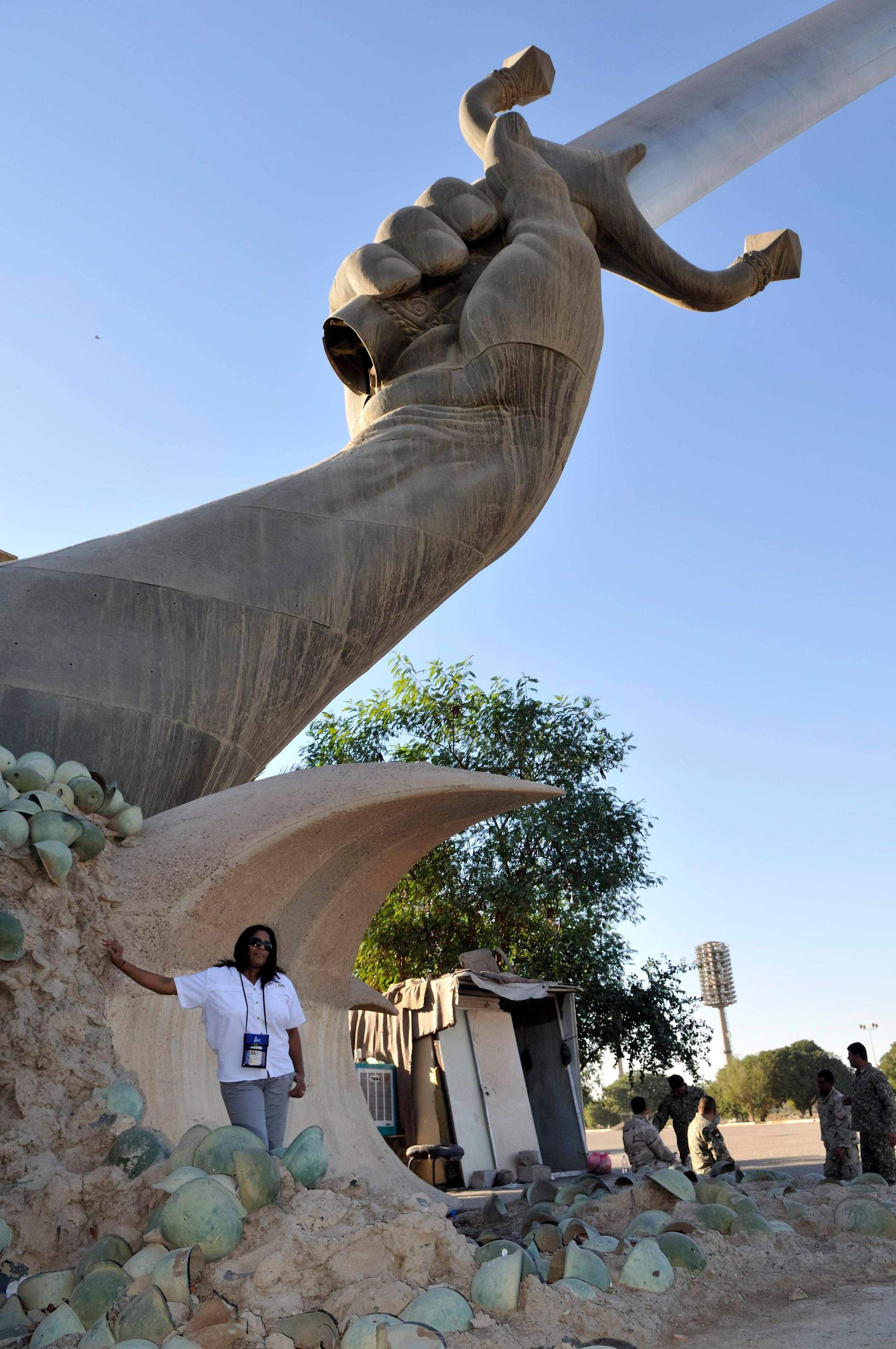
I first went over in 2003 as a soldier in a maintenance unit, which is to say we kept the things that shoot in working order and handed them back to the people who did the shooting. Later I moved into technology work for defense contractors; the same kind of work, but on machines that fail in quieter ways. What I watched, from the lean improvised chaos of 2003 to my last year working in Iraq in 2011, was the largest swelling of logistical mass I ever expect to see. It is hard to convey to people who were not there how the thing grew.
We arrived with not enough of everything and a great deal of duct tape. By the end, the bases had become small cities doing a convincing impression of peacetime, with their own bus routes and burger franchises and acres of climate-controlled tents, fed by a supply apparatus so vast and so baroque that no single human being could hold a picture of it in mind. After a while, I stopped seeing the War on Terror and started seeing the freight. And the longer I watched the freight, the more I understood that the freight was the war, that everything upstream of it — the doctrine, the speeches, and the maps with the bold arrows — was a kind of weather forecast, while the convoy was the weather.
I have been thinking about convoys lately, which is to say I have been thinking about the present American moment, because the two subjects turn out to be one subject wearing different clothes. There is a line passed around in uniform, old enough that it has been hung on Napoleon and Omar Bradley and a dozen other famous soldiers who probably never said it: amateurs talk strategy, professionals talk logistics. The earliest version anyone can actually source came from a Marine commandant most people outside the Corps could not name, which is the joke folded inside it, because the whole subject of the saying is that the decisive work goes uncredited. It is true as far as it goes, and does not go far enough.
The forecast can say whatever it likes. The convoy arrives or it does not.
We are told to judge the people now steering the federal government by whether they are good at their jobs, as though the obvious answer would settle something. But the competence that matters, the ability to get the right thing to the right place at the right hour, is only the professional’s half of the line. It sits downstream of a condition almost nobody examines, because they assume it the way they assume a floor will bear their weight. That condition is a functioning economy. You can field the finest logisticians in the history of the trade and it will buy you nothing if the thing they are meant to move does not exist, cannot be paid for or has been quietly pawned to cover last quarter’s improvisation. Skill at distribution presumes something to distribute. Stated that plainly, it sounds too obvious to say. This is forgotten daily by men who are paid handsomely to remember it.
Consider the German campaigns from 1939 through 1941, the stretch that gave us the word everyone still reaches for, Blitzkrieg, lightning war, a term that came from the foreign press more than from any German manual and promised more doctrine than ever actually existed. The early victories were real, and stunning, and have hypnotized strategists for three generations. Poland fell in weeks, helped along by a Soviet invasion from the east. France — the great prize, and the humiliation of 1918 paid back — in roughly six. The method turned on speed of a very particular and very brittle kind: armored spearheads punching through and racing ahead of their own infantry, frequently ahead of their own fuel, betting that the enemy would crack in the mind before the spearhead cracked in the metal. When it worked it looked like genius. But the method could stay solvent only so long as it kept winning, because German production alone could not carry it and the gap was filled by theft. Every country overrun was a fresh transfusion of stolen oil, stolen grain, stolen railcars, looted gold revalued to flatter ledgers that had not balanced honestly since before the shooting started.
This was not a flaw the German command stumbled into; it was the design. Adam Tooze’s economic history of the Reich argues that Germany understood it was outweighed by the industrial mass of the United States and the Soviet Union, and gambled on a run of fast victories precisely because it could not survive a slow war of production. Götz Aly has traced how much of the regime’s solvency, and how much of the loyalty it bought at home, ran on looted property and the seized assets of the people it murdered. The Reich was not an economy that happened to be fighting a war; it was a war that had to keep eating in order to impersonate an economy.
None of this means the fascist cannot run a railway on time. Inside the walls of a single operation the regime could be ruthlessly precise. But precision inside one operation is not competence across a war, and what it never had was the thing no timetable can supply, a productive economy to stand on instead of a stolen one and enough held back to survive the first day the plan went wrong. Someone will point to the machinery of the Holocaust as the proof of Nazi ‘competence’: the deportation timetables, railcars, punch-card tabulation, and the camps run like factories. The objection has the history backwards. The precision of the extermination proves the opposite of what it assumes. It was ideology eating logistics, in its clearest and most monstrous form.
By 1944, with the front collapsing and every locomotive needed to carry men and ammunition, the regime was still requisitioning trains to deliver Hungarian Jews to Auschwitz. It worked prisoners to death in the very months it was begging for labor. Resources that could have armed divisions went instead into killing that won nothing. A state that will tear up its own logistics to keep an ideological appointment is not a counterexample to any of this; it is the proof. The death camps were efficient the way a body that has begun to consume its own organs is efficient, and for the same reason.
I have gone to the worst case deliberately because horror on that scale burns away the incidental and leaves the mechanism bare. It outlived the men who built it, and it is loose again.
Look at the Russia that the current American president treats as a model and a friend. Putin runs the same animal in a colder climate — a state turned inside out to feed a war it no longer knows how to stop, kept upright by moving oil through a shadow fleet of obscurely flagged tankers and by converting whatever it overruns into next quarter’s budget line. A country like that does not wage war because its economy is strong. It keeps the war running because the war has become the economy, and the morning the guns go quiet is the morning the books finally have to be read out loud. But that morning can be a long time coming. Four years into his chosen war, with the economy shrinking under him, Putin still instructs his ministers to deliver growth the arithmetic will not produce.
The Russian books are already being read in a whisper: growth gone, the deficit doubling, taxes raised to feed a war that has become its own only reason. None of it has brought the regime down, and none of it will on any timetable a headline can promise. That is the part that should frighten rather than reassure. The model is doomed, but doomed is not the same as stopped, and the whole distance between the two gets paid in years and in other people's lives. A regime that cannot afford to feel the cost keeps borrowing against the future for as long as the future will lend and is likely to turn more brutal as the bill climbs.
Those German victories had a chemical dimension. Pervitin, methamphetamine in tablet form, rode to the front in tank crews and cockpits and infantry packs by the millions of doses. The drug does what it has always done. It advances you tomorrow’s vigor at an interest rate you do not get to negotiate, and repayment is not a thing you may decline.


And it worked, for precisely as long as the war it fueled remained a sprint. Once the blitz bogged down into the long grind in the east, the chemical that won the lightning was worthless in the siege. A Wehrmacht medical officer who served at Stalingrad, the man who handed the pills out, told the writer Norman Ohler as much: in a war of attrition the drug only wore men down, and the sleep they had borrowed came due anyway.
The metaphor doesn’t stay a metaphor; a regime can run on amphetamine logic without a gram changing hands. It draws the same loan against the same future and treats the borrowed momentum as a strategy. Each news cycle brings a fresh outrage to plaster over the exhaustion of the last, and you must never, on pain of collapse, stop moving long enough to total up the cost. The Reich was high in both senses, and the figurative high is the hardier, because it needs no pharmacy. You have only to refuse, structurally and forever, to feel tired.
So the thing was doomed in its bones, and not because the Germans could not fight. They could, though the early victories leaned as much on enemy blunders and luck as on any brilliance of their own. It was doomed because it had been built, whether or not anyone said so out loud, to require an unbroken chain of total victories. No serious reverse. No long stall. No campaign that curdled into a siege and then into a winter. The model carried no slack, no give, no reserve, because reserve is what you lay aside once you have privately conceded that things might go wrong, and the entire psychic machinery of the regime was wired around the certainty that things could not go wrong, that will and audacity and racial destiny would stand in for the dull material facts that dull material men kept raising in meetings. The dull material men were right. They are almost always right, and rarely thanked.
One of those men has a name. Franz Halder, Hitler’s own chief of the General Staff, warned at the outset that time and the economic balance both favored the other side, that the enemy’s means were simply stronger. He was overruled, the way such men are. Later, looking at the front his Führer had stretched to a barely tenable length in pursuit of a map that existed mostly in Hitler’s head, Halder said the decisions had given full power to wishful thinking. That phrase is the whole disease, named by a man with a front-row seat. And it does not stay in 1941.
Watch how the current administration and the men around it actually operate, not how they narrate it, and the same fatal architecture stares back. Hitler’s generals had a private name for the briefings where the reports were prettied up and the burning front went unmentioned: the Schaulagen, or show briefings. A government that asks to be judged by its announcements instead of its supply reports is running the same show, whether or not it knows the word.
A plan is announced with total confidence and zero contingency. The tariff goes on and the markets are assured the pain will be brief and the other fellow will fold first. The mass firing is carried out on the assumption that nothing those people did actually mattered, that the machine will run identically with a third of its parts pulled, that the institutional knowledge walking out the door was never load-bearing. The deal is demanded on the premise that the other side has no leverage and no patience and no memory. In each case the operation is engineered to succeed down one corridor only, the corridor in which the first move lands perfectly and the second move is therefore never required.
And then contact happens, as contact does. Iran was supposed to fold. The administration has now bet on that twice, and it is the second bet that gives the game away, because the first had already been read back to them in plain language and they had refused to hear it.
The first time, the strikes were sold as annihilation. The President told the country the nuclear program had been obliterated, completely and finally. His own Defense Intelligence Agency, doing the dull material work of looking, found it set back by a matter of months and said so. Within two months the man who ran that agency was gone, removed with no public reason that touched the finding, and the press got a scolding for reporting what the assessment had said. No one bothered to rebut the assessment; they simply removed the leader who signed it. The display needed the program to be gone, and an agency still saying otherwise was a problem to be managed rather than an argument to be met. That is the disease in miniature, a state that would rather put out its own eyes than be contradicted by them.
The second time, they ran the same play against the same country, the war Washington and Israel opened at the end of February. Contact came as it always comes. Iran did what a cornered state with a hand on a chokepoint does. It reached for the Strait of Hormuz, the narrow throat through which something like a fifth of the world’s oil has to pass, and it squeezed, and the global economy that no quantity of bluster can repeal felt the grip within hours. The war did not last days. This crisis has run for more than three months, through open strikes, a blockade, and a standoff that has still not formally ended.
As it dragged, the rift between the administration and its own commanders surfaced. Two weeks in, the Army’s most senior officer had stood in a North Carolina weapons depot and told the lawmakers with him that the target list was outrunning the supply, that the country was firing its munitions faster than it could replace them. He had looked at the freight and said out loud that it would not bear the plan. The President’s answer to all of it came in two moves. He went on television and promised to intensify the strikes. The next day that officer was forced out along with two more generals in a single afternoon, the rest of the building learning of it when the public did. This is where the fascist parts company with the merely arrogant. The arrogant man misjudges the wall, and when he hits it he curses and backs up. These men hit the wall, were told by their own experts it was a wall, and answered by firing the experts and driving in harder. Then they did it again.
A movement that will blind itself rather than look at what is in front of it cannot feel a setback in time to bend with one. At the end of it the administration took the nearest exit. What it reached, the Islamabad Memorandum, is not a deal that ends the nuclear program (the reason the whole thing was sold to the public) but an understanding to go on talking about it, a sixty-day window with that question still first on the list of things to be negotiated. The man who began the war over Iran’s nuclear program announced its end without once naming that program. He talked the deal up and still would not call it a victory. He signaled he would skip the formal ceremony in Geneva, where his vice president will sign for the United States.
The war closed the Strait of Hormuz and the deal has reopened it, which sounds like a wash until you read what the people who do the looking now think Iran walked away holding.

The war fought to keep one weapon out of Iran’s hands has, if the assessment holds, left a different one in them, and while a bomb is a threat a state can only make, a chokepoint is a threat it can carry out. And by the other side’s account, the terms read closer to concession than to conquest. The gutted civil service, in the same way, turns out to have been holding up functions nobody upstairs could name until they stopped. The market declines to cooperate with the press release. The corridor, in short, grows a wall halfway down it, and this is the precise instant that gives everyone away, because a flexible operator keeps a second corridor and a third, has held something back, has wargamed the failure in advance not out of gloom but out of professional respect for the universe’s habit of not playing along.
These people have nothing held back — they cannot have anything held back. To keep a reserve you must first have admitted, in the privacy of your own planning, that the main effort might fail, and that admission is the single thing the performance forbids. The strongman cannot be seen to have prepared to lose, so he does not prepare to lose, so he loses in a fashion that is total and surprises only him.
Soldiers have two sentences for all of this, rubbed smooth by a century of use. Hope for the best and prepare for the worst. No plan survives contact with the enemy. These are not pessimism. They are pessimism’s opposite. They are what confidence sounds like after it has grown up, been to a few funerals, and learned that the reserve you kept back and never had to use was not wasted money, that keeping it there at all was the whole reason you are still around to gripe about the budget. Real strength is built around the expectation of friction. The performance of strength is built around denying it, and the denial is load-bearing, which is only to say that the denial is the crack.
I want to be careful here, because the comparison can flatter the present by lending it a historical heft it has not earned in blood, and I have no wish to do that. The point is narrower, and I think more useful. Fascism, whatever else it is, carries a structural indifference to whether the economy in fact goes on functioning, an indifference that flows straight out of treating the economy as a stage set for displays of will rather than as the thing that decides what is and is not physically possible next Tuesday.
What recurs is not the death toll, and I am not claiming it is. It is the wishful thinking named by Halder, the conviction that pure strength of will can overrule arithmetic, and the reflex that always travels with that — which is to remove the person holding the arithmetic rather than absorbing what it says and adjusting accordingly. You can ignore the quartermaster for a season. You can ignore him for two. You cannot ignore him forever, because he is not venturing an opinion. No quantity of conviction at the top has ever once talked a fuel tank into refilling itself out of loyalty.
I learned that in places where failing to learn it gets people killed, which sharpens a lesson considerably. The men now running the government learned the opposite lesson, or learned nothing, in places where failure gets you a better quarter and a softer landing and somebody else’s name on the loss. Where I come from, a loss was a person, and a person stays lost. To them it is a line that moves to another man’s ledger. So they will move it. But the freight was always people. People do not reconcile like a column of numbers.
They are simply, afterward, not there.
Your article is powerful and astute. Thank you so much!
"and the entire psychic machinery of the regime was wired around the certainty that things could not go wrong, that will and audacity and racial destiny would stand in for the dull material facts that dull material men kept raising in meetings. The dull material men were right. They are almost always right, and rarely thanked."
Love this bit above. When I read that specific part, Israel also popped into mind immediately. Bibi and his gaggle of maniacal, murder-happy zealots are currently learning that lesson the hard way too. They really should've listened to the warnings back in May from their own "dull material men" who warned that they're running out of bodies to feed to the machine.
https://www.nytimes.com/2026/06/04/world/middleeast/israel-orthodox-riot-military-draft-judge.html