

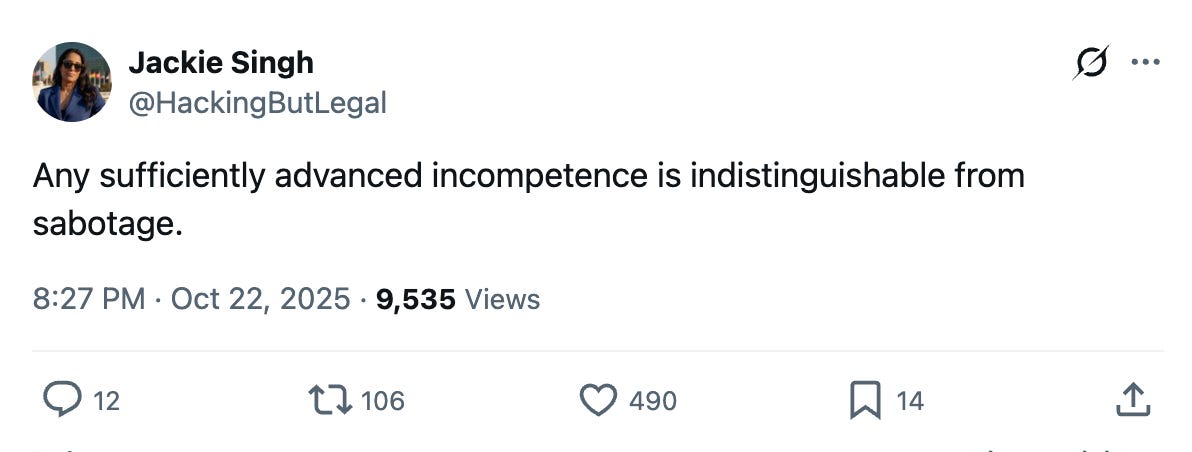
“Any sufficiently advanced incompetence is indistinguishable from sabotage.”
— @HackingButLegal, October 22, 2025, 8:27 p.m.
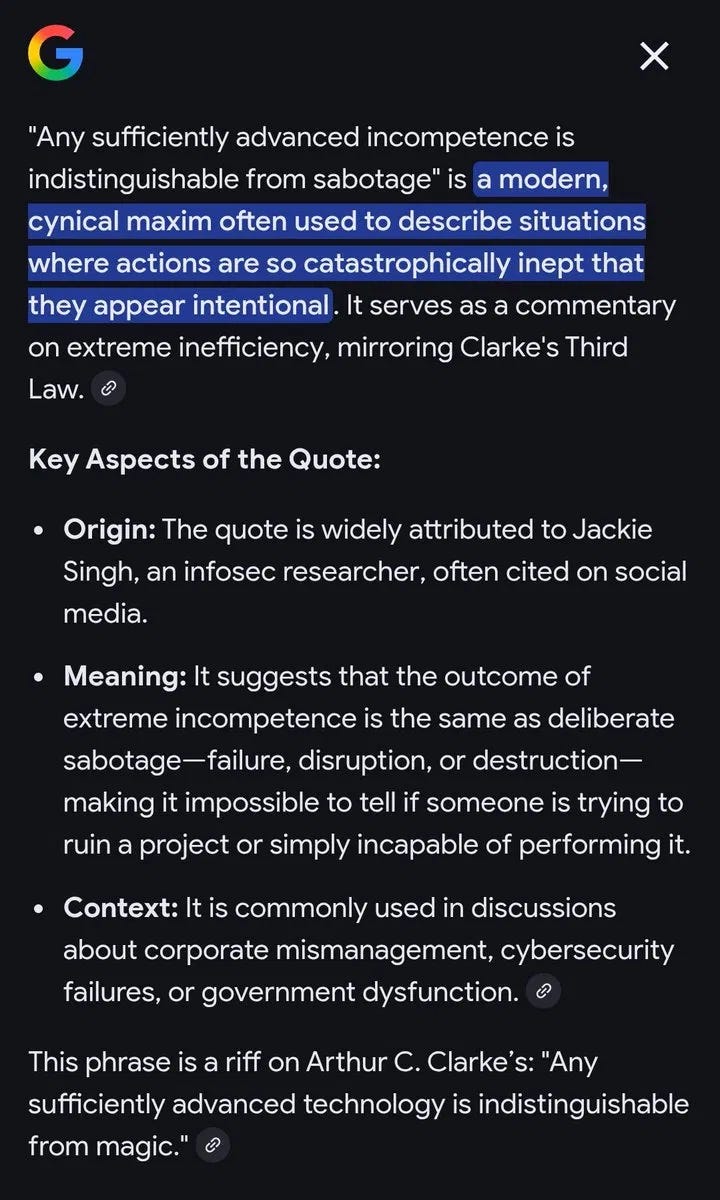
Google’s AI Overview has lately begun telling people that the sentence above is “widely attributed to Jackie Singh, an infosec researcher, often cited on social media.” I am Jackie Singh. I posted the sentence one October evening to modest applause, eleven words and a few hundred likes, and I can report that when the summary appeared, the attribution was wider inside the machine than anywhere a search could locate it.
The AI Overview had not discovered a consensus; it manufactured one in the confident register these systems reserve for settled fact, then offered it back to the public to be repeated until true.
I write about disinformation for a living, about the interval between source and summary where a claim gets laundered into a fact, and there is a certain professional etiquette for the moment the process performs itself on your own sentence. You do what the summary engine cannot, which is to produce a primary source.
This essay is the citation.
Aphorisms of this genre have always traveled as laundered goods. A maxim is a sentence that has outlived its circumstances, and shedding provenance is how it travels light. Mine splices two of the durable ones. The template belongs to Arthur C. Clarke, whose Third Law holds that any sufficiently advanced technology is indistinguishable from magic. Its subject descends from Hanlon’s razor, never attribute to malice that which is adequately explained by stupidity, by way of an inversion that circulates as Grey’s law: any sufficiently advanced incompetence is indistinguishable from malice. Nobody can say with confidence who Grey was, or whether he existed; even the attribution’s provenance is disputed which tells you most of what you need to know about how this genre assigns credit. Elon Musk brushed against the territory in May of 2023, tweeting that “Incompetence, in the limit, is indistinguishable from sabotage.”
We shall return to that wording to discuss its failure.
The word itself has spent a century trying to teach us the lesson. Students learn that sabotage descends from the sabot, the French worker’s wooden shoe, hurled into the gears of the loom by enraged weavers. The story is almost certainly apocryphal — a false attribution nested inside the etymology — which feels just right for this essay. The truer lineage is less cinematic and more instructive. Saboter meant to clatter about in wooden shoes, and by extension to bungle; to do work badly.
“In France, especially in the rural districts,” Spargo says in explaining the appropriateness of the term, “it has long been the custom to liken the slow and clumsy worker to one wearing wooden shoes, called ‘sabots.’ ”
He adds that the “phrase, Travailler a coups de sabots, to work as one wearing wooden shoes, has long been used with reference to the slow and clumsy worker.”
“The idea is obvious: the peasant with heavy wooden shoes walks clumsily and slowly in company with those who wear shoes of leather,” he writes.
When the French syndicalists took up the term in the 1890s, they meant exactly that, the deliberate performance of bad work. Bad pay, bad work, went the slogan. The first saboteurs did not throw their shoes into the machinery. They were the machinery, running badly on purpose.
Respectable theory followed the shop floor. Thorstein Veblen, writing in 1921, defined sabotage for the economists as “the conscientious withdrawal of efficiency,” a definition he lifted, almost verbatim, from the Wobbly agitator Elizabeth Gurley Flynn.
Legendary IWW activist Elizabeth Gurley Flynn attempted a more precise definition in her tract: “sabotage” referred to any effort “to limit his production in proportion to his remuneration,” or in other words, “the deliberate withdrawal of efficiency by a competent worker.”
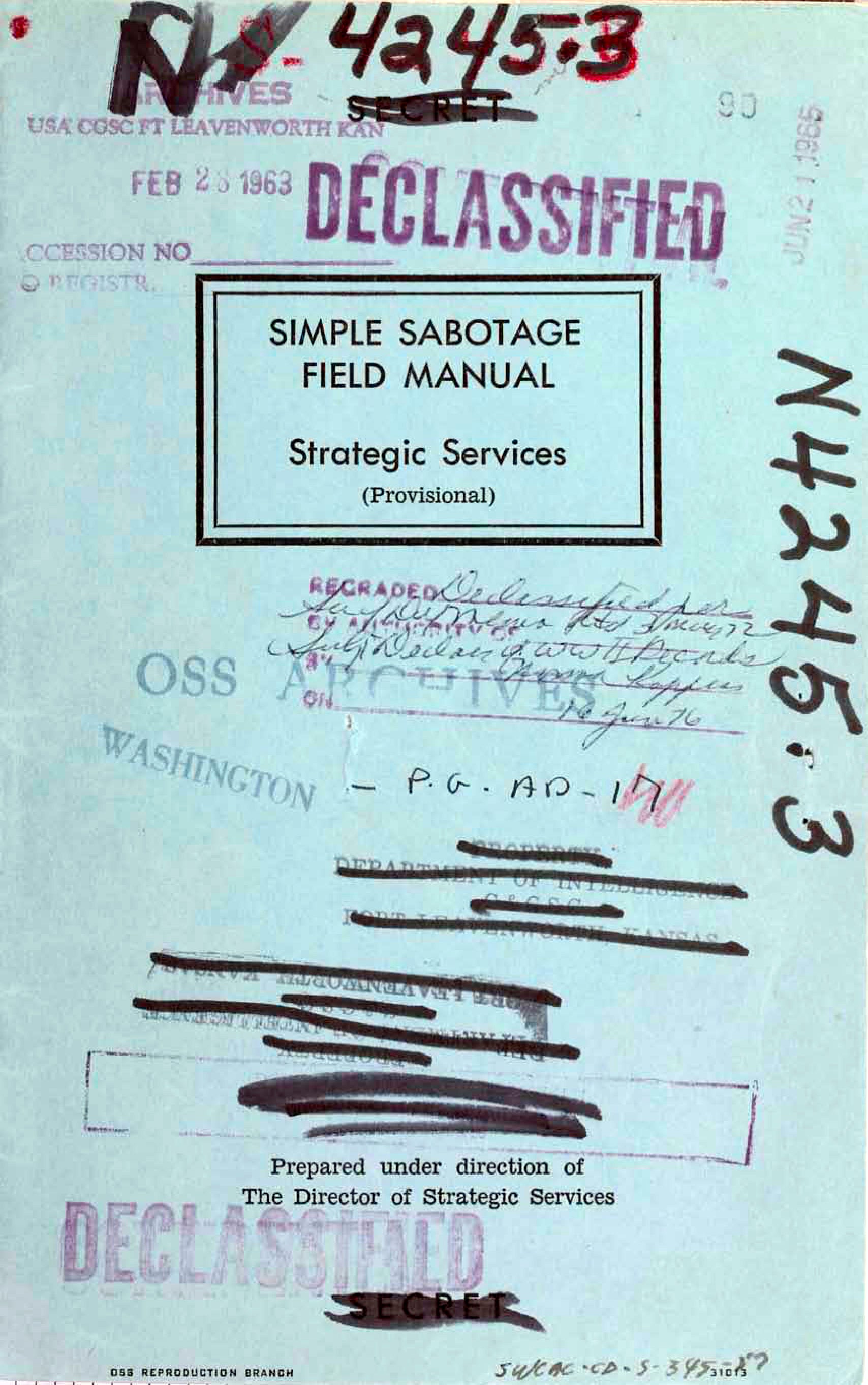
Even the canonical definition of sabotage is reattributed merchandise. And in 1944 the Office of Strategic Services distilled the whole tradition into the Simple Sabotage Field Manual, a wartime pamphlet for the citizen-saboteur that reads today like an unusually candid management or public relations consultancy. Its authors understood that the amateur’s best weapon was what the manual calls “purposeful stupidity”: insist that everything move through channels, refer decisions to committees for further study, haggle over the precise wording of communications, advocate caution. The tactics were chosen because no counterintelligence officer could tell them apart from the ordinary friction of institutional life.
What sits at the heart of my eleven words is American doctrine with a paper trail.
I did not come to the sentence through Veblen. I came to it the way most people come to maxims, by watching something happen and reaching for compression. Six months earlier, in the first spring of the second Trump administration, I had posted this:
“Reminder: The intention is sabotage at all levels. The methods are resourced from our enemies. The cover is that negative outcomes of the sabotage are accidental or products of incompetence.”
— @HackingButLegal, April 3, 2025
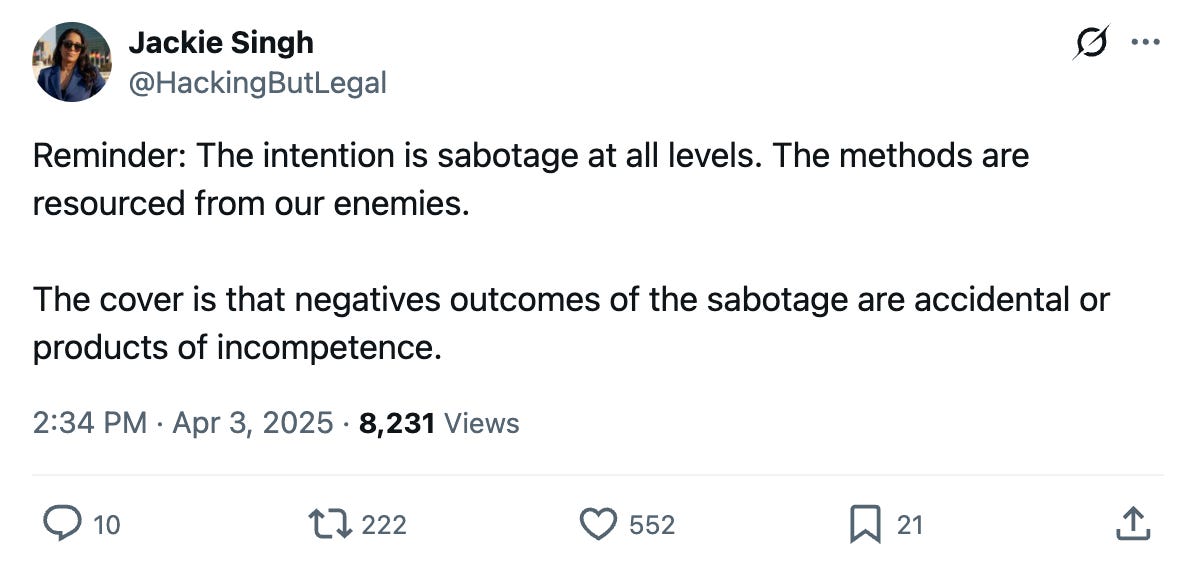
That was a specific claim about a specific moment: the sabotage is intentional, and incompetence is the cover story. My October sentence is what remained once the particulars boiled away and I reforged the accusation as an instrument. The reforging matters. If incompetence can serve as cover for sabotage, if the two are interchangeable by design, then indistinguishability is not a defect in the observer’s attribution process; it is the adversary’s deliverable, anticipated by the OSS eighty years ago.
Singh’s Law simply notes the observer’s side of that arrangement.
My claim of authorship covers only the construction — Clarke’s frame carrying sabotage rather than malice as its endpoint — but the endpoint earns its keep. Malice lives in someone’s head, while sabotage can be seen in incident, downtime, and breach reports. Intent can be endlessly litigated while wreckage can be audited by the quarter.
Which is also why the sentence functions less as a razor than as an anti-razor. Hanlon’s razor cuts: given two explanations, shave away malice and keep stupidity. Sound hygiene, and in my field chronically abused as an attribution sedative (probably a misconfiguration) administered to end inquiries that deserved to continue. My April tweet described the same mechanism from the saboteur’s side of the table… incompetence-as-cover is Hanlon’s razor wielded by the people it was meant to judge, purposeful stupidity dressed as the ordinary kind. Singh’s Law blunts the blade. Past a certain scale, neither explanation shaves away, and the attempt itself wastes the inquiry.
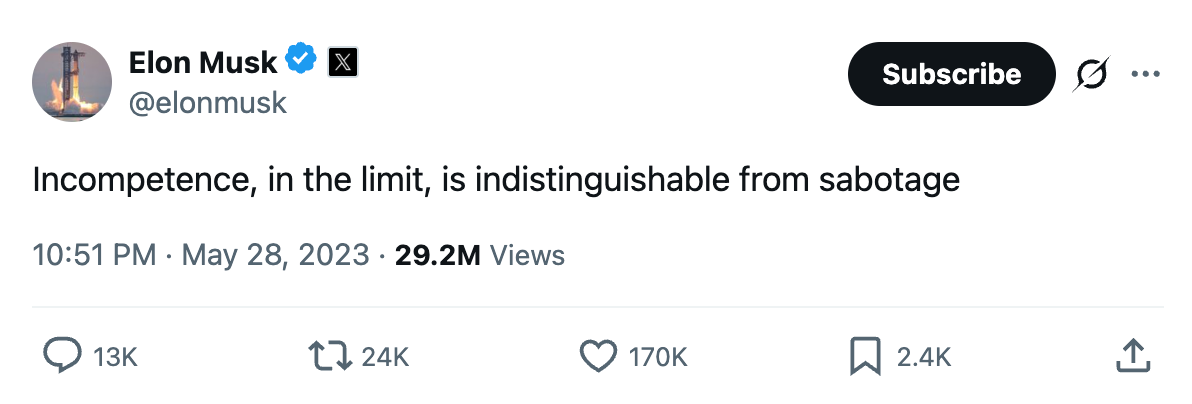
Now to Musk’s wording, and why it simply will not do. His version concedes the equivalence and then parks it at an asymptote. A limit, in the calculus, is the value a curve approaches without arriving. Therefore, under his construction, every disaster on record falls short — we are not at the limit yet — and the incompetence defense survives each finite case by definition. “In the limit” is that defense formalized: admitted in principle, priced never to pay out in practice. “Sufficiently advanced” stakes the opposite claim, a finite threshold crossed on observable dates.
I am likely to be asked whether Musk’s 2023 tweet represents some form of foreshadowing, and whether the man who articulated the principle and later ran the operation chose the asymptotic wording as cover. I decline the question, but not out of delicacy. Design or instinct behind “in the limit” is an intent claim beyond any audit. The field test its author went on to supply is not.
The test arrived in 2025, when the Department of Government Efficiency (DOGE) became the law’s definitive proving ground — the conscientious withdrawal of efficiency, administered by a department named for exactly that. One February week produced the pattern in miniature. On the thirteenth, as many as 350 nuclear-security workers were fired from the National Nuclear Security Administration; within about a day the terminations of all but 28 had been rescinded, by officials who then struggled to reach the reinstated, their contact information having departed with their access. On the nineteenth, bird-flu response staff were fired at the Department of Agriculture with the outbreak still culling flocks, then reinstated within days as a “mistake.” By March of 2026, according to the Brookings Institution’s Elaine Kamarck, some 25,000 dismissed federal workers had been rehired as “essential,” and federal judges ordered mass reinstatements of their own. The ledger side of the operation held to the same standard. Its largest claimed contract cut shrank from $8 billion to $8 million once the vendor’s paperwork was actually read, and independent reviews found the celebrated wall of receipts resting on contract ceiling values, duplicate entries, and claims no one could verify. By last December its architect had already returned his verdict on a friendly podcast: “somewhat successful,” and he would not do it again. On the Fourth of July, 2026, the organization self-terminated on the schedule its founding order had set, reporting $215 billion in savings against the $2 trillion once promised (eleven cents on the targeted dollar) with no closing report to follow.
Each of those outcomes was defended as accident or as tuition for moving fast: the cover mechanism from the April post, verbatim, running at federal scale, with the OSS manual’s tactics legible beneath the org chart. Run the record through the two formulations and watch them diverge. Under “in the limit,” all of it merely approaches the threshold, data points on an asymptote, each one excusable, with the defense intact in perpetuity. Under Singh’s Law, the threshold was crossed in the first month. Twice in one week.
The verdict requires no conspiracy, only a threshold. That is the entire argument for my wording — and the record, whatever the machines eventually make of it, now has a first entry.
Congratulations on making it to the big leagues Ms. Singh! I wonder what quantity of recorded attributions is required to meet Gemini's definition of "widely"?
It would be an interesting experiment to see if you could replicate a similar outcome intentionally using just a couple different accounts and a small online community willing to help out.
With regard to Clarke's "any sufficiently advanced technology is indistinguishable from magic" law, Futurama played off of it in their "Rage Against the Vaccine" episode in 2025. The episode itself was an awesome parody mocking the absurdities we had to endure during the pandemic. They twisted it slightly into "any sufficiently advanced magic is indistinguishable from science'. It's definitely worth the watch for anybody who needs a little comedy break from all of the impending doom we seem to be drowning in...
Got'damn!