

For fifty years, the US State Department’s Diplomatic Security Service (DSS) has run American security at overseas Olympic Games. The agency created a dedicated Olympic coordinator in 1992, established a Major Events Coordination Unit in 2004, and deployed agents to Paris last summer, where they embedded with Team USA, staffed the Olympic village, and coordinated with French authorities through a joint operations center.
DSS has done this work at every Games since Montreal. It is, by any reasonable measure, an important part of what the agency does—making a newly-announced arrangement at Milan-Cortina 2026 highly peculiar.


The Guardian’s sources at the US Embassy in Rome have confirmed the following statement from ICE:
“At the Olympics, ICE’s Homeland Security Investigations (HSI) is supporting the US Department of State’s Diplomatic Security Service and host nation to vet and mitigate risks from transnational criminal organisations.”
“All security operations remain under Italian authority.”
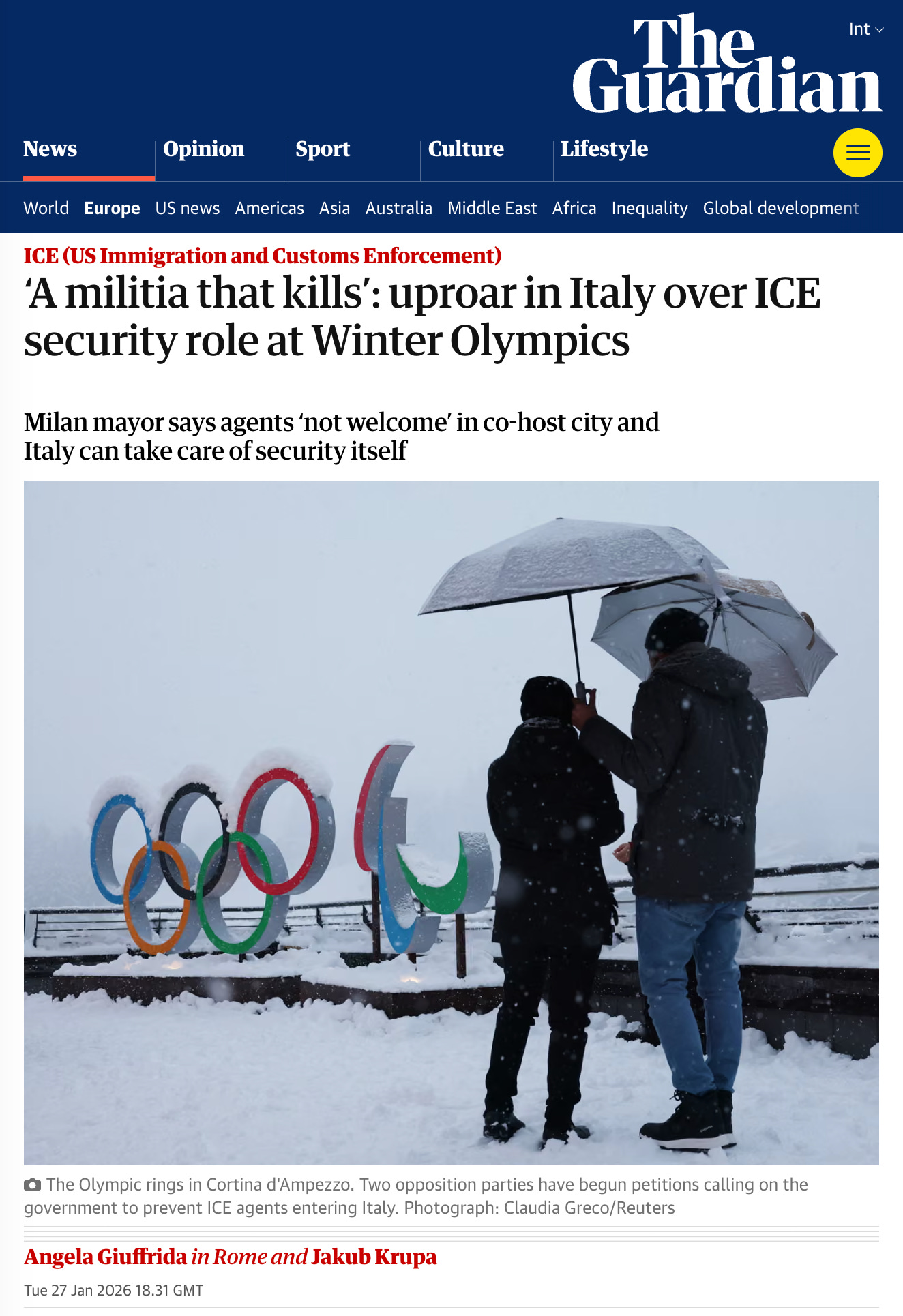
The official ICE statement describes Homeland Security Investigations as “assisting” DSS “to assess and mitigate threats posed by transnational criminal organizations.” Embassy sources confirmed that HSI would back up State Department security. The Department of Homeland Security said its agents would help with “vetting and mitigating risks.” This is not how federal agencies typically describe anti-trafficking operations, which is what HSI actually does at major sporting events. At the 2017 Super Bowl, HSI’s Operation Guardian Angel arrested 94 perpetrators. The agency runs similar programs at every Super Bowl, working hotels and monitoring patterns.
It does not provide protective security.
The distinction matters. HSI is the investigative arm of Immigration and Customs Enforcement, with over 6,700 agents focused on cross-border crime: narcotics, weapons, money laundering, trafficking. The agency has provided hundreds of thousands of hours of support to the Secret Service at National Special Security Events like inaugurations and Super Bowls. But those are domestic events under DHS coordination. Overseas, the State Department holds authority. DSS operates under Foreign Service protocols. No statutory or operational framework exists for HSI to augment DSS abroad.
Embassy officials told Reuters that several federal agencies have supported Olympic security before, including HSI. This is technically true and substantially misleading. At Paris, HSI ran the Open Doors Initiative, a trafficking prevention program partnering with French hotels and nonprofits. That is specialized law enforcement work, not threat assessment for DSS.
French reporting from RFI noted uncertainty about whether HSI had ever participated in Olympic security at all.
I was unable to locate any public record documents showing HSI providing operational support to DSS at any previous Games. NBC News went further, claiming, “It is not unusual for the division, which takes the lead in international human trafficking situations, to work on marquee events abroad,” and placing that claim in the subheader.
The network offered no evidence for this and appears to be the sole source for this claim among the dozens of international news organizations covering this story. RFI was more careful, reporting it is “not known whether the HSI has in the past been involved in the Olympics, or whether this is a first.”

Perhaps NBC has uncritically repeated an anonymous embassy source’s claim, or possibly conflated HSI's anti-trafficking work at Paris 2024 with the operational security role described for Milan-Cortina. The Open Doors Initiative partnered with hotels and NGOs to identify trafficking victims, which has nothing to do with threat assessment for DSS. One mission is routine. The other, if it has ever happened, left no trace in the public record. NBC’s framing risks normalizing a historically unprecedented arrangement by claiming it is routine.
So what explains Milan-Cortina?
The Department of Homeland Security’s own planning documents offer no answer. The agency’s FY2025 Financial Report, published this month, mentions the Olympics exactly once: TSA preparing for the 2028 Los Angeles Summer Games alongside the 2026 FIFA World Cup and America’s 250th anniversary. Surge staffing. Coordinated planning. Screening upgrades.
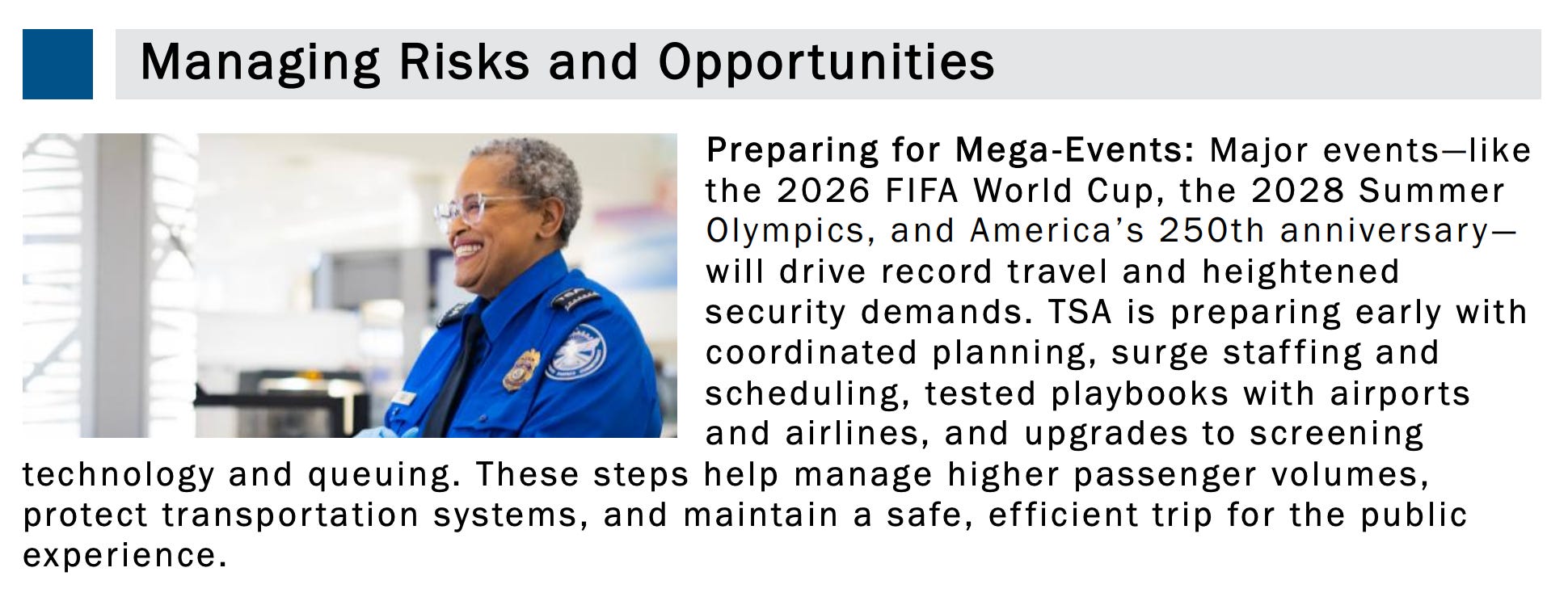
The report says nothing about HSI providing security support at Milan-Cortina, nothing about augmenting DSS operations abroad, nothing about threat assessment at international sporting events. If this deployment reflects institutional planning rather than political improvisation, DHS’s budget justifications do not show it.
The State Department announcement offers a clue: the arrangement demonstrates “the Trump administration’s bold leadership and steadfast commitment to law enforcement and security.” Vice President Vance is leading the U.S. delegation. The framing is political, not operational.
DSS does face staffing pressure. A 2022 study found the agency operating at 73 percent of authorized strength. But DSS managed Paris without HSI integration, despite an unprecedented open-air ceremony on the Seine that French security officials called the most complex Olympic event ever attempted. If DSS cannot staff Milan-Cortina, a smaller Games in a less challenging security environment, something has gone badly wrong at Foggy Bottom. If DSS can staff it, the HSI deployment is theater.
The Italian reaction suggests the latter interpretation.
Former Prime Minister Giuseppe Conte called on the Italian government to “set our own limits” regarding the United States and demanded an end to “capitulation” to Trump.

Interior Minister Piantedosi initially denied ICE involvement before clarifying that Italian authorities would maintain control and American agents would not operate on the streets. Foreign Minister Tajani told reporters HSI would work “in the operations rooms,” not in public.
The prominent LGBT activist and member of the European parliament for the centre-left Democratic party Alessandro Zan said:
“Trump’s private police agents will arrive in Italy for the Milan-Cortina Olympics. Their task? “To verify and mitigate risks arising from transnational criminal organizations.” If that’s the goal, it’s paradoxical to entrust it to those who are the first to commit crimes, operating with violence and killing innocents in cold blood.
In Italy, we don’t want those who trample human rights and act outside any democratic control. It’s unacceptable to think that an agency of this kind could have a role, whatever it may be, in our country.
Giorgia Meloni should stop taking orders from Trump and, for once, act as a patriot of Italy and not of the United States.”
Milan’s mayor called ICE “a militia that kills” and declared HSI agents unwelcome. He cited recent DHS enforcement operations in Minneapolis that left two U.S. citizens dead (one shot by Border Patrol, one by ICE), telling RTL 102.5 radio that,
“This is a militia that kills,” he said. “It’s clear that they are not welcome in Milan, there’s no doubt about it. Can’t we just say no to Trump for once? We can take care of their security ourselves. We don’t need ICE.”
“ICE agents should not come to Italy because they are not aligned with our democratic way of providing security.”
After the Minneapolis shootings, ICE officials threatened to break the car window of Italian Rai TV journalists who were filming the aftermath.
The video aired on Rai 3 and dominated Italian news for the past two days. Journalist Laura Cappon had shown both her press credentials and passport while identifying herself as Italian media. Foreign Minister Tajani, from Meloni’s own coalition, said the images “speak of abuse.” Even Tommaso Foti, a minister from Meloni’s Fratelli d’Italia party, called ICE’s approach “very harsh and censurable, not at all in line with what is adopted by our law enforcement agencies.” The opposition was less diplomatic: Angelo Bonelli of the Green-Left alliance called it
“mafia-like intimidation of the press in the heart of the United States.”
The backlash reflects ICE’s toxic brand, which has little to do with HSI’s actual mission. HSI is the investigative division of ICE, separate from the Enforcement and Removal Operations (ERO) unit that conducts deportations. Italian media has quite reasonably conflated the two, and American officials have struggled to explain the distinction while simultaneously refusing to explain why HSI will be sent.
I have a few unanswered questions: What capabilities does HSI possess that DSS lacks after five decades of Olympic security? Under what legal framework will HSI agents operate in Italy? Will they carry weapons or hold diplomatic credentials? Who commands them? And why divert HSI personnel from investigating transnational criminal organizations to provide event security, while investigating TCOs is the stated justification for their presence?
The public record offers no answers. What it offers instead is an arrangement without documented precedent, announced with political fanfare, defended with misleading claims about prior practice, and seemingly planned for implementation over the objections of the host city’s mayor. If DSS genuinely needs help, that is an institutional failure requiring congressional attention.
If it does not, the Milan-Cortina deployment is something else: an expansion of DHS’s international footprint dressed up as interagency cooperation, which establishes precedent for ad hoc federal deployments beyond statutory missions.
Either way, we Americans should probably ask why.
If I were a betting person, I would lay money down that someone high up wanted to justify some government paid trips to Italy for a romantic vacation. This has Kristi and Corey written all over it.