

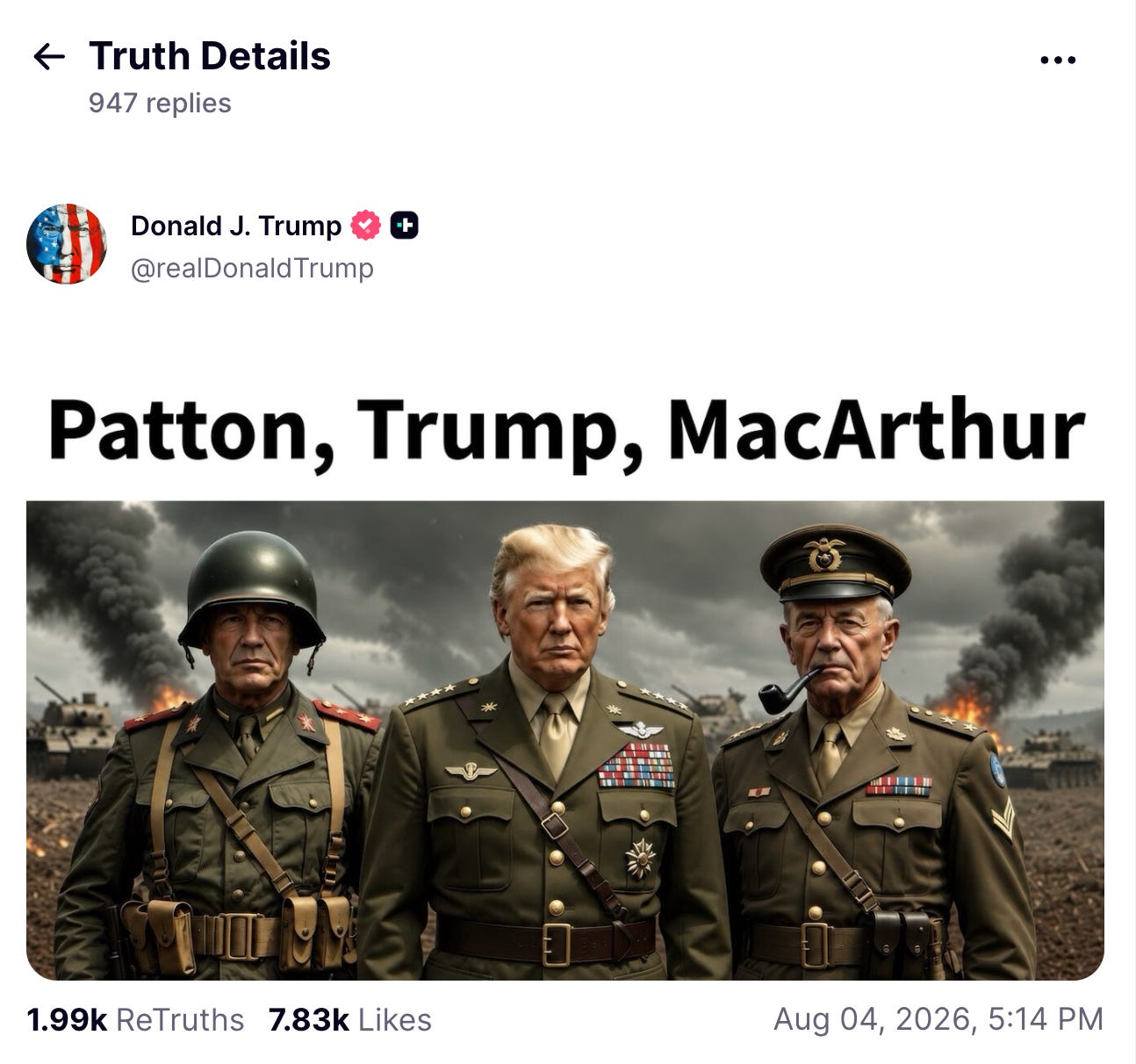
On Tuesday evening, the president posted an AI-generated image to Truth Social under a three-word caption: “Patton, Trump, MacArthur.”
Three men in olive drab stand before a burning battlefield, a squinting figure in a GI helmet on the left, a pipe smoker on the right, and between them, taller and younger than both, lit like a shampoo commercial, Donald Trump in a general’s dress uniform, wearing a ribbon rack of no known provenance. MeidasTouch Network had screenshotted it for X less than ten minutes later, about the half-life of anything the president posts.
Nobody believes Trump stood among burning Shermans in 1944, and nobody was meant to; unbelief is the image’s operating principle.


♦
My grandpa kept his VHS of Patton inside a cabinet with various other things he treasured, and as a kid spending summers at his house I understood the tape outranked some of the furniture. He was not unusual. For two generations of American men, Franklin Schaffner’s 1970 film is Patton: the wall-sized flag and George C. Scott growling the opening address, the trademark polished helmet and ivory-handled pistols rendered with a fidelity bordering on the liturgical.
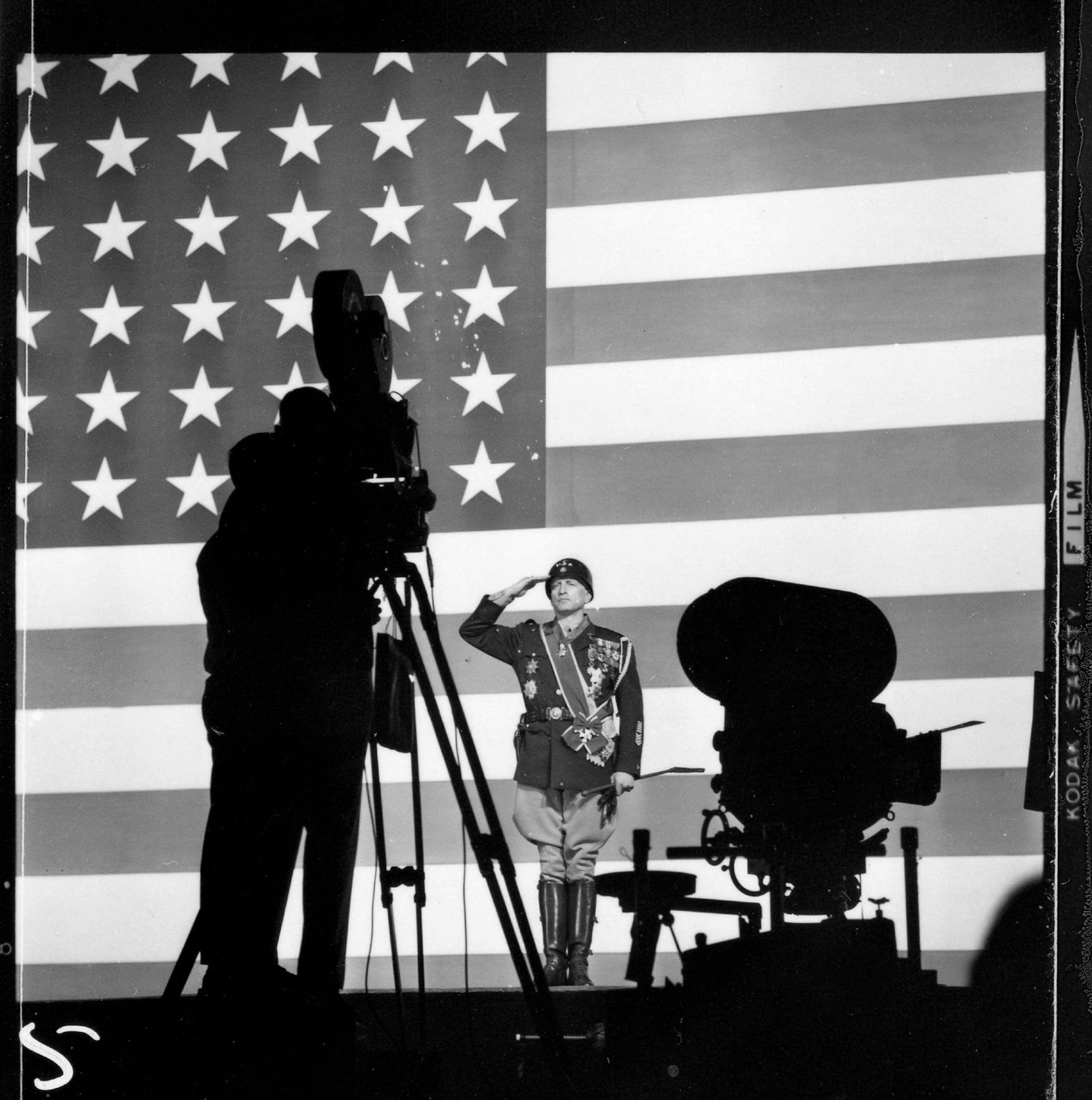
Seven Oscars later, the film owned the general's memory outright. Richard Nixon reportedly screened it again and again in the spring of 1970 while deciding to send troops into Cambodia, enough times to unsettle his own aides. Presidents projecting themselves onto Patton have a history, then; only the compression is new. Back then, Nixon needed a screening room and 170 minutes to feel like the general. Today, Trump needs only a text prompt. The fantasy arrives custom-rendered with his face on it. Even so, the shortcut is rather obvious.
Whatever AI model and corresponding prompt produced Tuesday’s image failed the film, never mind the man. Its “Patton” wears a bare helmet where the starred, lacquered one should sit; its “MacArthur” smokes a generic English briar in place of a corncob so famous that the Missouri Meerschaum Company, in business since 1869, still sells a model in his name.

The insignia belong to no army in particular, though a few belong to a very particular army: the “Patton” figure’s red collar tabs and red-piped shoulder boards run closer to Soviet pattern than to anything the U.S. Army has ever issued, and the star-shaped order screwed flat to the center figure’s chest sits the way Moscow pinned its decorations, where American orders hang from ribbons.
Neither portrait would fool a casual student of history. What we see is a texture called “WWII general” with celebrated names captioned on top; the past worn as costume rather than consulted as record.
♦
History kept better notes than the AI model was able to reproduce. Of all the commanders in the American pantheon, Trump’s caption reaches for the two most famously at war with civilian control of the military. Truman relieved MacArthur in April 1951 for public insubordination over Korea, and the firing became a constitutional lesson learned by every officer: generals answer to elected civilians. Patton, brilliant in the field and unemployable at peace, slapped two hospitalized soldiers in Sicily and spent his last years testing a chain of command that finally stopped indulging him.
Both men carry a darker credential. In July 1932 MacArthur, then Army chief of staff, commanded the eviction of the Bonus Army — thousands of destitute veterans camped in Washington, D.C. — and by most accounts pressed the operation far further than Hoover had authorized, even ignoring his command to stop the assault; then-Major George S. Patton led the cavalry, and infantry followed with tear gas. That morning District police, attempting to clear a downtown camp, had opened fire, killing William Hushka, a Lithuanian immigrant, and mortally wounding Eric Carlson of Oakland, both veterans of the war; their deaths gave Hoover his justification for calling in the Army.
The veterans and their families were driven out under threat of severe violence, and their camps and belongings were burned. As documented by Paul Dickson and Thomas B. Allen, authors of The Bonus Army, 55 veterans were injured and 135 were arrested. One veteran’s wife miscarried. Another’s malnourished 4-year-old son died.
Less than two weeks after the evacuation, 3-month-old Bernard Myers, the son of a bonus marcher from Pennsylvania, died in a Washington hospital. His parents said the infant’s health had deteriorated after he inhaled tear gas.
Countless marchers suffered injuries at the hands of the soldiers, and many lost their possessions in the fires. Yet for all the protesters’ sacrifices and efforts, a divided Congress did not pass the legislation granting them immediate compensation for their war service. As the veterans disbanded and settled in camps across the country, their campaign seemed a complete failure.
–"The Forgotten March," National Parks Conservation Association
In other words, flanking Trump in his AI-generated fantasy are the two officers most famously associated with insubordination and the two most storied soldiers on the scene the last time the Army attacked an encampment of American civilians in the capital.
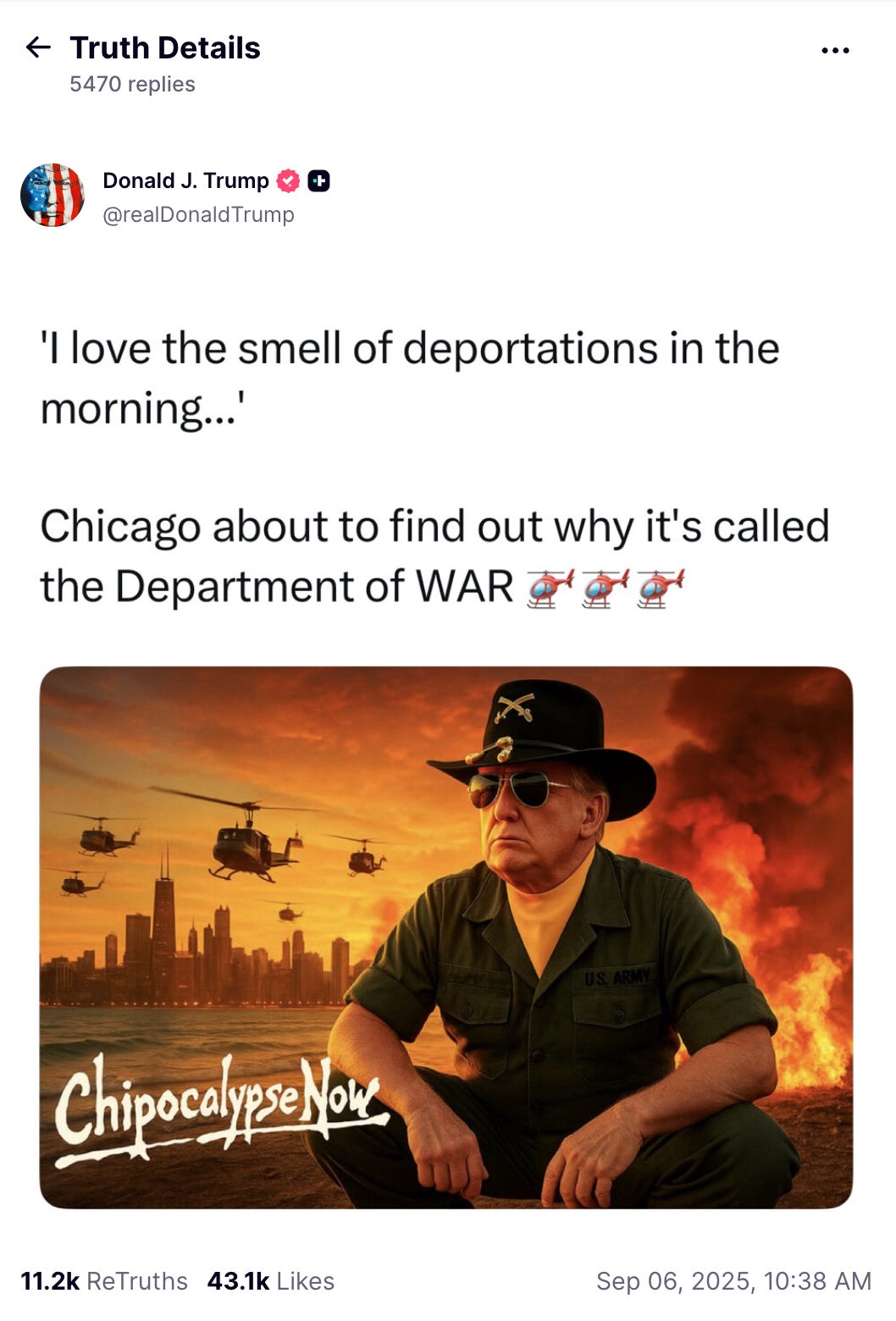
Whether anyone involved in generating the image was aware of these historical facts is unknowable. What we know is that it arrived from the president’s own social media account during a time of militarized policing and Guard deployments over governors’ objections and less than one year after “Chipocalypse Now,” the president’s post of himself as the napalm-loving colonel menacing Chicago. This is a genre, not a lark.
♦
Although we have had a dozen general-presidents, there is a reason no American has ever seen a president in uniform. More than any battle, arguably, the republic’s founding image is Washington at Annapolis in December 1783, handing his commission back to Congress, a renunciation European observers found nearly incomprehensible and American political culture has treated as scripture since. Grant governed in a frock coat; Eisenhower, who accepted the German surrender wearing five stars, spent eight years in business suits.
Trump’s image belongs instead to the tradition our iconography spent 240 years defining itself against: the marshal-president whose uniform is the office, a tradition with a rich photographic archive, none American. About the ribbons: the man wearing five rows of them received four student draft deferments and a fifth for bone spurs. Eisenhower had more right than any man alive to wear stars in the Oval Office but still understood why he couldn’t, or simply shouldn’t.
Tuesday’s image tramples the Constitution’s intentional subordination of the military beneath the office now borrowing its clothes.
♦
Images like this one get waved through as jokes, yet the levity holds more weight than it admits. Because the composite is self-evidently fake, it carries built-in deniability while still performing all the same symbolic work. Nothing here was offered as fact, so there is nothing to fact-check. A president depicting himself as a WWII general cannot be debunked, only objected to, and the objection itself is the product.
A social psychologist might label the underlying move basking in reflected glory, a sort of prestige by adjacency, with some of that five-star shine migrating toward a middle figure rendered golden, fit and youthful while the generals beside him go gray. Supporters get an identity offer, an opportunity to fuse the current leader with the last morally uncontested American war, causing loyalty to take on the feeling of patriotism. Opponents get rage bait, and their amplification serves as distribution strategy. And because norms die by repetition, everyone else gets erosion, and a president in a general’s uniform seen often enough stops registering as a violation at all.
The technique has doctrine behind it. Analysts were urging NATO to take memetic warfare seriously a decade ago, and the man who wrote the case, Jeff Giesea, a startup veteran out of Peter Thiel’s orbit, spent the next year practicing what he had preached, building the pro-Trump meme operation MAGA3X with Mike Cernovich and assembling an influencer network that included Jack Posobiec, a Navy Reserve intelligence officer turned far-right provocateur. Their DeploraBall sold out a thousand tickets at the National Press Club on the eve of the inauguration, a victory party for what the online right still commemorates as the Great Meme War; MAGA3X had billed itself as “Freedom’s Secret Weapon,” and the distance between those trenches and official government social media accounts has since closed to nothing.
Motive is a locked room, but the message is in plain view. Trump’s image collapses the visual distance between the presidency and military command in a format engineered so that anyone who objects can be told to “just lighten up.” Whether sincere self-image, planned strategy, trolling or some blend of the three, the outside view is identical, and Singh’s Law neatly applies, nowhere more than in the tailoring: a president who has spent a decade denying allegations of Russian compromise circulated a portrait dressed partly from the Red Army's closet. Can any outside observer say whether the machine blundered or somebody winked?
My grandpa’s tape, whatever the movie’s own myth-making, at least asked its audience to sit with a complicated man for three hours.
Trump’s version asks for nothing but a share.
♦
Thanks for the history lessons that I never learned. Unless one took honors level history courses in highschool or specific advanced history courses in college, most of us Americans learned very little about our own history. Especially modern history.
When my son spent 6 months learning abroad in Dublin and Sweden 2 years ago, meeting and traveling Europe with students from most countries he traveled to, he was shocked by the fact that most Europeans, he said, knew far more about American govt and history than the majority of American people. I'm sure there are pretty obvious reasons for our subpar lack of civics and extensive history education, and those motives seem to be growing more tenacious at this moment.
As far as the goddamn memes, they've done and continue to do far more damage than most people realize, and across the political spectrum. My son conducted a small study years ago sending sets of memes, some true, most absurdly false, to school members, family, and friends. He asked them to mark true or false without looking them up. The results were startling. Across the age, education, and political spectrum the number of people attributing truth to purely false statements was significantly large. I personally try not to interact with memes in anyway for this very reason. In fact, I created my very first one just yesterday to run my own little mini experiment.
Anyways, great article, thanks...