

In August, The Ideas Letter, an essay platform funded by Open Society Foundations, published a long piece by the political scientist Marlène Laruelle titled “In the Comfort of Apocalypse.” The premise does its own advertising.
Laruelle places Timothy Snyder, the Yale-trained historian of Eastern Europe who has become American liberalism’s most prominent civic alarmist, alongside Alexander Dugin, the Russian occultist and imperial ideologue whom Western journalists spent a decade casting as “Putin’s brain.”
Despite their opposed politics, she argues, the two men think alike.
Each wields a master concept that promises total clarity and divides the world into light and darkness. Each writes in the register of prophecy and treats Russia as a civilizational constant, letting private grief confirm public theory. The essay is elegant and heavily sourced, structured with the symmetry of a diptych: a photograph of Snyder gesturing at a lectern in Oslo, a photograph of Dugin gesturing at a lectern in St. Petersburg.
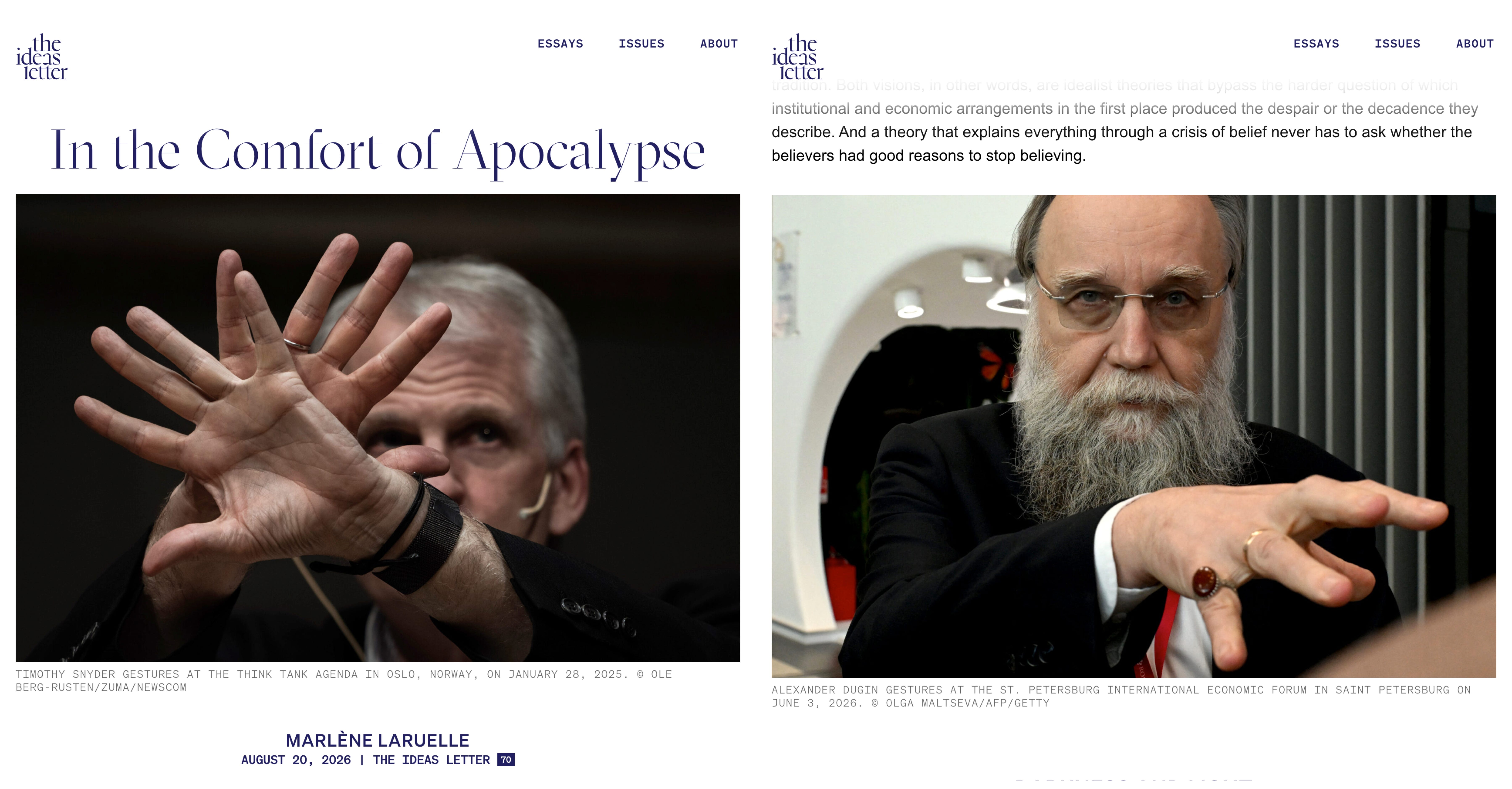
The essay is also doing a second job. The stated task is an argument about Snyder’s claims; the delivered output is the dismantling of his standing as a source, carried out in the genre of scholarly analysis.
By way of disclosure: after my initial reading, I called Laruelle’s essay “pseudo-intellectual bullshit intending to degrade the power of her subject’s work using a false and offensive comparison.” I stand by that.

That the essay accomplishes it is checkable, and it has consequences well past Snyder. The technique on display here is becoming a standard instrument in the wider information conflict the essay itself declines to take seriously, and it deserves to be taken apart in public, piece by piece, so that readers can recognize it the next time they encounter it, which they will. This essay comprises my verdict’s receipts.
♦
Laruelle is not a crank and not a marginal figure. She is among the world’s leading scholars of Dugin, Eurasianism and the Russian radical right, and the essay’s central factual claim about Dugin is correct: his influence on actual Kremlin decision-making has been wildly overstated by Western media. That position is neither fringe nor apologetic; it sits close to consensus among specialists across the hawk-dove spectrum, including researchers who have spent careers documenting Moscow’s cultivation of the European far right. The “Putin’s brain” framing was always better journalism than analysis, and Laruelle has spent years correcting it.
Nor are her criticisms of Snyder invented. They have a genealogy that long predates this essay and owes nothing to Dugin. When Bloodlands appeared in 2010, Richard Evans, the preeminent Anglophone historian of the Third Reich, attacked it in a review of famous severity, and the Holocaust historian Omer Bartov raised related objections: that merging Nazi and Stalinist killing into a single spatial frame risked blurring distinctions between the two regimes’ logics of violence that scholars had spent decades establishing. Black Earth, in 2015, fared worse. Its thesis that the Holocaust was deadliest where states collapsed runs into the Netherlands, where an intact and efficient administrative state coincided with one of the highest Jewish death rates in Western Europe precisely because bureaucratic continuity facilitated deportation.
Sophie Pinkham’s review in The Nation identified the deeper habit: Snyder treats functioning institutions as sources of moral illumination and their absence as darkness. And the Ilyin problem is real. The Road to Unfreedom hangs enormous interpretive weight on a reactionary émigré philosopher whom Putin has quoted ceremonially a handful of times, the way American presidents quote Lincoln, and its genealogy leaps from Ilyin’s 1922 expulsion to Putin’s rise as though seventy Soviet years, the very decades on which Snyder built his scholarly authority, had not intervened. Snyder’s prophetic ledger is genuinely mixed as well. He told an interviewer in 2017 that a Reichstag-fire moment was close to inevitable and gave the republic roughly a year; the assault on the Capitol arrived in 2021, and his admirers retroactively amortized the timeline. His critics hold their strongest card here: that a prophecy whose deadline can always be extended is no forecast at all, just a mood.
All of this is admissible. All of it was in print years ago, produced by historians and critics with no stake in any quarrel over Russia policy. The provenance card matters more here than the paintings; everything that follows hangs on it.
♦
Try this at home. Take Laruelle’s essay and strike every sentence that mentions Dugin. What remains? Everything. Every defensible criticism survives intact: the Ilyin overstatement, the missing Soviet decades, the statelessness thesis, the moral binaries, the prophecy ledger, the tendency to locate America’s pathologies abroad. Each was developed by Evans, Bartov, Pinkham and a small literature of Russia specialists without any reference to Dugin — none of them requires one. The Dugin half of the essay licenses no inference and supports no conclusion that the Snyder-only version could not reach. As analysis, it is inert.
Laruelle supplies the verdict herself. Her closing argument faults Snyder’s genre for placing its explanatory weight on an external corrupting agent and declares that “none of this requires a Russian villain.”
“None of this requires a Russian villain. And almost none of it features prominently in the genre of writing that Snyder, as liberalism’s most prophetic defender, has come to exemplify—a genre in which the explanatory weight falls overwhelmingly on an external corrupting agent.”
—Marlène Laruelle
Neither does her case against Snyder. The control version exists in print under her own byline: a 2021 book and a 2022 journal article that prosecute the same case against Snyder, prophet charge included, with no Dugin anywhere in the frame. The essay convicts a genre of needing a Russian villain while itself needing one to exist.
Five years in, the only new ingredient is the man on the other side of the table. The book makes the point exact. Across its two hundred fifty-odd pages Dugin is treated at length as a subject and Snyder at length as an adversary, and the two men never once share a page of her argument; their names co-occur only in the back matter, in separate citations that have nothing to do with each other. For five years the comparison went unmade. In August it became the entire essay.
So what is it for?
Its likely rhetorical effect is contaminative. The essay seats Snyder across the table from a man who spent 2014 agitating for the dismemberment of Ukraine and who, in a video interview that year, said of Ukrainians “kill, kill, kill,” remarks that cost him even his position at Moscow State University. Then it lets the seating arrangement do work the argument cannot. Laruelle is careful, in a single paragraph near the end, to disclaim any equivalence between the two men’s “political commitments or moral responsibilities.”
The disclaimer is real and perhaps sincere. It is also beside the point, because the essay denies at the level of the proposition what it performs at the level of architecture. The parallel section structure, the alternating paragraphs, the matched photographs of two men gesturing: the verdict is manufactured by the form, and the form says these two are a matched set. Anyone who has watched how ideas actually circulate knows which element survives transmission. The symmetry travels. The caveat dies at the border of the first screenshot.
The characterological accounting confirms the arrangement. Dugin arrives in this essay as a “self-taught esoteric thinker, more at home with occult speculations than archival footnotes,” a description with the texture of an affectionate faculty-lounge anecdote. His daughter’s death is rendered at length and with warmth. His decades of exterminationist agitation are nowhere, and her own earlier scholarship on the man is nowhere to be found.
Her 2008 study Russian Eurasianism devotes a section to Dugin’s connections with fascism and files a careful inventory: his ideas share many features of original fascism, down to the cultural revolution meant to produce a New Man; he advances a positive reading of fascism and does not denounce Nazism, regretting mainly that Hitler attacked the USSR; he especially appreciates the Waffen-SS and the Ahnenerbe; like the original fascists he admires the Romantic taste for death and combat.
She was careful then to brake the label, writing that his thought cannot be equated with fascism if that means the contemporary racist extreme right. The shape of that passage is the finding: the inventory, then the brake. In 2026 the inventory vanished and the brake was never built. The affable esotericist of the essay is a man whose admiration for the SS’s cultural apparatus she herself documented, with page numbers, eighteen years ago. Snyder, an archival historian who writes books and raises money for drones, receives the essay’s entire budget of moral scrutiny. A structural comparison would have flattened both men equally. This one flattens only one.
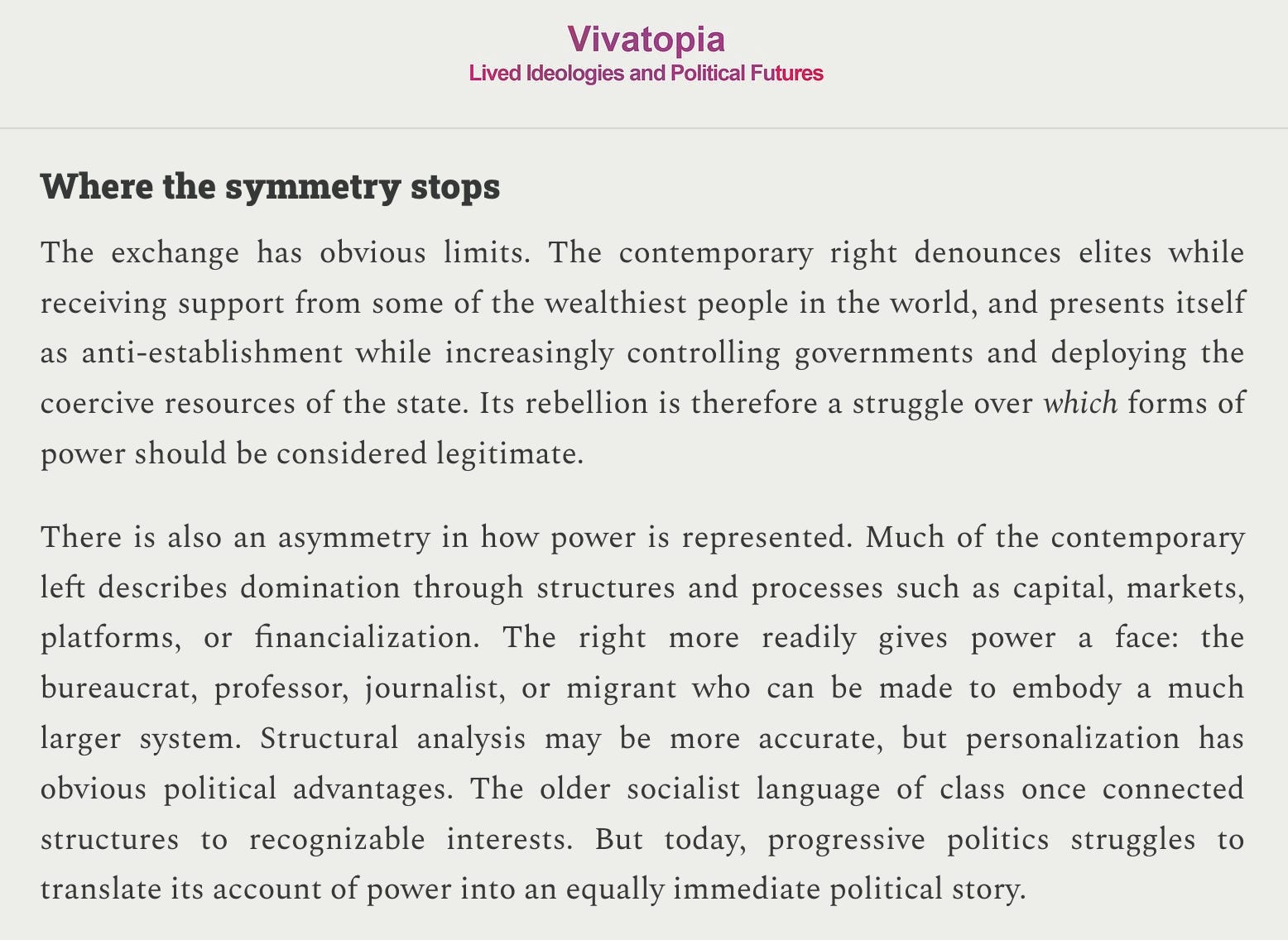
Her own publishing schedule settles whether the omission was a choice. Two days before the Ideas Letter essay appeared, Laruelle posted a piece on her personal Substack titled “Who Owns Rebellion?,” a left/right mirror essay arguing that the contemporary right has captured the aesthetics of rebellion while progressive politics became custodial of the institutions it once fought. Whatever its merits, that essay contains a component the Snyder piece does not: a section titled “Where the symmetry stops,” in which she brakes her own comparison and itemizes the concrete asymmetries, noting that the right denounces elites while drawing support from some of the wealthiest people alive and presents itself as anti-establishment while controlling governments and deploying the coercive resources of the state.
The brake, in other words, is part of her standard equipment, and has been since at least the 2008 study. On August 18 she demonstrated it. On August 20, in a comparison that needed it incomparably more, the section does not exist.
♦
There is a second mechanism running underneath the first, and it is subtler. Call it recoding. Laruelle’s essay works hard to establish that Snyder is received as a prophet: by his admirers, who read his warnings as foresight, and by his critics, who ask whether he has emptied the word “fascism” of meaning. The observation is accurate. It is also a trapdoor. A historian makes claims, and claims can be checked and weighed, credited in part. A prophet is not in the evidence business at all. He can only be believed or disbelieved, followed or mocked. Recode a scholar as a seer and you have quietly moved his entire output from the category of things that are true or false into the category of things that are felt. It is the most efficient form of disqualification available because it never has to dispute a single fact. It simply changes what kind of object the man’s sentences are.
The essay performs the exact maneuver it indicts. Laruelle writes that each man’s master concept is “wielded as a decoder: whoever has not grasped it looks, at best, naive.” Her essay then offers its own decoder, the mirror itself, a revelation that reorganizes everything the reader thought they knew about Snyder, and anyone who fails to perceive the symmetry is, presumably, naive.
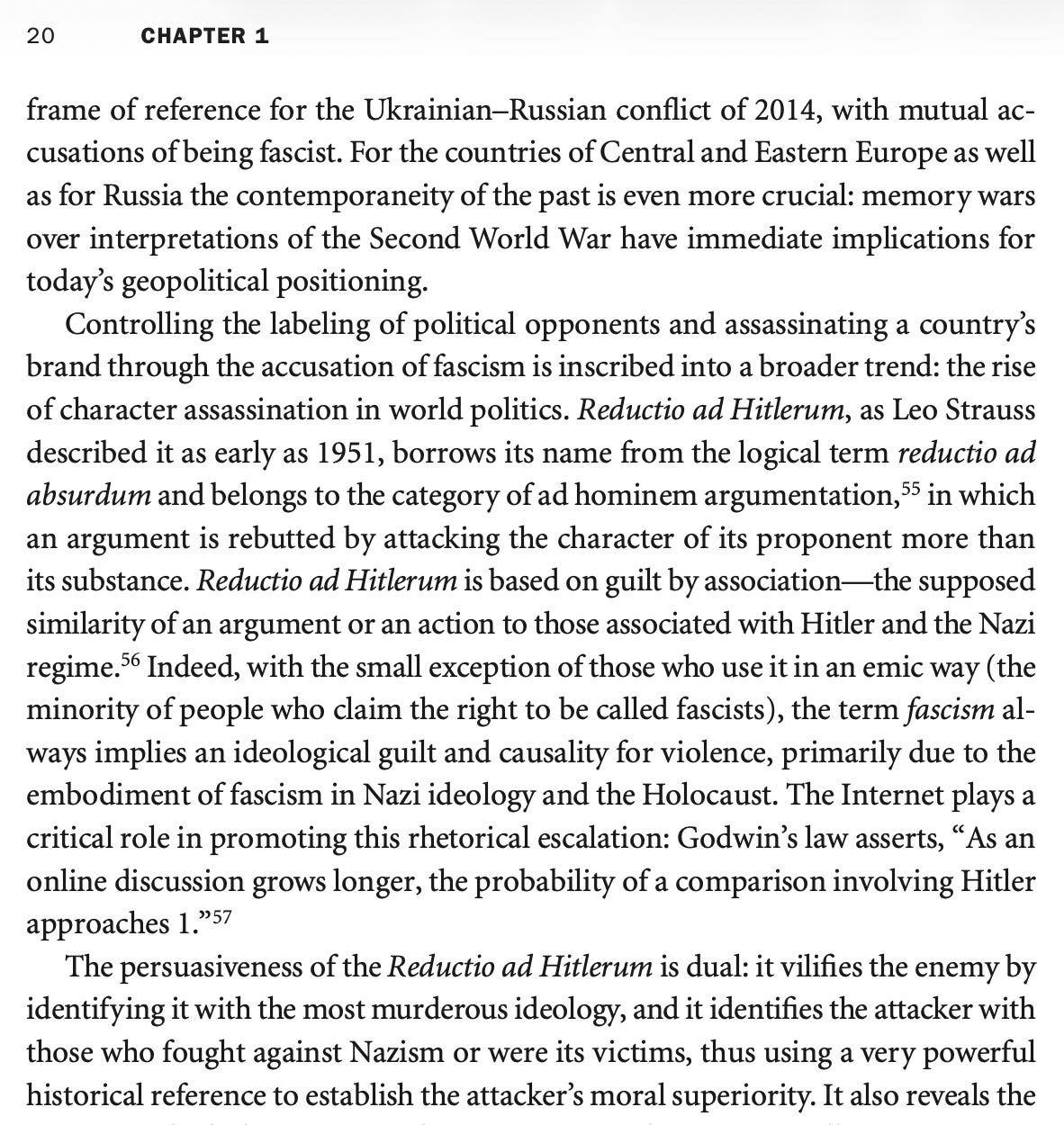
The deepest irony sits on page 20 of her own book, which defines Reductio ad Hitlerum as ad hominem argumentation, an argument rebutted by attacking the character of its proponent more than its substance, operating through guilt by association with a reviled figure. The device pays twice, her book notes, vilifying the target while certifying the attacker’s moral standing. Replace Hitler with Dugin and she has described the architecture of her own essay, five years in advance. Reductio ad Duginum.
Totalizing frames, it turns out, are like accents. Everyone else has one.
♦
The deeper trouble sits not in what the essay argues but in what it leaves out.
The essay never mentions that its author is a combatant in the fight it referees. Her case against Snyder began with the 2021 book, where the prophet charge already appears on page 19, prophetic warning against a new fascism filed under “bookselling strategies” with Snyder’s On Tyranny entered as an exhibit alongside Albright’s Fascism: A Warning, and continued in the 2022 article that named him the most vocal voice on the question of Russian fascism. This new essay is at least round three, and it cites her own prior interventions as though they were independent corroboration.
What the record does not contain is the other side. Snyder’s Substack archive does not contain her surname; no reply from him exists anywhere I can find, and neither does anyone else’s published defense of him against her. The scholarly pushback her book did receive, a symposium exchange with Yoshiko Herrera, Mitchell Orenstein and Anton Shekhovtsov, contested her thesis about Russia rather than her treatment of Snyder. Scholars continue arguments; that is the job. But a bout in which one corner has been throwing punches for five years while the other never answers is not much of a bout, and refereeing it without disclosing one’s corner is a different line of work entirely.
The graver omission is the information war itself. The closing argument I quoted earlier holds that liberalism’s crisis is homegrown. As intellectual history, that claim is half right, and I will return to why that half matters. But the passage waves away, in a subordinate clause, a documented operational record: the interference campaigns, the industrialized forgery of Western news outlets, the cultivation networks and the active-measures doctrine that researchers have spent a decade reconstructing from forensic evidence rather than vibes.
One need not believe Moscow elected anyone to find this negligent, and negligent is the word I mean. Not complicit, not captured. I want to be explicit about what I am not claiming, because the temptation to answer this essay in kind, to speculate about motives and funding, is exactly the reflex it will provoke and exactly the reflex that must be refused. The charge that can be proven from the text is that a scholar of influence operations wrote three thousand words about apocalyptic thinking in Russia coverage without engaging the operations themselves.
The harvesting is not hypothetical. It requires no conspiracy, only the ordinary appetite of an existing machine. Open Society Foundations are banned in Russia as an “undesirable organization”; George Soros is the standing demon of Kremlin propaganda. An OSF-funded essay arguing that liberalism destroyed itself and that the man who warns about Moscow mirrors the man widely cast as Moscow’s own court philosopher is, whatever its author intends, a pre-cut clip. “Even the Soros outlet admits it” writes itself.
Every credentialed skeptic learns this dynamic eventually, usually by finding their most careful caveats quoted, shorn of context, in Pravda. Utility is not intent. But an expert in narrative warfare who publishes without weighing utility has skipped a step her own field invented.
♦
The essay’s most substantive charge against Snyder is also its weakest under inspection, and its collapse points toward what a better public argument about fascism would look like.
Laruelle accuses Snyder of staging the present “inside the moral theater of the 1930s”: Trump as Hitler, democracy as Weimar awaiting its collapse. “Moral theater” testifies to a cartoon version of the decade, all newsreel torchlight and men shouting in stadiums. That cartoon is not what happened. The Nazi consolidation of 1933 ran overwhelmingly through paperwork. The Law for the Restoration of the Professional Civil Service, passed that April and named precisely to sound like routine administration, purged Jews and political unreliables from every level of the state down to village schoolteachers, and its background questionnaires reached millions while inviting their neighbors to inform. The Reich Flight Tax, a mundane 1931 capital-control measure, was converted into one of the devices that together stripped emigrating Jews of up to ninety percent of their assets.
The historians Robert Gellately and Nathan Stoltzfus assembled this record two decades ago; Victor Klemperer’s diaries recorded it in real time, one survivable-seeming restriction after another, until the ordinary became impossible. I have written about this machinery before: authoritarian consolidation as the quiet strangulation of ordinary life through administrative means, with each measure defensible in isolation and the net visible only in aggregate.
With that history in view, Snyder reads differently. The most durable sentence he has written, the first lesson of On Tyranny, is “do not obey in advance.” It is not advice about street fighters; it is advice about bureaucrats. It names anticipatory obedience, the discovery of the Gleichschaltung era that regimes receive most of their compliance before they demand it, from officials and institutions adjusting early to power’s anticipated wishes. “Defend institutions” is about the clerk’s office by definition. Say what you like about Snyder’s causal narratives, his civic pedagogy at its core is administratively literate in the way the cartoon 1930s are not. Laruelle’s “moral theater” charge convicts the meme version of Snyder, the version living in Hitler-comparison discourse, while the operative content of his warning walks free. The strongest available defense of the 1930s analogy is a basic working knowledge of the 1930s.
Here, too, Laruelle’s half-right closing argument completes itself against her. She is correct that American authoritarianism has a homegrown genealogy and needs no import license. But the homegrown version and the German precedent share methodologies: selective enforcement, weaponized routine process, quiet personnel purges and capture by memo. An essay built to improve public understanding would have said so. This one is built around the mirror.
♦
The essay’s first two days in circulation ran the experiment in public, and the results sorted by geography. The loudest amplification came from a comfortable distance from Russian power; the sharpest resistance came from close range.
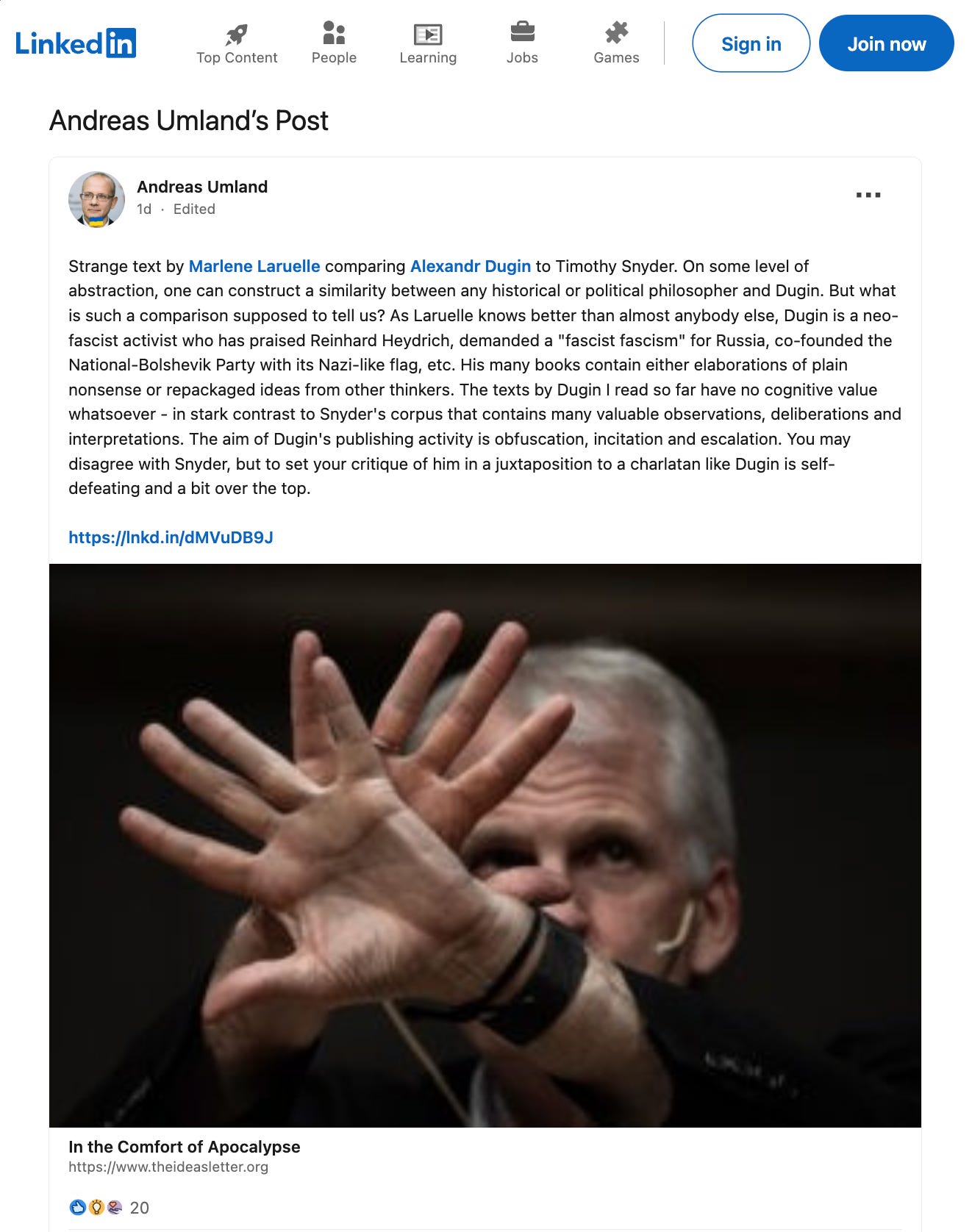
Andreas Umland, a Dugin specialist of two decades’ standing working from Kyiv, objected within a day that one can construct “a similarity between any historical or political philosopher and Dugin,” then filled in the ledger the essay leaves blank: the man in question praised Reinhard Heydrich and demanded a “fascist fascism” for Russia.
From Tbilisi, Hans Gutbrod observed that the apocalyptic register Laruelle files under cultural anxiety reads differently in places where it describes the weather: “unless you think repression, jail & exile are negligible.” The title’s thesis dissolves on contact with an address. Apocalypse is a comfort only at a distance; nearer the border it is a forecast.

The transmission side was just as legible. The Financial Times’ Edward Luce passed the essay to his readers with two words, “Excellent piece,” and no caveat aboard. Dave Troy, a serious researcher whose work I have cited, shared it with the worry that “some might abuse her sentiments” attached, and the post drew five thousand views and twenty-five reposts anyway. The caveat is the toll a careful sharer pays at the bridge; the payload crosses with him. Troy forecast the abuse and performed the amplification in the same post, friendly proof that utility and intent travel on separate tickets. He is also the essay’s ideal reader in miniature: the sophisticated skeptic for whom finding symmetry between enemies demonstrates independence from both camps. The essay pays its sharers in sophistication and collects in reach.
Some of those readers counsel silence. Troy himself suggested Snyder let it be, on the theory that the public sphere is large and has room for many ideas. The room does. The microphone does not. Two days of ‘letting it be’ produced caveat-free passage into mainstream Atlanticist feeds while the specialist objections idled at twenty reactions on LinkedIn, and the platform’s own principals spent those days soliciting the “debate” they had published, which is not a conspiracy, just marketing.
Waiting this one out means watching it harden.
♦
The essay is a specimen, and the species is spreading. Regardless of intention, its comparative architecture creates a reputational effect disproportionate to its stated claims. What Laruelle has produced is a disqualification instrument with deniability at every joint. Each sentence survives fact-checking. The stigma rides entirely on juxtaposition and recoding, on an accounting that audits only one side of the moral ledger.
None of this should be unfamiliar to my readers. Two weeks before Laruelle’s essay ran, I published a piece on the figure I called the honest curator: the professional who fabricates nothing because the lie lives in the hanging, in what gets left at the door and what stays crated in the dark. I did not expect so prompt a sitting for the portrait. The deletion test is the curator’s question asked of prose, what stayed in the crate, and the answer here is Dugin’s record and the brake that appears in her other recent essay. Fact-checking is the authenticator walking those rooms, armed with a science that answers one question, is this real, and a roomful of authentic things gives it nothing to find.
Each of Laruelle’s sentences is a genuine canvas. The essay is the hanging. Hers is the artisanal version of something the industrial information war produces in bulk, and the standard responses to it fail on schedule. Answer it with counter-disqualification, with speculation about the author’s motives or associations, and you have validated its premise while losing on craft — a naked ethos attack always loses to an armored one. Answer it with silence, and the frame sets.
One response works: exposure. A maneuver that depends on passing as analysis has a single point of failure, which is a reader who can see the machinery. The deletion test does most of the seeing; the exhibit tags do the rest, recording whose atrocities go unmentioned and whose grief gets the tender paragraph. The disclaimer over the entrance contradicts the architecture behind it. Once seen, the effect does not recover. A response such as this essay is the rival exhibition I explained would be both necessary and tough to pull off.
There is a larger reason to insist on this discipline. A public sphere in which every scholar is answered with an insinuation and every inconvenient essay with the question of who it really serves is a purchased outcome rather than a hypothetical dystopia, the explicit objective of a doctrine that never needed anyone to believe Moscow’s version of events, only to believe no one’s. Mutual disqualification is the equilibrium someone else has spent two decades and considerable budget trying to buy. Refusing to fight on that terrain looks like squeamishness and is actually the whole fight.
Snyder has taken his share of criticism from serious people, delivered straight, and straight is how it should arrive. What he does not deserve, and what no scholar deserves, is a hall of mirrors dressed as historiography.
♦
"Recode a scholar as a seer and you have quietly moved his entire output from the category of things that are true or false into the category of things that are felt. It is the most efficient form of disqualification available because it never has to dispute a single fact. It simply changes what kind of object the man’s sentences are."
In essence, one of the most common and insidious formulas used today to degrade the truth and denigrate the truth teller. One that has inflicted more damage and destabilization upon our society, both nationally and internationally, and upon the very concept of reality itself than I could've ever imagined a mere decade ago.
While I can't speak to most of the historical details as my ignorance of history, especially eastern European history, is admittedly quite profound, the rebuttal itself seems well crafted and was an informative read, as your writing always is...
I always learn so much from Jackie.
The phrase "reductio ad duginum" is a humorous neo-Latin coinage playing on reductio ad absurdum (reduction to absurdity).
It essentially means reducing or dismissing an ideological argument, political stance, or bizarre conspiracy theory by showing that it inevitably leads back to the ideas of Russian political analyst Aleksandr Dugin.