


Every age knows how to catch one kind of liar: the forger.
He’s undone by some small flaw he couldn’t help leaving — a pigment his master never owned, a craquelure of fine cracks too even to be the work of time. His fraud rests on that particular counterfeit, so it falls the moment a patient eye finds it. Him, we catch.
Beginners imagine the power sits in the size of the claim, but they have the physics backward. The bolder the fake, the harder it leans on a falsehood any idler can topple on a slow afternoon without getting up from his chair.
In July 1983, an Indian newspaper called Patriot — a quiet outlet for Soviet dezinformatsiya, though almost nobody outside Moscow knew it — ran a letter from an unnamed American scientist. The letter claimed the virus behind AIDS had been engineered as a weapon at Fort Detrick, the Army’s lab in Maryland. It grew into one of the most famous lies of the Cold War.
It also broke the idler’s rule. No slow afternoon ever brought it down.
Moscow supplied the laboratory. The fear it needed was already here. The conviction that the government had built the plague and loosed it intentionally was alive within the Americans with the most reason to hold it: the gay men dying while the administration looked away and the Black readers who remembered Tuskegee. The decade just behind them had furnished the rest — agencies caught dosing their own citizens with LSD and plotting the deaths of foreign leaders.
Little had to be invented because the experiments were real. New allegations only required the story to be extended.
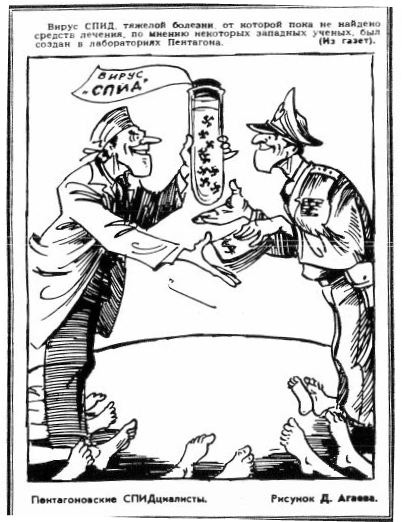
The suspicion was already hanging; the KGB’s work was to give it a fixed address. Three years in, Moscow produced a willing biologist from East Berlin to vouch for the science, and British tabloids and American cranks carried the thing the rest of the way around the world. The country that launched the lie has been gone for decades, while the lie hasn’t. It still spreads, and still talks people out of the testing and treatment that would keep them alive.
The invented part was the fragile part — the only part a debunker could successfully seize. The grievance beneath it and the arrangement above it gave the thing its long life. The craft’s best students noticed. They kept those two and let the invention go.
Today, the professional fakes nothing. He works the way a curator works, except his pictures are facts, every one true, every one certain to survive inspection. The art is all in the hanging, in what he sets at the door and what he leaves crated in the dark. In where the light falls, and where it is allowed to fail. Around it all, he fits a frame so quiet you never think to look at it.
You study the paintings. The frame is the one thing no visitor examines. After all, that is the entirety of what a frame is for. So, where is the lie? Not visible on the walls. The lie lives in the arrangement.
One true picture set beside another could imply a third that nobody painted, and the worst lie of all may live as omissions on canvases that never left the crate. A show like this outlasts a forgery because nothing in it can be readily exposed. Walk the finest authenticator alive through these rooms and she will call every canvas genuine, because every canvas is. Her science answers one question (whether a thing is real) and a roomful of authentic things gives it nothing to find. Their realness acts as an effective disguise.
Worse: her visit can’t save the rest of us. That visit recruits us.

The careful viewer does the very thing we’ve begged of him for twenty years. He checks the provenance. He finds every attribution sound. He then leaves a believer, doubting no part of the hanging. I looked into it, he says. It’s all genuine. Each painting has been authenticated. His care has made him the exhibition’s most trusted witness.
Through the summer and fall of the ill-fated year Trump ran against Clinton, Russian military intelligence broke into the mailboxes of one side of an American election and released what it found — and the pages were real. This show drew the largest crowd in the craft’s history. There was no fake laboratory in the batch for a debunker to seize. The operation was curation end to end: which correspondence to release, which to keep crated; a first tranche timed to the eve of the party’s own convention; and then, on the October afternoon a surprise tape surfaced of the other candidate boasting what he could do to women, a new crate thrown open and emptied onto the walls within the hour to draw the crowd off. The drip ran nearly every day for a month.
And the press did what the careful viewer does. Reporters checked the cryptographic signatures on the stolen mail, pronounced it genuine, and were right. Their verification ran beside every excerpt like a curator’s card, and a country walked the rooms in the order a foreign service had hung them. The hands that arranged that show served the same state that had planted the Fort Detrick letter a generation before. The apprentices of the forged lie had grown into curators of the true one.
Try to correct such a show, and you immediately sense the asymmetry at work. Against a forgery, the answer is a verdict: the canvas is fake, here is the proof, and it fits on one line. Against a hanging of genuine work there is no verdict, because nothing is fake. To answer it, you’d need to mount and advertise a rival exhibition by uncrating everything he buried and relighting the rooms he kept dim — weeks of labor set against the easy stroll it took to believe him. You end up gesturing at crates nobody opened, but an unhung picture is the toughest thing on earth to make a visitor see.
Because no court convicts a man for hanging real paintings, the law can’t touch him. The indictments that eventually reached the men of 2016 named the break-in, not the show. Inspectors pass him by. They were trained to catch forgery, a crime he studiously avoids committing. Even the authenticator ends up working for him, her certificate of genuineness lifted from the page and hung beside the entrance as praise. He comes with a show, planned and produced. You come with a footnote. Why would anyone choose the footnote over the show?
What he hangs in a room, he also hangs in your head. A fake, once spotted, comes down, but the frame persists; it becomes the way you see. Walk his rooms in his order, and you carry the arrangement out the door with you. Every new picture you meet for the rest of your life gets hung on his wall, in his light. The eye he trained to find composition now completes his composition for him. Repetition settles the rest — a thing seen three times hangs in the mind as fact, and genuine pictures are the easiest of all to show again. Even a debunking, on the rare day one lands, leaves the arrangement up. He never has to defend the show. It just stays there, year after year, at times with nothing to take its place.
The scholars have long had names for the parts. Framing, for the choice of light. Paltering, for the lie built entirely of true statements. And the old services learned the practice generations ago when their cleverest men stopped painting fakes and started curating real ones. They never had to paint a country’s ugliest pictures as the country had hung those itself. The work was to light them and march the crowd past in the right order. The most skilled of those men never told you what to make of the rooms. They built the rooms so you’d reach the verdict they’d chosen and leave the museum believing the path was yours.
Nor is the point, usually, to make you swallow one particular fake. The cruder regimes still try for that. The subtler ones wish for you to doubt that any canvas anywhere is real, and to leave you absolutely certain that every gallery in the city is a swindle and every curator, on the take. Peter Pomerantsev, who spent years inside the Russian television industry, found the phrase for what that produces — a world where nothing is true and everything is possible.
The old censorship emptied the walls. The new stuff floods the city with rival art shows until no one can say which gallery holds the real thing. Set two confident, opposite exhibitions side by side, each genuine down to the last canvas, and a partisan of either can audit his own walls to the decimal and still walk out certain it’s the other gallery that lies. Thucydides documented an older form of the collapse on Corcyra twenty-five centuries ago, when civil war pulled the meaning out of words the way a rival hanging pulls it out of pictures. Reckless aggression got relabeled courage. Level-headed caution became cowardice. The city lost the shared speech it needed to talk itself back.
A caught fake actually does the museum a kindness. It sharpens the authenticators. It becomes the cautionary tale every apprentice gets taught, and exposure leaves everyone a little harder to fool. The honest curator teaches the reverse, and he teaches it to the most diligent first: that a wall of authenticated masterpieces can still be a lie. That genuine and honest were never the same word. No forgery could work that corrosion. It breeds a tired refusal to look, the shrug of people who decided long ago that authenticity was just the name we gave whichever hanging won. And he turns our own defense to his use. The harder we teach a public to authenticate, the more faithfully it will certify his walls.
What once required an intelligence service now takes a laptop and a following. The show that arranges your sense of the world could be hung by anyone — some stranger with a newsletter, the feed you trust most — running the old tradecraft from a kitchen table. Some of those hands are paid. The payment is the part you were never meant to see. Money hires the voice that sounds like a citizen thinking out loud, and it moves through accounts that never have to name their owner. The conviction on your screen may be one somebody bought.
Despite all that, he isn’t the puppetmaster of everything. No one hand holds a culture’s walls, and some of what looks arranged is only the residue of many hands reaching alike. The busiest galleries now hang themselves; curation without a named curator. The feed is a room arranged by the footfall of earlier visitors, rehung by the hour toward whatever held the crowd, and what it holds to matter is typically whatever keeps you in the building.
An algorithmic curator has no thesis and no taste; it has a turnstile. And the turnstile favors the pictures people can’t stop staring at, which are mostly the ones that frighten or insult them. The all-important premise we are supposed to believe is that if nobody chose the show, nobody is accountable for its frame.

None of this has escaped the professional. A mindless curator makes a perfect assistant; he no longer has to hang the room himself, only to supply the canvases its turnstile already favors. But suspecting an arranger behind every frame is no answer either. That’s just hanging his portrait yourself and sinking into the paralysis he’d have chosen for you.
An essay is a hanging, too. This one sets two cases at the door and keeps whole wings of the gallery crated; the light falls exactly where I aimed it. I can plead honest intent — so does every curator — which you cannot validate from inside these rooms. Treat these walls like any others.
There is a defense, though not amongst the paintings. You cannot authenticate a frame because a frame makes no claim and answers to no test. A frame is a verdict about what matters, hung so smoothly it passes for the plain sight of things. The defense begins a step back from the canvas, with a harder question than ‘is this real’ (the question he has already rigged to come back ‘yes’). What stayed in the crate? Why these pictures? Why this room before that one? Who profits when I walk it in this order or that?
You’ll rarely find the answers under his light. A frame shows itself from the doorway of the gallery across the street. Not because that gallery is honest, having its own frame, but because two hangings of the same crates enable you to see both, and the rival exhibition that costs a debunker weeks only costs a visitor the walk. In everyday life, the walk is short. Take the story that has gained hold of you and find it told by an outlet across the divide. Notice what each version put first and what each left out. Ask who gains when a story won’t leave your screen, and who gains when one you expected never arrives.
The walk is short, but it isn’t free, and that cost is where the frame wins most of its days. Accepting a hanging costs nothing, while doubting one costs attention. The curator makes his tidy living in that gap between nothing and something. Most rooms, most days, every one of us walks exactly as the arrangement intends; he prices his show for a busy city. Therefore, the discipline can’t possibly be vigilance at every door — that would curdle into the shrug he was counting on. One alarm, though, comes free: your own pulse. The pictures lit to make your blood jump are the ones a hanging most needs to remain unexamined. Let the surge itself be the signal, the moment to step back from the canvas.
At a desk, the moment to step back might arrive with a data dump that clears every check on the first pass, timed for the week it will do the most damage, and seemingly offered to no one else. Flattery is key to these deliveries. You weren’t picked because you were careless — he chose you because you are careful. Your rigor is precisely why they were presented to you, and therefore authentication is the least of what a newsroom owes readers. The line you’ll run (”we have confirmed these documents are authentic”) is his ultimate goal. This is why details of the delivery, such as what hour was chosen, which desks he tried before yours, what remains crated, or what he refused to answer on the record should be reported as you would any other finding. Pace the findings by their actual weight, not the cadence of the drop, or consider breaking the whole batch at once, but never allow the source to set your publishing schedule.
Spend the few walks you own on the rooms where your own life is hung — your vote, your sense of whom to blame, the rooms you’ve toured so often they no longer seem like a room at all — and question those hangings. It’s the one move the gallery exists to prevent. His show is built on the bet that you never will.
Look at the frame.
Malign actors rely on you accepting the arrangement. My goal is to show you the frame. Hacking, but Legal operates without ads or algorithmic interference, relying entirely on reader support. Upgrade to a paid subscription to fund this research and get actionable analysis delivered straight to your inbox.
Brilliant.