

Trump’s January 7 withdrawals didn’t just suddenly redraw lines on global organizational charts; they also began to redraw the mental map inside the United States. The same moves that weaken international institutions and empower rival powers abroad are being sold to the American public through a steady diet of fear, militarized spectacle, and controlled information, reshaping what citizens understand “security,” “patriotism,” and “normal politics” to mean.
This second part follows that domestic arc: from the machinery of fear that casts multilateralism itself as a conspiracy, through the hyper‑militarization of everyday governance and the hollowing‑out of independent media, to a self‑reinforcing feedback loop in which anxious citizens, emboldened executives, and sidelined institutions steadily normalize more coercive, less democratic foreign and domestic policy.
This essay is the second part of a two‑part analysis of President Trump’s January 7, 2026 withdrawal from 66 international organizations.
Part One, “America Exits 66 International Organizations,” examines the institutional and geopolitical consequences abroad; this installment traces the domestic psychological, media, and coercive dynamics that help make that retreat possible and sustainable.
The Psychological Toll on the American People
The withdrawals are not just about institutions abroad, but also about reshaping how Americans think and feel at home, using fear of “globalist” enemies to justify isolation and control. Months of rhetoric casting multilateral bodies as conspiratorial threats have worked to heighten anxiety, normalize permanent emergency, and make citizens more willing to trade civil liberties and openness for the promise of protection by subtly rewiring expectations of what “security” and “patriotism” mean.
These trends are not uncontested. State and local governments, independent journalists, civil society groups, and some courts continue to resist authoritarian drift and defend pluralistic norms, creating pockets of resilience that complicate any simple story of linear democratic collapse.
I. The Machinery of Fear
The January 7th withdrawals do not occur in isolation. They are the latest culmination of a months-long rhetorical campaign designed to reframe international cooperation as threat and foreign institutions as enemies. Since the third quarter of 2025, administration officials have increasingly deployed language characterizing multilateral organizations as a “sprawling architecture of global governance” dominated by “progressive ideology,” advancing a “globalist project” that “actively seeks to constrain American sovereignty.” The State Department’s description of a “multilateral NGO-plex” employs the linguistic architecture of conspiracy: shadowy networks, elite capture, ideological infiltration.
This rhetoric serves a psychological function beyond policy justification. Research in political psychology demonstrates that fear-based messaging activates authoritarian predispositions, increasing citizens’ willingness to trade civil liberties for perceived protection. When authorities frame issues through a lens of national security and existential threat, populations become more accepting of extraordinary measures. The administration’s framing of routine international cooperation as an attack on American sovereignty exploits this dynamic, manufacturing threat where none exists.
The past 90 days have witnessed an acceleration of this fear-based governance. The Venezuela operation on January 3rd in which the Trump administration bombed a sovereign nation’s capital, capturing its president, and declared the United States would “run” the country, demonstrated an active interest in translating rhetorical aggression into highly visible kinetic action.
Defense Secretary Hegseth’s framing of the invasion as accessing “additional wealth and resources” without “American blood” came amid rapidly escalating casualty estimates: a senior Venezuelan official told the New York Times that at least 40 people, including civilians and soldiers, had been killed, with subsequent reports raising the toll to around 80 dead. That framing normalizes imperial extraction as foreign policy. When the President threatens Mexico as “run by drug cartels” requiring that “something is gonna have to be done,” Americans internalize that their government views military action against neighbors as routine and even desirable.
Fear‑based politics is not entirely new in the United States. From McCarthyism’s anti‑communist purges to the “War on Terror” era’s color‑coded threat alerts and PATRIOT Act surveillance, elites have repeatedly used security rhetoric to expand executive power and constrict dissent. What distinguishes the current moment is the fusion of that repertoire with an explicit retreat from multilateralism and an open attack on the very institutions that once constrained such overreach, both at home and abroad.
II. Domestic Militarization and the Normalization of Violence
The psychological impact extends beyond foreign policy. Throughout 2025, Americans witnessed the militarization of immigration enforcement at unprecedented scale. The $170.1 billion allocated to enforcement under the “One Big Beautiful Bill Act” made ICE the highest-funded federal law enforcement agency in history, funded at levels exceeding some foreign militaries. Military-style raids on apartment complexes, National Guard deployments to Democratic-led cities, drone surveillance in urban areas, and the designation of border regions as military zones have habituated Americans to armed federal presence in civilian life.
The Lemkin Institute, which monitors genocide risk globally, documented “hyper-militarized mass deportation operations” involving Black Hawk helicopters, armored vehicles, and agents from multiple federal agencies conducting pre-dawn raids. Videos of agents smashing car windows, tackling mothers, and deploying tear gas against peaceful protesters circulated on social media, images the White House amplified through its own channels by posting photographs of shackled deportees and “perp walk” footage. This publicity campaign, described by commentators as coming close to “glorifying violence and rough justice,” was run by political appointees in their twenties and received criticism for promoting imagery associated with white nationalism and “remigration” ideology, a term with documented ties to ethnic cleansing movements in Europe.
The psychological literature on authoritarianism identifies this pattern precisely. When governments deliberately display state violence against designated out-groups, they achieve multiple objectives: demonstrating power, defining who belongs and who does not, and habituating the majority population to accept escalating coercion as normal. Each raid that proceeds without consequence expands the boundaries of acceptable state action.
III. Information Control and Epistemic Isolation
Simultaneously, the administration has systematically dismantled independent information sources. Two days ago, the Corporation for Public Broadcasting formally dissolved after 58 years, its board voting to shut down rather than allow the organization to “remain defunded and vulnerable to additional attacks.” Congress rescinded over $1 billion in funding last summer, and the FY 2026 appropriations bill excluded CPB funding for the first time since 1967.
The consequences have cascaded through local journalism: New Jersey PBS will cease operations in 2026, GBH in Boston paused production of American Experience, WQED in Pittsburgh laid off 35% of its staff, and stations from Indiana to Wisconsin have eliminated reporting teams and emergency broadcast capabilities. The infrastructure that delivered trusted local news, educational programming, and emergency alerts to rural and underserved communities is collapsing.
The assault on broadcast journalism extends to commercial media. In October 2025, Paramount Skydance installed Bari Weiss as editor-in-chief of CBS News after acquiring her website The Free Press for $150 million. Weiss, who built her career attacking “woke” culture and has no broadcast television experience, immediately began reshaping coverage at the network of Walter Cronkite and 60 Minutes. In December, she spiked a 60 Minutes segment about Venezuelan men deported to El Salvador’s notorious CECOT prison hours before airtime, overruling correspondents and standards departments that had cleared the story. Correspondent Sharyn Alfonsi’s internal memo warned that “the public will correctly identify this as corporate censorship.” Staff have threatened to quit. The pattern is clear: critical coverage of administration actions faces interference at the editorial level.
Meanwhile, the administration has attempted to destroy Voice of America, purged government databases of climate and health information, fired scientists producing congressionally mandated assessments, and launched the taxpayer-funded “White House Wire” as what critics call a “propaganda outlet.” When the FCC investigates news organizations for coverage the President dislikes, when reporters are barred from the Oval Office for refusing to adopt state-mandated terminology, when the administration sues journalists and revokes security clearances of former officials who speak publicly, these actions create chilling effects that extend far beyond their immediate targets.
The withdrawal from 66 international organizations compounds this epistemic isolation. Americans will no longer benefit from IPCC climate assessments that have long informed domestic policy, from UNFPA data on global health trends, from UNCTAD analysis of trade dynamics affecting American workers, or from the democracy monitoring that International IDEA provides to help citizens evaluate their governments. The organizations being abandoned are not merely diplomatic conveniences; they are sources of independent information that enable citizens to evaluate their government's claims. Their elimination leaves Americans more dependent on official narratives they have fewer tools to verify.
IV. Fear, Militarization, and the Foreign Policy Feedback Loop
The withdrawals and accompanying rhetoric do not just reflect foreign‑policy choices; they actively reshape the domestic psychology that will govern future choices. Fear‑based messaging about “globalist” enemies, migrant “invasions,” and neighboring states “run by cartels” constructs a sense of permanent siege, blurring the line between routine politics and existential emergency. This is consistent with political‑psychology work showing that threat framing increases willingness to trade civil liberties for security; for instance, research published in the American Journal of Political Science demonstrates that perceived national threats significantly bolster support for punitive surveillance and restricted dissent. Experimental and comparative studies of fear appeals and authoritarian predispositions find that when people perceive threats as real and proximate, especially when elites frame them as national‑security challenges, they become more supportive of strong leaders and restrictive policies, a phenomenon detailed in Psychology Today’s analysis of authoritarian appeal.
Militarized spectacle then embeds this mindset in daily life. Hyper‑militarized immigration and policing operations—raids using helicopters, drones, armored vehicles, and tactical teams—create the lived impression that society is under siege and that military‑style force is the normal instrument for managing social problems. The ACLU’s landmark report, War Comes Home: The Excessive Militarization of American Policing, documents how these paramilitary tactics shift the public’s perception of their own neighborhoods into “war zones.” Public opinion research on support for the use of force shows that when interventions are framed as responses to “national security” threats, backing for coercive tools is significantly higher than when motivations are purely humanitarian or economic. Each unpunished display of state violence against designated out‑groups tends to widen the boundary of acceptable coercion, making more aggressive external action easier to justify and even politically rewarding as a demonstration of “toughness.”
Inside the state, this psychological and political environment shifts incentives and narrows the menu of live options. Agencies and officials who deliver visible kinetic “wins” gain resources and prestige, while those arguing for multilateral cooperation or restraint are more easily sidelined as naïve or disloyal. As noted by the Carnegie Endowment for International Peace, this produces a selection bias in favor of unilateral, hard‑power solutions—from airstrikes and punitive raids to expansive enforcement and sanctions. This “militarization of foreign policy,” further explored by former Ambassador Karl Eikenberry, suggests that over-reliance on the military organ of the state erodes diplomatic capacity. Each new operation then generates images of chaos and backlash abroad that can be fed back into domestic narratives as proof that enemies are everywhere and only further force will suffice. In this way, fear‑based messaging, domestic militarization, and aggressive foreign policy form a self‑reinforcing feedback loop that, over time, can steadily marginalize cooperative, law‑bound approaches to international order.
V. The Psychology of Siege
Research on authoritarian governance identifies a characteristic psychological syndrome: citizens experiencing persistent threat develop chronic anxiety, hypervigilance, and self-censorship. They narrow their “circle of compassion” to immediate in-groups while becoming suspicious of outsiders. They convert fear into anger, an emotion that restores a sense of agency, and direct that anger toward targets designated by authorities. Over time, this fear can become internalized for many people, affecting decision‑making, dampening civic engagement, and weakening social cohesion, even as others respond with mobilization and resistance.
The administration's rhetorical pattern exploits these dynamics systematically.
International organizations become threats serving a “globalist project” rooted in “progressive ideology” that “actively seek to constrain American sovereignty.” Immigrants perpetrate an “invasion”—language deliberately chosen because, as budget director Russell Vought has explained, it “unlocked” extraordinary presidential powers under the Constitution. Journalists become “the enemy of the people” and purveyors of “fake news,” now tracked on an official White House “Media Bias Portal.” Climate scientists are dismissed as promoters of “climate orthodoxy” and “climate alarmism,” their assessments characterized as “junk science.”
Each designated enemy justifies expanded state power; each expansion normalizes the next. The psychological research is unambiguous: populations subjected to sustained threat-based messaging become more accepting of authoritarian measures, more hostile to out-groups, and less capable of collective action to protect democratic institutions.
VI. Human Rights Erosion and Its Witnesses
The human rights infrastructure being dismantled served functions beyond its overseas beneficiaries. When the United States participated in UN Women, the Freedom Online Coalition, and the various mechanisms protecting children in armed conflict, these commitments established normative boundaries that constrained domestic policy as well. Withdrawal signals that these norms no longer bind American conduct, a message received by both foreign and domestic audiences.
Americans watching their government abandon organizations protecting women from violence, children from armed conflict, and refugees from persecution absorb lessons about whose suffering matters. The defunding of the UN Voluntary Fund for Victims of Torture, which the United States funded at 85% of its annual budget since 1998, communicates that torture survivors’ recovery is no longer an American priority. The termination of gender-based violence programming communicates that women’s safety is expendable. These messages shape what Americans come to expect from their government and what they believe their government owes to anyone.
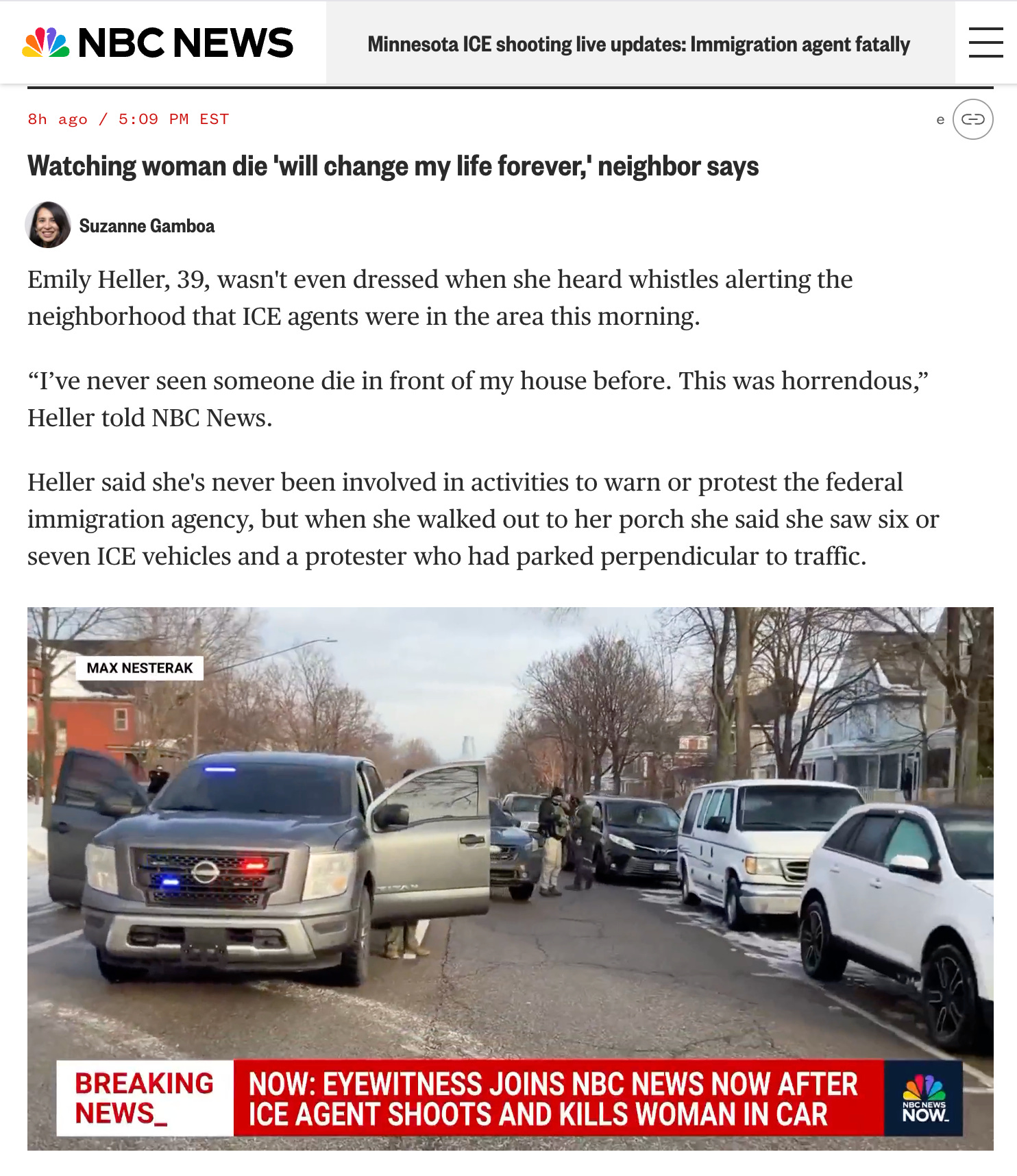
The psychological toll compounds across these domains. Citizens experience their country conducting military strikes that kill civilians abroad—independent and official estimates suggest that between 40 and roughly 80 people, including civilians and military personnel, were killed in the January 3 Venezuela operation alone, with prior strikes on alleged drug vessels killing what governments and families say were primarily fishers and civilians. They witness military forces deployed to their own communities, with 20,000 National Guard troops requested for deportation operations including “night operations and rural interdiction” and “riot control” in cities across the country—operations that have resulted in documented human rights violations against both citizens and noncitizens, including today’s homicide of an unarmed civilian in Minneapolis by Immigration and Customs Enforcement which has already been viewed by millions of Americans as of the time of this writing.
They see their government eliminate independent information sources and abandon human rights commitments by withdrawing from the UN Human Rights Council and boycotting the Universal Periodic Review, all while being told this represents “restoring American sovereignty” and putting “America First.” The cognitive dissonance between democratic self-image and authoritarian reality produces either denial, rationalization, or despair. None of these responses support healthy civic engagement.
VII. The Long Shadow
Psychological research on post-authoritarian societies documents that fear persists long after the conditions that created it change. Even after regime collapse, populations exhibit chronic anxiety, avoidance behaviors, reduced civic participation, and weakened social trust. The trauma becomes collective, shaping not just individuals but the society’s capacity for democratic self-governance.
The United States has not experienced full‑scale authoritarian governance in living memory, and most Americans lack lived experience of overt autocracy, even though communities of color and political dissidents have long confronted state overreach and repression. That uneven history leaves large parts of the population with little preparation for the psychological dynamics now being activated: the fear-based mobilization, the designated enemies, the spectacular displays of state violence, the information control, the abandonment of normative constraints. The 66 withdrawals announced today via one single executive order accelerate a process already well underway, the psychological reconditioning of the American public to accept as normal what, for many Americans outside directly targeted communities, would have seemed unthinkable a year ago.
The damage extends beyond policy reversibility. Even if future administrations rejoin these organizations, the psychological impact on Americans who lived through this period, who watched their government bomb foreign capitals, deploy military force against their neighbors, celebrate the detention of families, and systematically dismantle the architecture of international cooperation, will persist. A generation is learning that American power serves extraction rather than cooperation, that international institutions are enemies rather than partners, and that human rights are obstacles rather than principles.
This is the cost that no policy analysis fully captures: the reshaping of American civic psychology to accept isolation, aggression, and indifference to suffering as the natural condition of a great power. The international organizations being abandoned today were imperfect institutions, but they embodied a vision of America as a nation that builds rather than destroys, that cooperates rather than dominates, that protects rather than exploits. Their abandonment teaches Americans a different lesson about who they are and who they are becoming.
Conclusion
Taken together, these two parts trace a single, integrated transformation: outwardly, a United States that walks away from the architecture of multilateral cooperation and cedes rule‑making space to others; inwardly, a polity conditioned by fear, militarization, and epistemic isolation to accept that retreat as both necessary and virtuous. The withdrawals accelerate the shift from a system in which U.S. influence flowed through institutions, norms, and development to one where power is pursued through naked leverage and episodic displays of force—precisely as the domestic audience is primed to distrust compromise and regard international law as a threat. This is not an overnight collapse but a path‑dependent choice: each treaty abandoned, each institution defunded, each raid or strike applauded as “toughness” makes it harder for future leaders to rebuild credibility, re‑enter cooperative regimes, or persuade citizens that shared rules are a source of strength rather than shackles. Whether this trajectory becomes locked in or can still be reversed will depend less on the next communiqué from an international body than on how quickly Americans recognize that the real cost of “America Alone” is not just diminished influence abroad, but a steadily shrinking horizon of freedom and possibility at home.
This publication operates on reader subscriptions. If your felt this analysis was valuable, please consider becoming a paid subscriber to help my research reach more people.
Breathtaking.
All about divide and conquer