

Key Takeaways
The UN Secretary-General has implicitly challenged President Trump’s authority to withhold assessed contributions, asserting they are “a legal obligation under the UN Charter” that cannot be unilaterally abrogated by executive action.
The United States owes approximately $4 billion in unpaid UN dues, representing 80% of all regular budget arrears globally. America has already crossed the threshold where voting rights suspension becomes legally mandated.
This withdrawal follows the UN’s criticism of the January 3 Venezuela military operation, mirroring the administration’s sanctions campaign against the ICC after it issued arrest warrants for Israeli officials.
New investigative reporting reveals that Russia proposed the Venezuela-Greenland strategy to Trump as early as 2017: America gets the Western Hemisphere, Russia gets Ukraine. Fiona Hill testified to Congress that her NSC team received these offers directly from Russian counterparts. John Bolton blocked them. Bolton was indicted in October 2025.
The UN headquarters occupies 17 acres of extraterritorial land in Manhattan under the 1947 Headquarters Agreement. The U.S. cannot unilaterally abrogate this treaty or expel the UN.
NYC Mayor Zohran Mamdani controls the NYPD and city services surrounding UN headquarters. He has already demonstrated willingness to oppose Trump’s foreign policy on legal grounds.
Silicon Valley ideologues are proposing “Freedom Cities” to replace institutions destroyed by regime change. Two days after the Venezuela operation, Charter Cities Institute director Mark Lutter called for corporate-governed enclaves there. Russia provides the geopolitical logic; the Thiel network provides the economic model for what comes after.
The UN has announced it will continue operations regardless of U.S. participation. China will fill the vacuum America creates.
Historical precedent is ominous: The League of Nations collapsed after major powers withdrew, paving the way for World War II.
The statement reads like diplomatic boilerplate: four sentences, no named officials beyond the spokesperson, a formulaic expression of “regret.” To the casual observer, it might appear that the United Nations simply acknowledged another policy dispute and moved on.
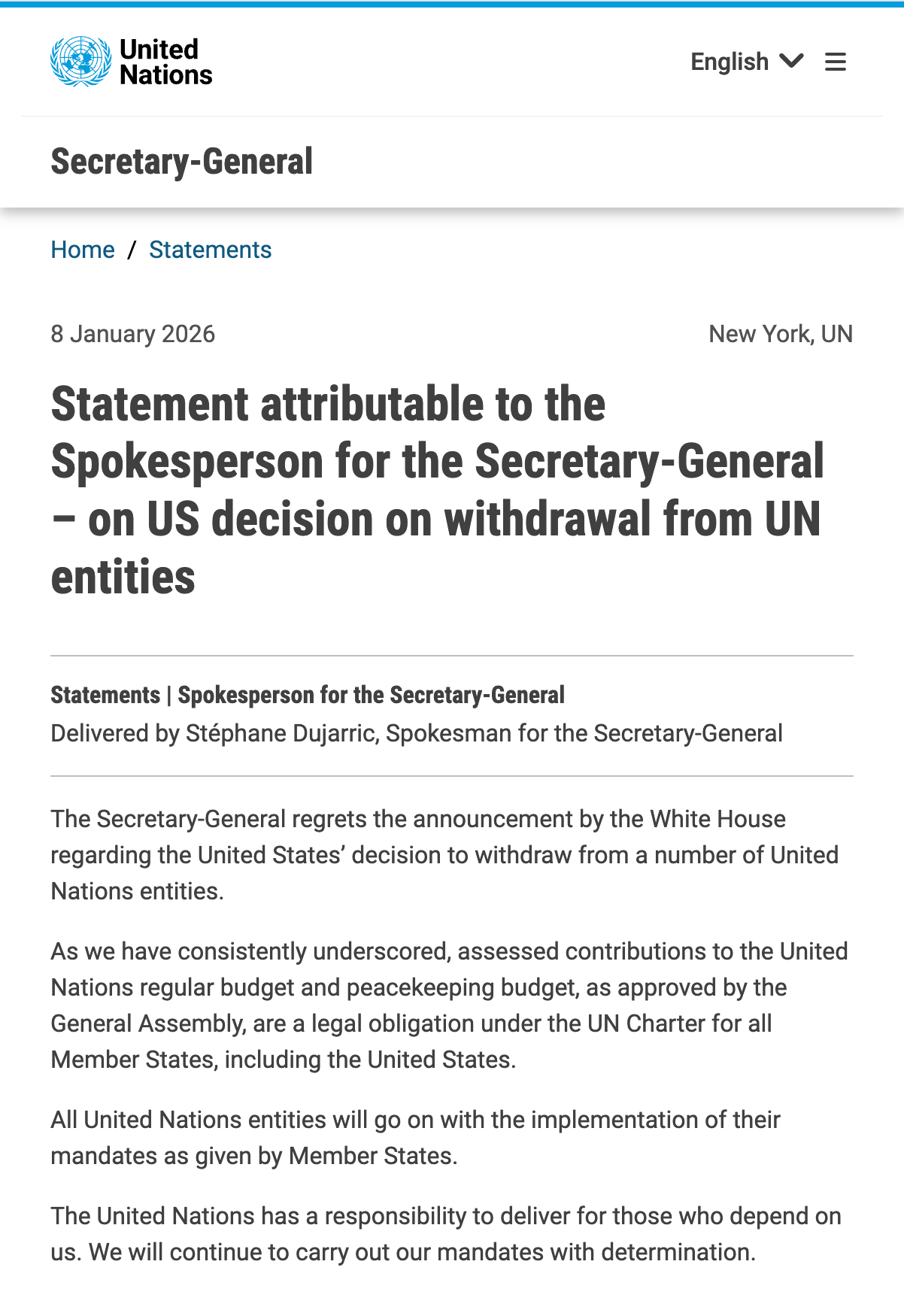
Those who understand the context know better. The $4 billion in unpaid American dues. The systematic defunding campaign. The looming voting rights suspension. The military strike on Caracas five days earlier that the Secretary-General condemned as potentially violating international law. These words constitute something far more consequential than diplomatic pleasantries. They are the opening salvo in what could become the most significant constitutional crisis in United Nations history.
Less than 24 hours after President Donald Trump signed the presidential memorandum withdrawing the United States from 66 international organizations, UN Secretary-General António Guterres issued a response through his spokesperson Stéphane Dujarric that amounts to a reminder of Charter law and of the Trump administration’s treaty obligations:
“Assessed contributions to the United Nations regular budget and peacekeeping budget, as approved by the General Assembly, are a legal obligation under the UN Charter for all Member States, including the United States... All United Nations entities will go on with the implementation of their mandates as given by Member States. The United Nations has a responsibility to deliver for those who depend on us. We will continue to carry out our mandates with determination.”
The diplomatic language barely conceals the message: The UN will not allow American financial pressure to halt operations. The United States remains legally bound to pay its assessed contributions regardless of what President Trump orders.
The statement does not function as a negotiation, but as a legal confrontation.
This essay is the third part of an ongoing analysis of President Trump’s withdrawal from international organizations.
Part One, “America Exits 66 International Organizations,” examines the institutional and geopolitical consequences abroad. Part Two, “The Psychological Costs of America’s Exit,” traces the domestic psychological, media, and coercive dynamics that make this retreat possible.
Why the UN Matters to Americans
The United Nations is not, as its critics caricature, a world government or a forum for anti-American rhetoric. It is the infrastructure through which the United States has exercised global leadership for 80 years.
The UN system encompasses far more than General Assembly debates. The World Health Organization coordinates pandemic response that protects Americans from outbreaks originating abroad. The International Atomic Energy Agency monitors nuclear programs in Iran and North Korea. The World Food Programme feeds 150 million people annually and prevents the famines that destabilize regions and create refugee crises. Peacekeeping operations keep conflicts from escalating into wars requiring American military intervention.
The UN also provides forums where the United States sets international standards on telecommunications, aviation, shipping, and intellectual property. American businesses benefit from rules America helped write. When the U.S. withdraws from these standard-setting bodies, it does not eliminate the standards. It simply transfers control to China.
For Americans specifically, reduced UN engagement means:
Diminished early warning on disease outbreaks that could become pandemics affecting U.S. public health
Reduced intelligence sharing on terrorism, trafficking, and transnational crime through UN coordination mechanisms
Lost influence over trade standards that affect billions of dollars in American exports
Increased likelihood of regional conflicts escalating into crises requiring expensive U.S. military intervention
Accelerated climate impacts as coordinated global response collapses, affecting American agriculture, coastal cities, and disaster costs
Brain drain as American scientists excluded from international bodies lose professional standing and career opportunities
American withdrawal creates vacuums that authoritarian powers are eager to fill. The rules-based international order that has prevented great power war for 80 years depends on its architect remaining committed to its maintenance.
The Legal Foundation
The Secretary-General’s position rests on solid legal ground. Article 17(2) of the UN Charter states unequivocally: “The expenses of the Organization shall be borne by the Members as apportioned by the General Assembly.”
This language is not discretionary. It does not say “may be borne” or “should be borne if Members agree.” It says “shall be borne,” which in treaty law constitutes a binding obligation.
The definitive interpretation came in 1962, when the International Court of Justice ruled that peacekeeping expenses constitute “expenses of the Organization” and that the General Assembly’s apportionment creates binding legal obligations on all member states.
Under the U.S. Constitution’s Article VI, treaties ratified by the Senate are “the supreme Law of the Land.” The UN Charter was ratified in 1945. President Trump cannot unilaterally abrogate treaty obligations through executive action any more than he could unilaterally repeal a federal statute.
The Trump memorandum itself tacitly acknowledges these constraints, specifying that “withdrawal means ceasing participation in or funding to those entities to the extent permitted by law.” That caveat matters enormously.
The $4 Billion Question
The Secretary-General’s statement gains urgency from a financial reality that has reached crisis proportions. As of January 2026, the United States owes the United Nations approximately $4 billion in unpaid assessed contributions.
According to the Congressional Research Service, U.S. unpaid assessments stand at $1.5 billion for the regular budget and $2.4 billion for peacekeeping. The United States alone accounts for 80% of all regular budget arrears globally. China, the second-largest debtor, owes less than a quarter of U.S. arrears.
The Secretary-General warned in December 2025 that the organization faces “a race to bankruptcy” unless member states pay their dues. The financial strangulation has been ongoing. According to testimony before the UN Fifth Committee, the organization started 2024 with only $67 million in liquidity reserves. To make payroll, it borrowed from the Working Capital Fund, Special Account, and closed tribunals. A senior official told the committee that “the Secretariat almost ran out of cash in December.”
The Trump administration’s FY2026 budget request proposed ending UN peacekeeping payments entirely. This represents an 83% reduction from pre-rescission funding levels. Call it what it is: effective organizational destruction.
The Voting Rights Threshold
Embedded in the Secretary-General’s statement is an implicit warning. Article 19 of the UN Charter provides that a member in arrears “shall have no vote in the General Assembly if the amount of its arrears equals or exceeds the amount of the contributions due from it for the preceding two full years.”
The United States is already at this threshold. Current arrears of $1.5 billion essentially equal the two-year assessment of roughly $1.52 billion.
If the United States continues non-payment through 2026, the General Assembly would be legally entitled to suspend U.S. voting rights. America would become the first permanent Security Council member ever sanctioned for non-payment.
The Trump administration likely views this as acceptable, perhaps even desirable. Article 19 applies only to General Assembly voting; U.S. veto power in the Security Council remains unaffected. Being sanctioned might reinforce Trump’s narrative that the UN is biased against American interests.
The precedent could run deeper. In theory, crossing the Article 19 threshold creates legal grounds, as some scholars argue, for other members to invoke Article 60 of the Vienna Convention on the Law of Treaties, which permits states to suspend obligations toward a party in “material breach.” U.S. refusal to pay could release other nations from their Charter obligations toward America.
What the Statement Does Not Say
The Secretary-General’s statement is notable for what it omits. It does not mention Article 19 voting rights suspension, despite the U.S. being at the threshold. It does not threaten expulsion under Article 6 (persistent Charter violations) or invoke Article 60 of the Vienna Convention permitting other states to suspend treaty obligations toward a state in material breach.
This restraint reflects political reality. The UN cannot effectively sanction its most powerful member and largest financial contributor without triggering the cascade of consequences described above.
The Secretary-General also refrains from directly criticizing the withdrawal decision itself. He expresses “regret” but does not characterize the action as wrong, harmful, or counterproductive. This diplomatic caution contrasts with stronger statements from others.
The Executive Secretary of the UN Framework Convention on Climate Change (UNFCCC) called the climate withdrawal a “strategic blunder that gives away American advantage.” Former Secretary of State John Kerry characterized it as “a gift to China and Russia and a get-out-of-jail-free card to polluters who want to avoid responsibility.” The Natural Resources Defense Council warned it is “not only self-defeating to let other countries write global rules of the road but also to skip out on trillions of dollars in investment.”
By remaining diplomatically neutral, the Secretary-General preserves space for future U.S. re-engagement while avoiding giving Trump ammunition to claim the UN is “attacking” America. But this restraint also reveals the organization’s fundamental weakness. The UN cannot compel U.S. compliance. It can only assert legal obligations and hope that domestic political constraints, allied pressure, or future administrations restore American participation.
An Attempted Humiliation
Part and parcel of political reality is Trump’s September 2025 address to the UN General Assembly. This attempt to publicly humiliate the institution from its own podium largely backfired, drawing international condemnation and reinforcing perceptions of American chaos and unreliability.
Trump asked “What is the purpose of the United Nations?” while standing at its lectern. He complained about broken escalators and a malfunctioning teleprompter, mobilizing the Secret Service to investigate alleged UN “sabotage” of his equipment. He dismissed climate science as “the greatest con job ever perpetrated” and predictions as “made by stupid people.” He accused the organization of “funding an assault on Western countries” through migration support.
He told assembled world leaders their countries were “going to hell” and warned that “if you don’t get away from this green scam, your country is going to fail.” The rambling, nearly hour-long speech veered repeatedly off-script.
The global response was swift and negative. French President Emmanuel Macron responded that same day by declaring France “proud to be among the people of the United Nations” and asserting the organization “cannot be replaced.” South African President Cyril Ramaphosa criticized the use of trade as “a weapon against a number of countries in the world.”
A foreign diplomat texted the Washington Post’s Ishaan Tharoor: “This man is stark, raving mad. Do Americans not see how embarrassing this is?”

The Chicago Council on Global Affairs noted that Trump’s views diverged sharply from American public opinion: 79% of Americans consider climate change at least an important threat, and majorities support multilateral engagement. Former U.S. diplomat Hugh Dugan observed that despite hammering the UN, Trump “left a vacuum instead of a narrative” on reform. “Next: let’s see if China is editing its speech now to swoop down to fill the missing narrative vacuum,” he predicted.
The speech was not diplomacy. It was performance; one that damaged American credibility far more than the institution it targeted.
Why U.S. Withdrawal Could Destroy the UN
The Secretary-General’s restraint in not threatening punitive measures reflects a brutal reality: the UN cannot effectively sanction its most powerful member without triggering consequences that could destroy the organization itself.
The United States provides approximately 22% of the UN regular budget and 26% of peacekeeping funding. No obvious combination of other contributors can easily replace this. If the U.S. withdraws entirely:
Immediate operational collapse: Many UN agencies would face 20-30% budget cuts overnight. The World Food Programme, UNHCR refugee operations, and peacekeeping missions would require immediate downsizing. Peacekeeping missions already reduced by 25% due to cash shortages would face further troop repatriations, potentially allowing conflicts in Mali, South Sudan, and the Democratic Republic of Congo to reignite.
Headquarters relocation pressure: The UN headquarters in New York operates on U.S. soil under a 1947 headquarters agreement. A hostile administration could make operations increasingly difficult through visa restrictions on diplomats, security complications, and infrastructure neglect. Pressure to relocate to Geneva, Vienna, or elsewhere would intensify—an enormously expensive and disruptive proposition.
Legitimacy crisis: The UN’s authority rests partly on the participation of all major powers. An organization that excludes the world’s largest economy and most powerful military loses credibility as a universal forum. Other nations might question why they should remain bound by UN decisions the United States ignores.
Security Council paralysis: While the U.S. would presumably maintain its Security Council seat even if General Assembly voting rights are suspended, relations would deteriorate to the point where productive Council action becomes nearly impossible. The U.S. might begin vetoing resolutions out of spite, grinding the Council to a halt.
Cascade of withdrawals: If the United States demonstrates that withdrawal carries no meaningful consequences, other dissatisfied members (Ex. Russia, which has its own UN grievances, or developing nations frustrated by Western dominance) might follow. The organization could fragment into irrelevance.
This is why the Secretary-General treads carefully. Any punitive action risks provoking the very outcome it seeks to prevent.
The Venezuela Connection
The timing of this withdrawal raises an unavoidable question: Is this punitive?
On January 3-4, 2026, U.S. forces struck targets around Caracas and captured Venezuelan President Nicolás Maduro. The Secretary-General responded: “These developments constitute a dangerous precedent... The rules of international law have not been respected.”
Less than a week later, the Trump administration announced withdrawal from 66 international organizations.
The pattern mirrors the administration’s approach to the International Criminal Court. After the ICC issued arrest warrants for Israeli Prime Minister Benjamin Netanyahu in November 2024, the administration launched sanctions against the court itself. Secretary of State Marco Rubio has sanctioned 11 ICC judges and prosecutors, freezing assets, revoking visas, and devastating their ability to function. Canadian ICC judge Kimberly Prost told reporters she lost access to all credit cards and bank accounts: “How do you order an Uber? How do you get a hotel?”
The administration has even demanded that the ICC amend its Rome Statute to guarantee that Donald Trump himself can never be prosecuted for war crimes.
The message is consistent: International institutions that criticize or constrain U.S. actions will face retaliation.
Calling Trump’s Bluff
The Secretary-General’s commitment to continue mandate implementation despite U.S. withdrawal represents operational defiance, not rhetoric. It signals specific survival strategies the UN is already implementing.
The organization has proposed unprecedented measures to continue operations without full U.S. funding. These include suspending the return of $298.9 million in unspent funds to member states (keeping it as cash reserve instead), authorizing supplementary assessments on member states not in arrears to cover amounts owed by delinquent states, and exploring voluntary contributions from non-traditional donors.
The supplementary assessment option is particularly significant. The General Assembly could effectively make compliant countries subsidize U.S. non-payment by increasing their assessment rates to compensate for American arrears. This would shift the financial burden to European nations, Japan, Canada, and other reliable contributors.
The alternative funding strategy carries its own risks. Increased reliance on voluntary contributions from China, Gulf states, and private foundations risks what some experts call “donor capture,” where funders gain disproportionate influence over UN priorities and operations.
But the core message is unmistakable: the UN will not allow U.S. financial pressure to force organizational collapse. This demonstrates resilience, but it also normalizes a UN system functioning without American participation; a situation that China has been positioning itself to exploit.
The China Opportunity
While the Secretary-General’s statement carefully avoids mentioning alternative funders, the geopolitical reality is impossible to ignore. China has systematically positioned itself to fill the upcoming vacuum.
Beijing now pays approximately 20% of the UN regular budget, second only to the United States. Chinese nationals lead four of 17 specialized UN agencies. China has expanded its civil servant presence across the UN system. The Belt and Road Initiative provides alternative development financing for more than 150 countries. China is championing the “Global Development Initiative” and “Global Security Initiative” as alternatives to Western frameworks.
Chinese Foreign Ministry statements characterize U.S. withdrawals as America “placing self-interest first” and drawing “growing, intense criticism from the international community.” This narrative positions China as the responsible stakeholder committed to multilateral cooperation while America retreats into isolationism.
If the UN successfully continues mandate implementation with reduced U.S. involvement but increased Chinese financial and diplomatic support, it permanently shifts the organization’s center of gravity eastward. American influence contracts to Security Council veto power while China gains operational control over developmental, humanitarian, and environmental programs.
This is already underway. China leads the International Telecommunication Union, the Food and Agriculture Organization, the International Civil Aviation Organization, and the UN Industrial Development Organization. Chinese officials occupy senior positions throughout the UN system, embedding Beijing’s priorities in institutional DNA.
The Secretary-General’s statement attempts to maintain the fiction that the UN can continue current operations with existing resources, even as internal documents reveal desperate cash shortages. The reality is that continued operations will require someone to fill the funding gap. Europe lacks the fiscal capacity. That leaves China, Gulf states, or a combination thereof.
Each option transforms the UN’s character. European dominance would preserve Western influence but at reduced capacity. Gulf state funding comes with conservative social policy strings attached. Chinese funding comes with geopolitical expectations. None preserves the U.S.-led order of the past 80 years.
The “My Way or the Highway” Doctrine
Daniel Forti of the International Crisis Group characterizes U.S. policy: “What we’re witnessing is the crystallization of the U.S. stance on multilateralism, which can be summarized as ‘my way or the highway.’”
This approach fundamentally misunderstands power in the 21st century. Unlike the post-Cold War era when the U.S. could dictate terms, today’s world requires coalition-building and sustained engagement. By demanding compliance rather than seeking partnership, the U.S. accelerates the formation of blocs designed to counter American influence.
Secretary of State Marco Rubio framed the withdrawals in ideological terms, characterizing the targeted organizations as part of “a sprawling architecture of global governance, often dominated by progressive ideology and detached from national interests. From DEI mandates to ‘gender equity’ campaigns to climate orthodoxy, many international organizations now serve a globalist project rooted in the discredited fantasy of the ‘End of History.’”
This rhetoric positions multilateralism itself as an enemy. But the institutions being abandoned are not ideological constructs; these are the mechanisms through which the United States has exercised global leadership for 80 years.
Their abandonment does not eliminate the functions they serve. It simply transfers control to others.
Movement Towards Full UN Withdrawal
The escalating pattern suggests the Trump administration may be deliberately building toward complete UN withdrawal, pursuing a strategy similar to its apparent goal of weakening NATO until American withdrawal becomes politically feasible.
The progression is unmistakable. During Trump’s first term (2017-2021), the U.S. withdrew from UNESCO, the UN Human Rights Council, WHO, and stopped funding UNRWA. Biden reversed these decisions (2021-2025), rejoining WHO, restoring UNESCO funding, and re-engaging with UN agencies. Now in his second term, Trump has re-withdrawn from WHO, the Paris Agreement, and the Human Rights Council (January 2025), ordered a comprehensive review of all international organizations (February 2025), and withdrawn from 66 organizations including 31 UN entities (January 2026).
This trajectory suggests not selective pruning but systematic dismantling.
Congressional legislation reveals growing Republican consensus on full withdrawal. Senator Mike Lee and Senator Marsha Blackburn introduced the “DEFUND Act” on February 20, 2025. The bill would repeal the 1945 UN Participation Act, terminate U.S. membership, close the U.S. Mission to the United Nations, expel UN headquarters from U.S. territory, withdraw diplomatic immunity for UN employees, end all payments, and prohibit participation in peacekeeping.
While this bill has not passed, its existence signals that full withdrawal has moved from fringe position to mainstream Republican policy option. The Trump administration’s systematic defunding and withdrawal creates conditions where the DEFUND Act becomes not radical departure but logical conclusion.
The parallels to NATO are instructive. Trump has repeatedly questioned NATO’s value, threatened withdrawal, and demanded that allies pay more. His administration’s actions, including reducing troop commitments, questioning Article 5 obligations, and publicly berating allies, have weakened the alliance without formally leaving it. The pattern suggests a strategy of gradual disengagement that makes formal withdrawal appear inevitable rather than revolutionary.
The same pattern is visible with the UN: systematic non-payment, hostile rhetoric, withdrawal from component organizations, and public humiliation of the institution all working synergistically to create conditions where complete withdrawal seems like merely the final step in an already-accomplished transition.
17 Acres of Extraterritorial Land
One dimension of this confrontation has received insufficient attention: the physical territory of the United Nations itself.
The UN Headquarters occupies 17 acres along the East River that is, under the 1947 Headquarters Agreement, “under the control and authority of the United Nations.” This is not a metaphor. The Agreement, signed by Secretary of State George Marshall and ratified by Congress, creates essentially extraterritorial space within U.S. borders.
Section 9(a) states: “The headquarters district shall be inviolable. Federal, state or local officers or officials of the United States... shall not enter the headquarters district to perform any official duties therein except with the consent of and under conditions agreed to by the Secretary-General.”
The FBI, federal marshals, and ICE cannot enter UN territory without explicit permission. Section 23 provides: “The seat of the United Nations shall not be removed from the headquarters district unless the United Nations should so decide.” The U.S. cannot unilaterally expel the UN.
The 1988 ICJ precedent reinforces these protections. When Congress prohibited the PLO from maintaining UN offices, the Secretary-General invoked arbitration. The ICJ ruled that the United States is legally obligated to arbitrate such disputes. The U.S. backed down rather than face international condemnation.
The DEFUND Act explicitly calls for expelling UN headquarters and withdrawing diplomatic immunity. If enacted, it would trigger the most significant property dispute between the U.S. and an international organization in history.
But there is a complicating factor.
The Mamdani Variable
On January 1, 2026, one week before Trump announced the 66-organization withdrawal, Zohran Mamdani was inaugurated as New York City’s 112th mayor.
Mamdani is a 34-year-old democratic socialist, DSA member, immigrant from Uganda, the city’s first Muslim mayor, and youngest to hold the office in over a century. He was sworn in by Senator Bernie Sanders and declared he would “govern as a democratic socialist” and not “abandon my principles for fear of being deemed radical.”
His relevance became immediately apparent. Two days after his inauguration, when Trump launched the operation that captured Maduro, Mamdani called Trump directly to register opposition. In a public statement:
“Unilaterally attacking a sovereign nation is an act of war and a violation of federal and international law.”

This matters because the Mayor controls the NYPD, city services, permits, and infrastructure surrounding the UN campus. The 1947 Agreement establishes UN territory as inviolable by federal authorities, but depends on a cooperative relationship with the host city for external security, utilities, and the thousands of diplomatic missions generating $3.69 billion in annual economic output.
Mamdani’s political profile suggests he views the UN as a bulwark against Trump’s unilateralism. He has pledged to arrest Netanyahu if he visits New York under ICC warrants. His immigrant background as a refugee from Idi Amin’s Uganda means he understands personally what happens when international protections fail.
If the administration attempts to make UN headquarters “uncomfortable” through harassment tactics, Mamdani could become an active obstacle. The NYPD provides external security. City agencies control permits and infrastructure. A mayor determined to protect UN operations could use these levers to counteract federal pressure.
This creates a potential three-way standoff: Trump pushing to expel the UN, the Secretary-General asserting legal protections, and New York City’s mayor actively defending operations through municipal authority.
The first week of Mamdani’s term already involved coordinating with the NYPD on security for Maduro’s federal prosecution. His statement condemning the Venezuela operation as illegal under international law signals ideological alignment with the UN’s position.
International law lacks effective enforcement mechanisms against powerful states. The United States can violate the Headquarters Agreement with impunity. ICJ advisory opinions and General Assembly resolutions carry no material consequences.
A 34-year-old democratic socialist mayor of New York City might provide more effective resistance than the entire UN system. If federal agents attempt to enter UN headquarters without Secretary-General consent, Mamdani could order NYPD to maintain a protective perimeter. If federal authorities attempt to seize UN property, the city could challenge it in court.
The irony: the international legal order’s survival depending not on international law itself, but on domestic political resistance within the host country.
What remains unclear is whether Mamdani will actually fight. His first week has shown willingness to criticize Trump publicly and coordinate on security matters professionally. But there is a difference between rhetorical opposition and the kind of sustained institutional resistance that would genuinely protect UN operations against determined federal pressure.
The next 90-180 days will reveal whether Mamdani is a true obstacle to Trump’s UN agenda or merely a symbolic critic. If the former, the UN headquarters question becomes far more complicated than the administration anticipated. If the latter, the path to eventual expulsion clears considerably.
The Freedom City Scenario
One dimension of this crisis connects the Venezuela operation, recent threats towards Greenland, UN withdrawal, and Silicon Valley ideologues in ways that have received insufficient attention.
Two days after U.S. forces captured Maduro, Mark Lutter, executive director of the Charter Cities Institute (funded by Peter Thiel’s venture network), issued a public call:
“Venezuela doesn’t need to become another Iraq. It needs a Freedom City... A Freedom City = new land, new rules, real property rights, real rule of law—jointly built with the U.S.”

“Freedom City” is Trump’s term for what the tech-right calls a “Network State”: sovereign territory governed by corporations rather than democratic governments. The concept has developed in Silicon Valley for over a decade, backed by Thiel, Marc Andreessen, and other tech billionaires through Pronomos Capital.
The operational prototype exists. Próspera, a charter city on Honduras’s Roatán island, operates under its own legal framework: 1% business taxes, Bitcoin as legal tender, governance by corporate board rather than elected officials. When Honduras attempted to repeal enabling legislation, Próspera’s backers filed an $11 billion lawsuit. That’s 31% of Honduras’s GDP.
The connection to the Trump administration is direct. JD Vance is a former Thiel employee. Roger Stone argued that pardoning Honduras’s drug-trafficking ex-president could “crush socialism and save a freedom city.” Trump’s 2024 platform included plans for “Freedom Cities” on federal land.
These projects emerge from what researchers Timnit Gebru and Émile Torres call “TESCREAL” ideology: overlapping beliefs (Transhumanism, Extropianism, Singularitarianism, Cosmism, Rationalism, Effective Altruism, Longtermism) that justify authoritarian means through appeals to civilizational advancement. As Dave Troy writes, TESCREAL proponents have an “ends justify the means” mindset antithetical to democratic governance. The charter city movement operationalizes this: if democratic governments obstruct progress, create territories where democracy and its bothersome regulations don’t apply.
The Pattern: Venezuela, Cuba, Greenland, Manhattan
Now apply this framework across four targets, each facing different forms of U.S. pressure, each with charter city interests waiting.
Venezuela: Military Capture. Trump stated January 6: “I’ve spoken with several U.S. oil companies about commitments to rebuilding Venezuela’s infrastructure. They wanna go in so bad.” Within 48 hours of Maduro’s capture, Lutter proposed his Freedom City.
Cuba: Economic Strangulation. Trump and Rubio have explicitly stated their goal of collapsing Cuba’s government by cutting off Venezuelan oil. “Cuba is ready to fall,” Trump said. Rubio warned: “If I lived in Havana and I was in the government, I’d be concerned.” Lutter has published proposals for converting Guantanamo Bay into a charter city.
Greenland: Threats Against a NATO Ally. The same week, the administration escalated threats to seize Greenland from Denmark, declaring “utilizing the U.S. military is always an option.” Danish Prime Minister Mette Frederiksen warned this would end NATO.
Praxis, a $525 million “network state” startup backed by Thiel through Pronomos Capital, has pursued Greenland since 2019. That’s the same year Trump first proposed buying the island. Founder Dryden Brown traveled to Nuuk in 2024, tweeting: “I went to Greenland to try to buy it.” When Trump renewed acquisition threats in January 2026, Praxis’s account responded: “According to plan.”
Trump’s nominated ambassador to Denmark is Ken Howery, Thiel’s former business partner and Founders Fund co-founder. If confirmed, Howery would lead Greenland negotiations while maintaining financial ties to the network state movement.
The 1951 U.S.-Denmark Defense Agreement already gives America extensive military access to Greenland. Danish officials are baffled by Trump’s threats because the U.S. can achieve virtually any legitimate security objective under existing agreements. The threats make sense only if the goal is sovereignty transfer for projects requiring territorial control beyond what treaties permit.
UN Headquarters: Financial Strangulation. Now apply the same logic to 17 acres of prime Manhattan waterfront.
If the UN relocates to Geneva, Vienna, or Nairobi, the property becomes available. Under Section 22 of the Headquarters Agreement, the UN must offer it first to the U.S. government. The federal government could claim $4 billion in arrears as offset against fair market value.
The site could be designated a “Special Economic Zone” under expanded Opportunity Zone legislation. Private governance by Thiel network figures, crypto billionaires, and Trump associates could replace democratic accountability. Corporate tenants would replace diplomatic missions.
The marketing writes itself: “Freedom City Manhattan: Former site of failed international bureaucracy, now global innovation hub.”
The Russian Angle
The Greenland dimension becomes more troubling when examined through recent investigative reporting by Dave Troy, which reveals that the Venezuela-Greenland strategy did not originate in Silicon Valley boardrooms. It appears to have originated in the Kremlin.
According to Troy’s investigation, Vladimir Putin has been attempting to influence Trump to seize both Venezuela and Greenland since at least 2017. The reasoning is simple: if Trump would disengage in Ukraine, Putin would give Trump free rein in Venezuela. Each country is in the other’s “backyard.”
A swap.
The Greenland idea came not from security officials but from Ron Lauder, the Estée Lauder cosmetics heir and confidant to both Trump and Putin. As reported in The Divider by Peter Baker and Susan Glasser, Lauder approached Trump in 2017 saying he could help acquire Greenland. Lauder volunteered to serve as “back channel” to the Danish government. Kremlin records confirm that Lauder met with Putin on March 19, 2019, right when the administration’s still-private Greenland talks were at their peak. Lauder subsequently made direct investments in Greenland’s infrastructure, energy, and mining sectors.
The explicit quid pro quo came in spring 2019. Fiona Hill, then serving on the National Security Council under John Bolton, testified to Congress that her team received informal proposals from Russian counterparts signaling willingness to back off Venezuela if the United States would disengage in Ukraine:
“You have your Monroe Doctrine. You want us out of your backyard. Well, you know, we have our own version of this. You’re in our backyard in Ukraine.”
Bolton blocked the overtures, dismissing them as absurd. Hill was instructed to “go out to Russia to basically tell the Russians to knock this off.” The deal went nowhere during Trump’s first term.
On Russian state television in November 2020, days after Trump’s election loss, nationalist commentator Vladimir Zhirinovsky articulated the offer explicitly: “He will take Venezuela, we will take Ukraine. And he will say to everyone: Look—Venezuela. Tomorrow I will take Cuba. I would help him... If we need Trump, then let’s help him.”
Bolton resigned in September 2019 after repeated clashes with Trump over Russia policy. In August 2025, FBI agents raided Bolton’s home. He was indicted in October 2025 on 18 counts related to classified information in his memoir that documented these incidents. The man who blocked Russia’s Monroe Doctrine offers is now facing prosecution. The man who made those offers is executing them.
This reframes the Thiel network’s charter city interests not as the origin of the strategy but as opportunistic alignment with it. Putin provides the geopolitical logic. Silicon Valley provides the economic model for what comes after. The destination is the same: American withdrawal from the international order, territorial expansion in the Western Hemisphere, and corporate governance in the vacuum.
As Troy concludes: “NATO, the United Nations, and the European Union will all be challenged if the US continues on this hemispheric romp.”
The Through-Line
This is the thread connecting Venezuela, Cuba, Greenland, and potentially UN headquarters: weaponization of U.S. power to create “inflection points” where desperate governments or displaced institutions cede territory to corporate governance projects.
The pattern is consistent: create crisis, force institutional collapse, establish private governance in the vacuum. The actors overlap. The funding sources overlap. The ideology is explicit.
This is not speculative fiction. The legal infrastructure exists. The ideological framework exists. The operational prototype exists. The political access exists. The Venezuela precedent demonstrates willingness to convert regime change into corporate territorial control.
A Historical Warning
The current crisis invites comparison to the most consequential failure of international organization in modern history: the League of Nations.
The League was Woodrow Wilson’s brainchild, the centerpiece of his Fourteen Points for peace after World War I. But the United States never joined. Despite Wilson’s advocacy, including a speaking tour that contributed to his incapacitating stroke, the Senate refused ratification. Republican Senator Henry Cabot Lodge led opposition, arguing League membership would entangle America in foreign conflicts.
Without its most powerful potential member, the League was set to fail from its inception. Its failures accumulated: Japan invaded Manchuria in 1931, the League condemned it, Japan withdrew and kept Manchuria. Italy invaded Ethiopia in 1935; limited sanctions proved ineffective. Hitler remilitarized the Rhineland, annexed Austria, dismembered Czechoslovakia. The League proved impotent.
By 1939, the League was irrelevant. World War II killed an estimated 70-85 million people.
The United Nations was explicitly designed to avoid these failures. It gave major powers permanent Security Council seats with veto authority, ensuring continued participation. It established assessed contributions as legal obligations. Most importantly, the United States joined, and for 80 years remained committed.
The parallels are uncomfortable. Then as now, American critics argued international organization constrained national sovereignty. Then as now, isolationists promised withdrawal would free America from costly obligations. Then as now, absence of American leadership created vacuums aggressive powers exploited.
The lesson is not that international organizations always succeed. It is that their failure carries catastrophic consequences.
The Trust Deficit
Even if a future administration attempts to reverse withdrawals and resume funding, the credibility collapse may prove irreversible. Developing countries have now experienced two full cycles of U.S. withdrawal-reengagement-rewithdrawal: Trump 1.0 withdrew from Paris, WHO, and UNESCO. Biden rejoined. Trump 2.0 withdrew again, far more comprehensively.
No rational actor will structure long-term planning around American commitments after this pattern. Countries will not build energy transitions around U.S. climate commitments. Allies question NATO reliability if the U.S. won’t honor UN Charter obligations. Aid recipients diversify toward Chinese, European, and Gulf alternatives. Trading partners negotiate frameworks designed to function without U.S. participation.
The League of Nations’ inability to function after major power withdrawal led to World War II. The difference this time: China stands ready to lead a post-American international order. Not to destroy the UN, but to remake it in Beijing’s image.
Probability Assessment
How likely is any of this? Unlikely, but no longer absurd.
The chain of events faces obstacles at each stage. Most probable outcome: the UN stays put, operates under financial strain, and the headquarters question remains theoretical.
But “most probable” isn’t “certain.” A year ago, U.S. forces capturing a sitting head of state and flying him to Brooklyn for arraignment would have seemed like fiction. Now Maduro sits in the Metropolitan Detention Center. The Overton window for what this administration will attempt has shifted dramatically.
What to watch: Thiel network figures meeting with State Department or NSC officials. Legislation expanding Opportunity Zone authority. Trump riffing about “wasted space” at the UN. Ken Howery’s confirmation hearing. Quiet property acquisitions near Turtle Bay. Any of these would suggest the scenario is moving from ideological fantasy toward operational planning.
Conclusion
The UN Secretary-General’s statement today, while measured in tone, constitutes a sophisticated legal and political counteroffensive. Its goal: establish a firewall around UN operations allowing continued functioning as the U.S. withdraws. Whether this succeeds depends on factors beyond the Secretary-General’s control: European willingness to increase contributions, Chinese restraint, developing country loyalty to multilateral institutions, and the posture of New York City’s government.
The headquarters dimension adds complexity the Trump administration may not have anticipated. The 1947 Agreement creates legal obligations that cannot be abrogated by executive fiat. The mayor who controls the surrounding city has already challenged Trump’s foreign policy on legal grounds. And waiting in the wings are Silicon Valley ideologues with blueprints for converting institutional collapse into corporate territorial control.
International law lacks effective enforcement mechanisms against powerful states. The United States can violate treaty obligations with impunity. But domestic political resistance from courts, Congress, states, or cities can provide constraints international institutions cannot. The strange truth emerging from this crisis: the international legal order’s survival may depend less on international law itself than on subnational actors within powerful states who refuse to comply with federal abandonment of treaty obligations. A 34-year-old democratic socialist immigrant from Uganda may matter more to the UN’s physical survival than the Security Council.
The liberal international order constructed after 1945 provided frameworks that prevented major power war for eight decades, lifted billions from poverty, and facilitated unprecedented prosperity. That order is now in its death throes.
The question is what replaces it: a Chinese-centric order with the UN as instrument, a fractured world of competing blocs unable to cooperate on existential challenges, or a network of corporate enclaves where the billionaires who helped destroy multilateralism profit from its ruins.
The League of Nations collapsed because its most powerful potential member refused to join. The United Nations may collapse because its most powerful founding member decided to leave. America, having learned from the League’s failure that international institutions require great power commitment, is now teaching the world that American commitments cannot be trusted.
The contest is joined. On one side: the Secretary-General, developing countries clinging to multilateral frameworks, European allies torn between Atlantic partnership and institutional preservation, and a democratic socialist mayor who may or may not choose to fight. On the other: a president determined to destroy what he sees as constraints on sovereignty, a Congress aligned with withdrawal, and an ideological movement viewing democratic governance itself as obsolete.
The stakes could not be higher. The battle will be fought not only in diplomatic forums but on 17 acres of Manhattan real estate representing either the enduring promise of international law or its final grave.
This publication operates on reader subscriptions. If this analysis demonstrated value, please consider becoming a paid subscriber to help my research reach more readers.